Outcome-Based AI Pricing Is Here: Why Small Businesses Should Only Pay When AI Delivers Results
For years, small business owners have faced the same frustrating question when buying AI tools: "Am I actually getting my money's worth?" Yesterday, HubSpot answered that question by shifting two of its Breeze AI agents to outcome-based pricing — charging customers only when the AI resolves a support ticket or qualifies a lead. They are not alone. This pricing shift is reshaping how SMBs buy and budget for AI, and it could finally close the gap between AI hype and real ROI.
What Is Outcome-Based AI Pricing?
Outcome-based AI pricing is exactly what it sounds like: you pay for results, not access. Instead of a flat monthly subscription or a per-seat licence, you are charged when the AI agent actually delivers a measurable outcome — a resolved customer ticket, a qualified lead, a completed workflow.
This is a fundamental break from how software has been sold for decades. Traditional SaaS pricing charges per user or per month regardless of whether the tool is sitting idle or driving revenue. Outcome-based pricing flips that equation. The vendor carries the performance risk, and the customer only pays when value is delivered.
For small businesses running lean operations, this distinction matters enormously. If you are paying RM500 a month for an AI customer service tool that resolves three tickets, that is expensive. If you are paying RM0.50 per resolved ticket and the tool handles 200 conversations, you know exactly what you are getting.
Why This Shift Is Happening Now
Three forces are converging to make outcome-based AI pricing viable in 2026.
AI Agents Can Now Measure Their Own Results
Modern agentic AI systems do not just respond to queries — they complete tasks end-to-end and track whether those tasks were successful. When an AI customer service agent resolves a ticket without human intervention, that resolution is logged, verified, and measurable. This built-in accountability makes it possible to tie pricing directly to performance.
Earlier generations of AI tools — simple chatbots and basic automation — lacked this capability. They could not reliably determine whether they had solved a problem. AI agents in 2026 can.
SMBs Are Demanding ROI Proof
The data tells a clear story. According to a 2026 Medha Cloud report, 91% of SMBs using AI report a revenue boost, but 61% still cite cost as their primary barrier to adoption. A separate CIO study found that 53% of investors expect positive ROI within six months, while 84% of CEOs say it realistically takes longer.
This expectation gap creates friction. Small business owners want AI, but they are tired of paying upfront for tools that may or may not deliver. Outcome-based pricing removes that uncertainty. As HubSpot's chief customer officer put it, the model means you pay when it works — full stop.
The Per-Seat Model Is Breaking Down
Seat-based SaaS pricing dropped from 21% to 15% of SaaS companies in just 12 months. The reason is simple: when one AI agent can handle hundreds of support tickets without a single human login, charging per seat makes no sense. The value is in what the AI accomplishes, not how many people have access to it.
Who Is Already Doing This?
Several major platforms have moved to outcome-based or hybrid AI pricing models in 2026.
HubSpot Breeze Agents
HubSpot's April 2026 announcement shifted two AI agents to outcome-based pricing. The Customer Agent moved from USD 1.00 per conversation to USD 0.50 per resolved conversation. The Prospecting Agent moved from a flat monthly fee per contact to USD 1.00 per qualified lead. According to HubSpot, their Customer Agent resolves 65% of conversations and cuts resolution time by 39% across 8,000 customers.
Intercom Fin
Intercom charges USD 0.99 per AI-resolved support ticket. Their Fin AI agent handles over 80% of support volume and resolves one million customer issues per week. The company has grown Fin's revenue from USD 1 million to over USD 100 million ARR on this model — and backs it with a performance guarantee of up to USD 1 million if resolution targets are not met.
Zendesk AI Agents
Zendesk charges USD 1.50 to USD 2.00 per automated resolution. Salesforce uses an AI credit system tied to agent actions. Both represent variations on the same principle: pricing anchored to outcomes rather than access.
Gartner projects that 40% of enterprise SaaS contracts will include outcome-based components by the end of 2026. For SMBs, the adoption curve may be even faster — these are the businesses most sensitive to wasted spend.
What This Means for Malaysian SMBs
Malaysia's digital transformation market is projected to grow from USD 12.67 billion in 2026 to USD 29.74 billion by 2031, with SMEs recording the fastest growth at a 19.56% CAGR. But adoption remains uneven. A survey of 800 Malaysian SMEs found that rising operational costs (57%), labour expenses (52%), and inflation (55%) are the top business pressures.
Outcome-based AI pricing directly addresses two of the biggest barriers Malaysian SMBs face when adopting AI.
Lower Financial Risk
With traditional per-seat pricing, a small kedai or service business in Penang pays the same monthly fee whether the AI tool is used constantly or barely at all. Outcome-based pricing means the business only pays when the AI actually resolves a customer query, books an appointment, or qualifies a lead. For businesses already squeezed by rising costs, this is a meaningful difference.
Clearer ROI Calculation
One of the persistent challenges in calculating AI ROI for SMBs is separating the tool's contribution from other factors. When pricing is tied to specific outcomes, the math becomes straightforward. If your AI chatbot resolves 150 tickets at RM2 each, your cost is RM300 and you can compare that directly against what a part-time support hire would cost.
The Malaysian government's SME Digitalisation Grant already funds up to 80% of digital tool costs. Combining grant-subsidised AI adoption with outcome-based pricing creates a compelling financial case — you get the tool at a fraction of the cost and you only pay for results.
How to Evaluate Outcome-Based AI Tools
Not all outcome-based pricing is created equal. Before committing, small business owners should ask these questions.
What Counts as an "Outcome"?
This is the most important question. HubSpot distinguishes between a "conversation" and a "resolved conversation." Intercom counts a "resolution." Zendesk counts an "automated resolution." Each definition has different implications for your bill.
A resolved conversation might mean the AI answered the question and the customer did not follow up. An automated resolution might require the customer to explicitly confirm the issue is fixed. Understand the definition before you sign up.
What Happens When the AI Gets It Wrong?
Ask whether you are charged for failed attempts. If the AI cannot resolve a ticket and escalates to a human, do you pay for the AI interaction, the human interaction, or both? Some vendors only charge for successful outcomes. Others charge for every interaction the AI handles, regardless of result.
Is There a Minimum Commitment?
Some outcome-based models still require a base subscription fee plus per-outcome charges. Others are purely pay-per-result. For small businesses with unpredictable volumes, a pure outcome-based model is usually safer. For businesses with steady, high-volume workflows, a hybrid model with a discounted per-outcome rate might save money.
Can You Set Spending Caps?
Runaway costs are a real concern. If your AI lead generation tool suddenly qualifies 10,000 leads in a month, your bill could spike unexpectedly. Look for tools that let you set monthly spending limits or volume caps.
The Catch: Where Outcome-Based Pricing Falls Short
Outcome-based pricing is not a universal fix. There are scenarios where it works less well.
High-volume, low-value tasks. If your business processes thousands of routine interactions daily, per-outcome pricing can actually cost more than a flat subscription. A bakery chain answering the same five questions about operating hours might be better served by a fixed-rate chatbot solution.
Complex, multi-step workflows. When AI workflow automation involves multiple agents working together across systems, defining a single billable "outcome" becomes difficult. These use cases often work better with usage-based or project-based pricing.
Early-stage AI adoption. If you are still figuring out where AI fits in your business, a fixed monthly subscription gives you room to experiment without per-outcome costs adding up during the learning curve. Read our guide on building your AI strategy before committing to any pricing model.
Five Steps to Get Started With Outcome-Based AI
-
Audit your current AI spend — List every AI or automation tool you are paying for. Note the pricing model, monthly cost, and whether you can tie it to specific business results. The average 25-person business manages over 30 software subscriptions — tool overload is real.
-
Identify your highest-value AI use case — Start with the workflow where outcomes are easiest to measure. Customer support resolution, appointment booking, and lead qualification are strong candidates because success is binary and trackable.
-
Request outcome-based pricing from your existing vendors — Many AI vendors now offer this as an option even if it is not their default. Ask. The worst they can say is no.
-
Run a 30-day comparison — If a vendor offers both flat-rate and outcome-based tiers, run a month on each and compare total cost versus outcomes delivered. Use the AI ROI framework to standardise your comparison.
-
Set spending guardrails — Before switching, define your monthly budget cap, minimum acceptable resolution rate, and escalation threshold. Monitor weekly for the first month to catch any surprises.
The Bottom Line
The shift to outcome-based AI pricing is one of the most SMB-friendly developments in the AI industry this year. It reduces financial risk, simplifies ROI measurement, and forces AI vendors to prove their tools actually work. For Malaysian small businesses navigating tight margins and rising costs, this model offers a way to adopt AI with confidence — paying only for the results that move the business forward. The question is no longer whether you can afford AI. It is whether your AI vendor is willing to bet on their own product.
Internal links used:
- AI agent — "What Are AI Agents?"
- agentic AI systems — "What Is Agentic AI"
- AI agents in 2026 — "Agentic AI for Small Business"
- AI agent can handle hundreds of support tickets — "AI Customer Service Agents for Malaysian SMBs"
- adopting AI — "AI Agents for Small Business Malaysia"
- calculating AI ROI — "How to Calculate AI ROI"
- AI chatbot — "AI Chatbots for Small Business Websites"
- SME Digitalisation Grant — "Malaysia SME Digitalisation Grants"
- AI lead generation tool — "AI Lead Generation for Small Business"
- chatbot solution — "WhatsApp AI Chatbots for Small Business"
- AI workflow automation — "AI Workflow Automation for Small Business"
- building your AI strategy — "Why Your Small Business Needs an AI Strategy"
- tool overload — "AI Tool Overload"
- appointment booking — "AI Appointment Booking for Malaysian Service Businesses"
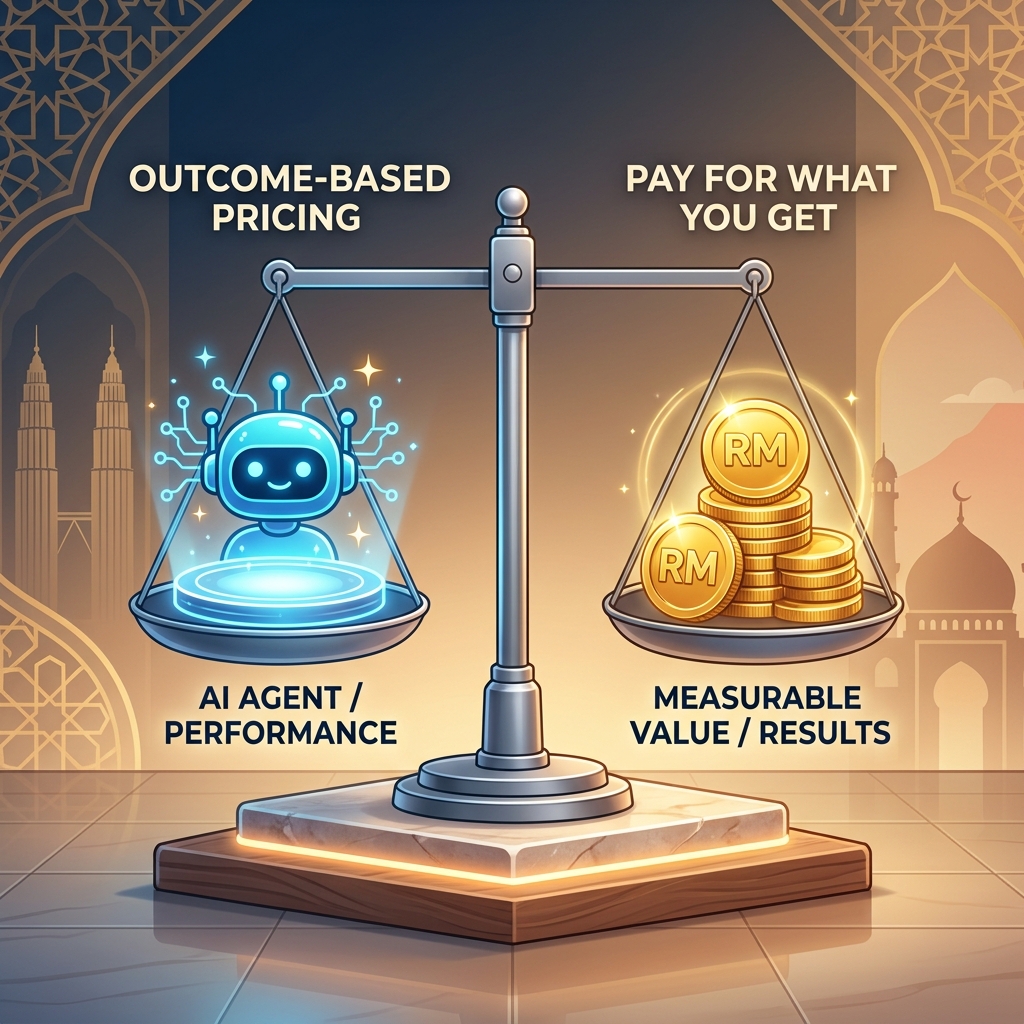
Featured image concept: A clean, modern illustration showing a balance scale — on one side, a glowing AI agent icon; on the other side, gold coins. The background is warm with subtle Malaysian architectural elements. The visual conveys "pay for what you get" in a professional, approachable style.
Schema markup: Article, FAQPage (for the evaluation questions section), HowTo (for the five steps section)