Primary Keyword: agentic AI for small business Secondary Keywords: AI agents for small business, agentic AI tools, AI automation small business, small business AI Meta Title: Agentic AI for Small Business: A Practical Guide (2026) Meta Description: What agentic AI actually means for small businesses — real use cases, tools, costs, and honest limitations. No hype, just practical advice. Suggested URL Slug: agentic-ai-for-small-business Target Word Count: 2,000–2,500 Suggested Schema Markup: Article, FAQ
Agentic AI for Small Business: What It Actually Means and How to Use It
"Agentic AI" has become the buzzword of 2026. Vendors are attaching it to everything from email plugins to CRM features, making it nearly impossible to separate the real capabilities from the marketing language. If you run a small business and you're trying to figure out whether this technology is worth your time and budget, you're right to be skeptical — and right to pay attention.
Here's the reality: agentic AI refers to AI systems that can take independent action to accomplish goals, not just answer questions. That's a meaningful upgrade from traditional chatbots. But it's also a technology that's still maturing, and the gap between what vendors promise and what the tools reliably deliver is significant.
This post breaks down what agentic AI actually does, where it's genuinely useful for small businesses today, where it falls short, and how to start using it without overcommitting.
What "Agentic" Actually Means
Most AI tools you've used — ChatGPT, Claude, Gemini — are reactive. You type a prompt, you get a response, and the cycle resets. Agentic AI breaks that pattern by adding three capabilities that standard chatbots lack.
Autonomous planning. You give the system a goal ("schedule a team meeting this week"), and it breaks that goal into steps: check availability across calendars, identify open slots, propose a time, draft the invite, send it. You don't manage each step manually.
Tool use. An agentic system can interact with external software — your email, calendar, CRM, project management tool, spreadsheets, databases, and web browsers. This is what separates an agent from a chatbot that can only produce text.
Self-correction. When a step fails — a calendar API returns an error, a search returns irrelevant results — the agent recognizes the failure and tries a different approach instead of simply returning an error message to you.
The result is an AI that functions less like a conversation partner and more like a junior assistant who can follow procedures across your existing tools. That's powerful for small teams where everyone is already wearing multiple hats.
Why Small Businesses Should Pay Attention
Large enterprises have entire departments for process optimization. Small businesses don't. A five-person company often has the same operational complexity as a much larger organization — invoicing, scheduling, customer follow-ups, inventory management, marketing — spread across far fewer people.
That's exactly the environment where agentic AI can create disproportionate value. Microsoft's chief product officer for AI recently described a scenario where a three-person team launches a global marketing campaign with AI handling data analysis, content generation, and personalization while the humans focus on strategy and creative direction. That's not science fiction. It's the direction tools are actively moving.
Three factors make 2026 the first year this is genuinely accessible for small businesses:
- Cost has dropped significantly. AI API pricing has fallen by roughly 80–90% compared to two years ago. Running an agent workflow that would have cost $50 per execution in 2024 might cost $2–5 today.
- No-code agent builders have arrived. Platforms like Relevance AI, Lindy, and features within tools like Zapier and Make now let non-technical users build multi-step AI workflows without writing code.
- Existing tools are adding agentic features. Your CRM, help desk, or project management platform may already have basic agent capabilities built in — you just haven't activated them yet.
Where Agentic AI Works Well for Small Businesses
Not every process benefits from an AI agent. The sweet spot is tasks that are repeatable, rule-based, involve multiple tools, and currently eat up significant time. Here are five categories where small businesses are seeing real results.
1. Customer Follow-Up and Lead Nurturing
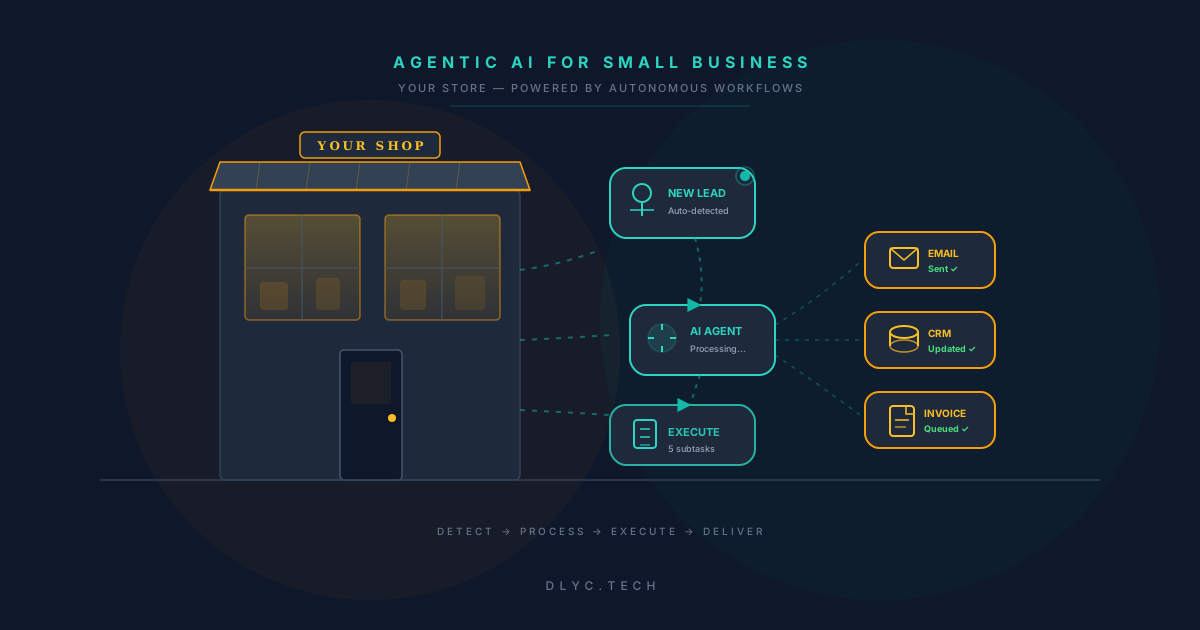
A common small business bottleneck: a lead fills out a contact form, and nobody follows up for 48 hours because the team is busy. An AI agent can monitor new form submissions, enrich the lead with publicly available company data, draft a personalized follow-up email, and queue it for your review — or send it automatically if you set that permission.
The key is that the agent handles the multi-step workflow (detect new lead → research → draft → send), not just one piece of it.
2. Invoice Processing and Bookkeeping Prep
If your accounts payable process involves receiving invoices via email, extracting key data, matching to purchase orders, and entering into accounting software, that's a textbook agent workflow. Tools like Nanonets and Vic.ai are already doing this for small and mid-size businesses, reducing processing time from 15–20 minutes per invoice to under 2 minutes.
3. Meeting Scheduling and Coordination
Scheduling across multiple people, time zones, and availability constraints is tedious and error-prone. Agentic tools like Reclaim.ai and scheduling agents built into platforms like Motion can handle the full cycle: find open windows, propose times, handle rescheduling, and send reminders.
4. Content Repurposing
You publish a long blog post. An agent can automatically generate a LinkedIn summary, three tweet-length highlights, an email newsletter blurb, and a short-form video script — each adapted to the platform's tone and format. Platforms like Repurpose.io and custom workflows in Zapier handle this, freeing your marketing person (or you) from hours of reformatting.
5. Competitive Monitoring
Manually checking competitor websites for pricing changes, new product launches, or content updates is a time sink. An AI agent can monitor specified URLs on a set schedule, flag meaningful changes, summarize what's different, and update a shared dashboard or send a Slack notification. This used to require expensive monitoring subscriptions — now it's a buildable workflow.
Where It Falls Short (Be Honest About This)
Transparency matters here, especially if you're making budget decisions. Agentic AI has real limitations in 2026, and ignoring them leads to wasted money and frustration.
Error rates are still too high for unsupervised critical tasks. Research from Anthropic and Carnegie Mellon University found that AI agents make enough mistakes that they shouldn't run unsupervised on processes involving money, customer data, or legal obligations. A study on computer-use agents showed success rates between 14–22% on complex real-world tasks. Simpler, well-defined tasks perform much better, but the takeaway is clear: agents need guardrails.
Security isn't solved yet. Prompt injection — where malicious inputs trick an agent into taking unintended actions — remains an active vulnerability. If your agent processes incoming emails and one contains a crafted prompt, the agent could be manipulated. This is a known, unsolved problem that the AI industry is actively working on.
Integration complexity is real. Connecting an agent to your specific combination of tools (this CRM, that email provider, this accounting software) often requires configuration that's technically possible but time-consuming. "No-code" doesn't always mean "no effort."
Cost can creep. While per-query costs are low, agents that run frequently — monitoring tasks, continuous processing — can accumulate meaningful API costs, especially if they're poorly optimized and making redundant calls.
How to Start Without Overcommitting
The businesses getting the most value from agentic AI right now share a common approach: they started with one specific workflow, measured the results, and expanded from there. Here's a practical framework.
-
Audit your repetitive tasks. Spend one week tracking every task that follows a predictable pattern and involves more than one tool. Write each one down with the approximate time it takes and how often it happens.
-
Pick the lowest-stakes, highest-frequency task. You want something that happens daily or weekly, follows clear rules, and where an error costs you time rather than money or a customer relationship. Internal processes are ideal starting points.
-
Choose a platform that matches your technical comfort. If you already use Zapier or Make, explore their AI agent features first — you'll benefit from existing integrations. If you're comfortable with slightly more setup, standalone platforms like Relevance AI or Lindy offer more flexibility.
-
Build with human checkpoints. Configure your first agent to draft and propose rather than execute. Have it prepare the invoice entry for your review, draft the follow-up email for your approval, or suggest the meeting time for you to confirm. Remove checkpoints only after you've built trust in the agent's accuracy over weeks, not days.
-
Measure against the baseline. Track two things: time saved per task and error rate. If the agent saves you 3 hours a week on lead follow-up but introduces errors in 20% of emails, you need to adjust the workflow before expanding.
-
Expand gradually. Once your first agent is running reliably, add a second workflow. The compounding effect is where the real value emerges — three or four well-configured agents running across your operations can reclaim 10–15 hours per week for a small team.
What to Spend (and What to Avoid)
For most small businesses, effective agentic AI in 2026 costs between $50–300 per month, depending on volume and platform. That typically covers a workflow automation platform subscription plus AI API usage.
Avoid enterprise-grade "AI agent platforms" that charge thousands per month and require dedicated implementation. These are built for companies with 500+ employees and complex compliance requirements. If a vendor can't show you a working demo with your specific use case in under 30 minutes, the tool probably isn't designed for businesses your size.
Also avoid building custom agents from scratch unless you have a developer on your team. The open-source agent frameworks (LangChain, CrewAI, AutoGen) are powerful but require meaningful technical skill to deploy, maintain, and debug. For most small businesses, the no-code and low-code platforms offer 80% of the value at 20% of the effort.
The Bottom Line
Agentic AI is the most practical AI advancement for small businesses since generative chatbots arrived in 2023. The ability to delegate multi-step, multi-tool workflows to an AI system — not just ask it questions — changes what a small team can accomplish in a day.
But the technology is early. Error rates are real, security gaps exist, and the vendor landscape is noisy. The businesses that will benefit most are the ones that start with a single, well-defined process, keep humans in the loop, and expand based on measured results rather than marketing promises.
Your competitors are experimenting with this right now. The advantage goes not to whoever adopts fastest, but to whoever adopts smartest.
Suggested Internal Links:
- AI Agents vs Chatbots — link from the opening paragraph where you contrast agents and chatbots
- What Is Agentic AI? — link when first defining "agentic AI"
- What Are AI Agents? — link from the "What Agentic Actually Means" section
- How to Implement AI Automation in Your Business — link from the "How to Start Without Overcommitting" section
- AI Agents in Enterprise — link when referencing Gartner's enterprise adoption stat
- What Is Multi-Agent AI? — link from the competitive monitoring use case or "What's next" context
- The AI Skills Gap — link when discussing the need for teams to understand AI tools
- SEO for Beginners — link from the content repurposing use case as a related resource
Suggested External Links:
- Gartner: 40% of Enterprise Apps Will Use AI Agents by 2026
- MIT Sloan: Five Trends in AI and Data Science for 2026
- HBS Working Knowledge: AI Trends for 2026
Featured Image Concept: A minimal illustration of a small business storefront (coffee shop or boutique) with subtle digital nodes and workflow arrows connecting icons for email, calendar, CRM, and documents — representing AI agents working behind the scenes. Warm, approachable color palette to avoid a cold "tech" feel.
FAQ Section (Optimized for Featured Snippets)
What is agentic AI in simple terms? Agentic AI refers to artificial intelligence systems that can independently plan, execute, and adjust multi-step tasks across multiple tools — rather than just answering questions one at a time like a traditional chatbot.
How much does agentic AI cost for a small business? Most small businesses can implement effective AI agent workflows for $50–300 per month using no-code platforms like Zapier, Make, Relevance AI, or Lindy, combined with AI API usage costs.
Is agentic AI reliable enough for small businesses in 2026? For well-defined, low-stakes workflows with human oversight, yes. For unsupervised tasks involving financial transactions, customer data, or legal obligations, the error rates are still too high to operate without human checkpoints.
What's the best first use case for agentic AI in a small business? Start with a repetitive, multi-step internal process that happens frequently and where an error costs time rather than money — such as lead follow-up emails, meeting scheduling, or content repurposing.
Do I need a developer to use agentic AI? No. No-code platforms like Zapier, Make, and Lindy allow non-technical users to build AI agent workflows. Custom development with frameworks like LangChain or CrewAI offers more power but requires programming skill.