AI for Malaysian Manufacturing SMEs: Why You Should Automate the Office Before the Factory Floor
When most manufacturing SME owners in Malaysia hear "AI for manufacturing," they picture robots on a production line, expensive sensors, or a full factory overhaul. That picture — while real for large enterprises — is the reason 80% of Malaysian businesses have still not started their smart factory journey. AI for manufacturing SMEs in Malaysia doesn't have to begin on the shop floor. The fastest, cheapest wins are in the business operations that run behind every factory: sales, procurement, finance, and HR.
Malaysia's New Industrial Master Plan (NIMP) 2030 sets an ambitious target of 3,000 smart factories by 2030. As of early 2026, only around 100 companies are progressing through smart factory certification phases. The gap isn't a lack of ambition — it's a lack of starting points. This guide gives manufacturing SMEs in Malaysia a practical entry point that doesn't require dismantling a single machine.
The Two Layers of Manufacturing AI
Before deciding where to invest, it helps to separate what AI actually means in a manufacturing context. There are two distinct layers.
Layer 1: Production Automation
This is the layer most people imagine — robotic arms, machine vision for quality inspection, predictive maintenance sensors, and digital twins of the production floor. It's real, powerful, and expensive. Entry-level smart factory projects under the SMART Tech Up Grant start at RM500,000 in matching investment. Full certification requires significant operational changes.
This layer is genuinely transformative. But it is not where most manufacturing SMEs should start.
Layer 2: Business Operations Automation
This is the layer that most manufacturing owners are sitting on and haven't touched. It covers every process that supports the factory: quoting and order management, supplier communication, invoice processing, payroll and HR administration, customer follow-up, and financial reporting.
These processes are often manual, repetitive, and handled by a small admin team that is already stretched. Automating them doesn't require new equipment, sensors, or a systems integrator. It requires the same type of AI workflow automation tools already used by retail and service businesses.
The business case is strong. Manufacturers implementing AI-driven operations automation report an average 20–25% increase in productivity and a 15–20% reduction in operating costs within 18 months, according to research on AI adoption in SME manufacturing contexts.
Where Manufacturing SMEs in Malaysia Are Losing Time and Money
Here are the four business operations areas where Malaysian manufacturing SMEs consistently bleed time, errors, and ringgit — and where AI delivers measurable results fastest.
Sales and Order Management
A typical Malaysian manufacturing SME receives purchase orders via email, WhatsApp, and sometimes fax. Each order has to be manually checked against stock, entered into a system (or a spreadsheet), and confirmed to the customer. When a customer asks for a quote, someone has to manually pull pricing, check material costs, and draft a response.
AI changes this. A well-configured AI agent can receive a customer inquiry, retrieve standard pricing data, generate a draft quotation, and send it for approval — all within minutes. Once an order is confirmed, the same agent can update the production schedule, notify the warehouse, and send a confirmation to the customer via WhatsApp or email.
For manufacturers dealing with repeat buyers, an AI-powered CRM layer can flag dormant accounts, trigger follow-up sequences, and alert the sales team when a customer's order cadence drops — all without anyone looking at a dashboard. Pairing this with a WhatsApp AI chatbot gives you a 24/7 order intake capability that your competitors likely don't have yet.
Procurement and Supplier Communication
Procurement is one of the highest-friction areas in manufacturing operations. Comparing supplier quotes, sending purchase orders, chasing delivery confirmations, and managing supplier documents is deeply manual work — often sitting with one person who becomes the bottleneck.
AI can cut manual invoice processing time by up to 80% while also saving 2–3% per invoice by catching late payment penalties and early-payment discounts that humans miss. An AI procurement agent can monitor supplier lead times, flag deviations from contracted terms, and draft supplier communications in seconds.
For Malaysian manufacturers dealing with suppliers across different time zones or languages — a common reality in Penang's E&E ecosystem or Selangor's industrial parks — AI agents that can operate asynchronously and handle Bahasa Malaysia, English, and Mandarin correspondence are a genuine competitive advantage.
If you're looking at the supply chain side, our guide on AI agents for Malaysian SME logistics covers the downstream piece — shipment tracking, carrier communication, and distribution — in depth.
Finance and Invoice Processing
Finance teams in manufacturing SMEs are frequently underwater. Monthly close takes days instead of hours. Invoices pile up. Accounts receivable chasing is done manually via phone calls and WhatsApp messages.
AI-powered accounting automation can handle accounts payable matching, generate payment reminders for outstanding invoices, reconcile bank statements against purchase orders, and flag discrepancies before they become problems. For manufacturers preparing for MyInvois e-invoicing compliance, AI tools that automate invoice generation and submission to LHDN's portal are now critical infrastructure, not optional extras.
The LHDN MyInvois compliance requirement — which rolls out to smaller businesses through 2026 — is itself a forcing function. Manufacturers who automate their invoice workflows now get compliance and efficiency gains simultaneously.
HR and Workforce Administration
Manufacturing SMEs in Malaysia manage complex workforce dynamics: shift scheduling, overtime calculations, attendance tracking, and increasingly, labour law compliance. Doing this manually for a team of 20–100 workers is one of the most time-consuming administrative burdens an owner faces.
AI doesn't solve all HR challenges, but it reduces the manual load significantly. Automated shift scheduling based on orders in the pipeline, AI-assisted job postings that screen initial applicants, and WhatsApp-based attendance bots are all deployed by Malaysian manufacturers today. For a deeper look at AI-assisted recruitment, the guide to AI recruitment for Malaysian SMBs is worth reviewing.
The NIMP 2030 Opportunity Most SMEs Are Missing
Here's the part most conversations about smart manufacturing miss. The Malaysian government doesn't just want manufacturers to install sensors — it wants the entire supply chain and business ecosystem around manufacturing to go digital. That creates a funding opportunity that Layer 2 automation projects (business operations) can qualify for, not just factory floor projects.
SMART Tech Up Grant
Administered by SME Corporation Malaysia, this matching grant provides up to RM500,000 for technology-driven projects. Eligibility requires at least 60% Malaysian ownership, active SSM registration, and at least six months of operation. While the grant was designed with technology upgrades in mind, AI-powered business automation systems — particularly those that integrate with production management software — qualify.
PowerUp10K Low-Cost Financing
Announced on April 10, 2026, Malaysia's Entrepreneur and Cooperatives Development Ministry is rolling out up to RM5 billion in low-cost financing at interest rates of 3–5%, channeled through Bank Rakyat, SME Bank, and licensed commercial banks. As of February 2026, RM2 billion had already been approved under the initiative. Manufacturing SMEs investing in automation and digitisation are explicitly listed as target beneficiaries. As of early April 2026, disbursements are ongoing.
MDEC Digital Acceleration Grant
Covering up to 70% of project costs (max RM2 million), this grant is the most substantial direct subsidy available. Our complete guide to Malaysia SME digitalisation grants covers eligibility and application steps in detail.
If you want a framework for making the business case internally or to a bank, this guide on calculating AI ROI covers how to model expected returns in terms a lender or finance director will accept.
Key Considerations Before You Start
You Don't Need to Digitise Everything at Once
The most successful AI deployments in Malaysian manufacturing SMEs follow a 90-day pilot model. Pick one process — typically the one that eats the most admin hours per week — and automate it fully before expanding. Order intake, invoice processing, and customer follow-up are all good starting points.
Integration Matters More Than Feature Count
A well-integrated AI tool that connects your WhatsApp, your inventory system, and your accounting software is worth ten standalone tools that don't talk to each other. Before buying anything, map the data flows between your key systems. Your AI strategy should include this mapping step.
Your Team Needs to Be Part of the Plan
Manufacturing SMEs that see the highest AI adoption ROI are those where floor managers and admin staff are consulted during implementation. AI that disrupts existing workflows without buy-in gets worked around rather than adopted. Bring your team in early.
Getting Started: Your 90-Day Action Plan
1. Identify your highest-friction process — Spend one week tracking where your admin team loses the most time. If it takes more than 15 minutes of manual work per occurrence and happens more than twice per day, it's an automation target.
2. Map the tools you already use — List every piece of software your business currently runs (accounting, inventory, sales, HR). AI implementations that build on existing tools are faster and cheaper than those that require replacing them. This overview of AI implementation in small businesses walks through the mapping process step-by-step.
3. Pick one automation project for Q2 2026 — Scoping is critical. One well-defined project (e.g., "automate customer quotation and confirmation for repeat orders") is more valuable than a vague "AI transformation plan." Define the trigger, the action, the output, and how you'll measure success.
4. Apply for funding before you build — Check eligibility for the SMART Tech Up Grant and MDEC Digital Acceleration Grant before starting any external vendor conversations. Grant applications take time, but knowing what you qualify for shapes what you can afford to build.
5. Pilot for 60 days, then measure — Track time saved, error rates, and any revenue impact (faster quotes often mean faster closed orders). Use real numbers to justify the next phase.
The Bottom Line
Malaysia's 3,000 smart factory target will not be achieved by large manufacturers alone. The path runs through the 90,000-plus manufacturing SMEs that form the backbone of Malaysia's industrial sector — and most of them will never start if the conversation stays at the factory floor level.
The business operations side of manufacturing — sales, procurement, finance, HR — is where AI delivers its fastest, most affordable wins. The tools exist, the grants are available, and the competitive pressure from manufacturers who are already automating is building. The question is no longer whether to start with AI. It's which process to automate first.
Internal links used:
- "AI workflow automation tools" →
/blog/2026/ai-workflow-automation-tools-smb - "WhatsApp AI chatbot" →
/blog/2026/whatsapp-ai-chatbot-small-business-malaysia - "AI agents for Malaysian SME logistics" →
/blog/2026/ai-supply-chain-logistics-malaysia-sme - "accounting automation" →
/blog/2026/ai-accounting-small-business - "AI recruitment for Malaysian SMBs" →
/blog/2026/ai-hiring-recruitment-malaysia-smb - "complete guide to Malaysia SME digitalisation grants" →
/blog/2026/malaysia-sme-digitalisation-grant-2026-ai - "calculating AI ROI" →
/blog/2026/how-to-calculate-ai-roi - "AI strategy" →
/blog/2026/small-business-ai-strategy - "AI implementation in small businesses" →
/blog/2026/how-to-implement-ai-automation-in-your-business
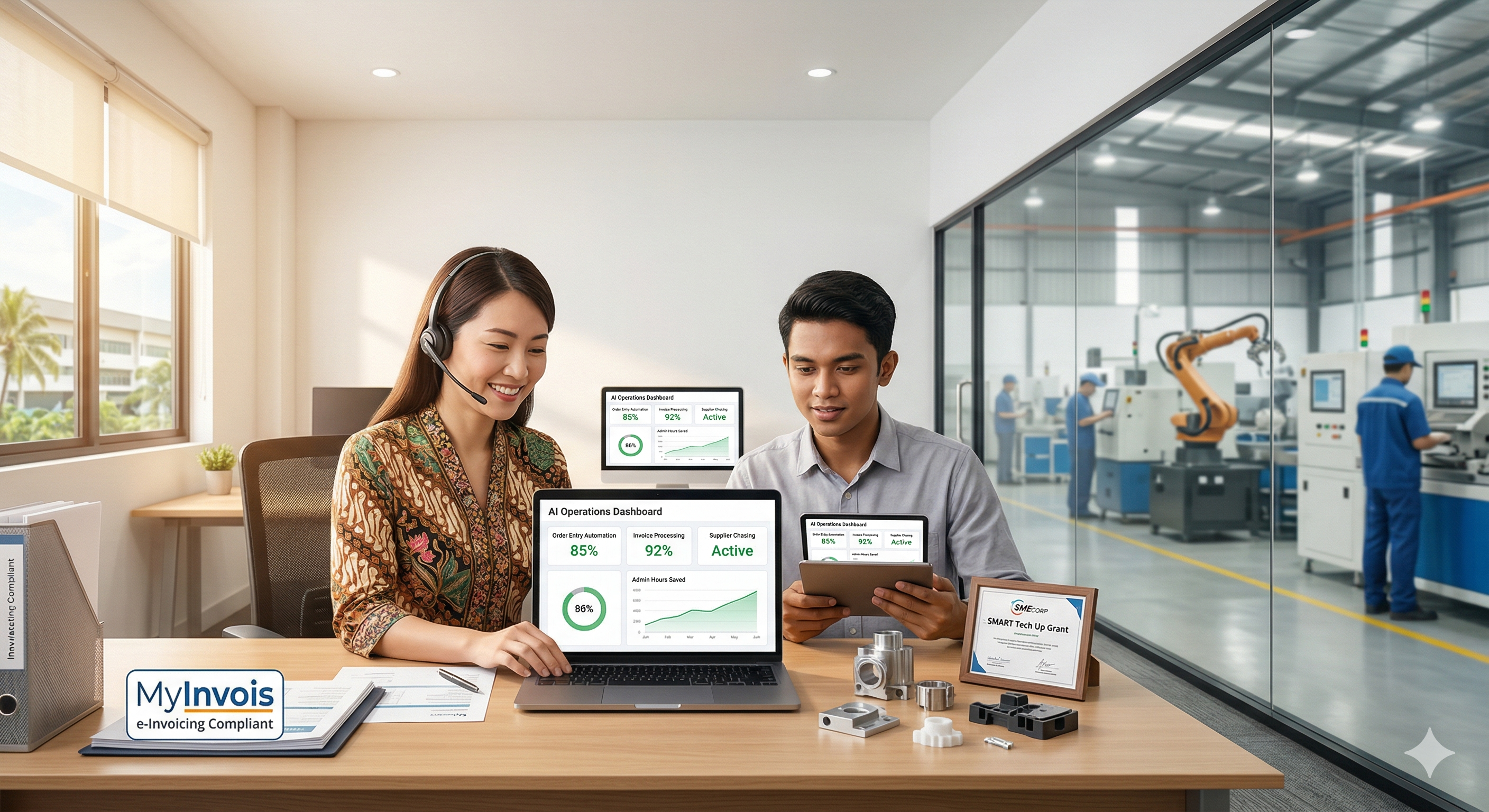
Featured image concept: A bright, clean graphic showing a Malaysian factory office — a compact workspace with a laptop displaying an AI dashboard alongside physical manufacturing samples on a desk. Warm light, professional tone, modern but grounded in a real SME environment.
Schema markup: Article schema (BlogPosting), HowTo schema for the 5-step action plan, FAQPage schema for common questions about AI in manufacturing SMEs.