AI Customer Service Agents for Malaysian SMBs: How to Cut Support Costs by 30%
Handling a customer enquiry costs your business an average of RM27 (about $6) when a human responds. An AI customer service agent handles the same interaction for under RM2.25 — a 12x difference. For Malaysian small businesses running lean teams, that gap is worth closing.
Gartner projects that 40% of small and mid-size businesses will deploy at least one AI agent by end of 2026, up from roughly 8% at the start of 2025. Malaysian businesses are tracking ahead of this curve, driven by government digitalisation funding and a new generation of locally-tuned AI tools. The question for most SMB owners is no longer whether to deploy, but how to do it properly.
Why Malaysian SMBs Are Paying Too Much for Customer Support
Most business owners do not think of customer support as a cost problem until they run the numbers. A retail shop in Petaling Jaya fielding 200 queries per week — about 800 per month — spends over RM21,000 monthly just on staff time to answer questions, many of which are identical day after day.
The hidden cost is worse. Inconsistent answers damage trust. Slow responses lose sales to competitors. Staff juggling support alongside other responsibilities make errors. And when your business is closed, potential customers go elsewhere.
The AI customer service market hit $15.12 billion in 2026, growing at 25.8% annually. Companies that have deployed AI support report 30-40% reductions in overall support costs. For a Malaysian SME, that is real money reinvested into growth.
The shift that matters is not about replacing the pop-up widget on your website. It is about agentic AI — AI that reasons about a customer's intent, accesses your business systems, takes action, and escalates intelligently when a human is needed. To understand why this is different from older chatbot tools, read AI Agents vs Chatbots: Key Differences and Which One Your Business Actually Needs.
What an AI Customer Service Agent Actually Does
A basic chatbot matches keywords to scripted replies. Type "refund" and it pastes your refund policy. That is useful but limited.
An AI customer service agent does more. It reads context, accesses your live data, executes tasks, and responds in natural language — in English, Bahasa Malaysia, Mandarin, or the Manglish your customers actually write in. When a customer says "Eh can change my delivery ar? Need tomorrow lah," the agent understands the request, checks your order management system, confirms whether the change is possible, updates the record, and tells the customer it is done — without a human touching the interaction.
Teams using agentic AI customer service resolve 65% or more of conversations automatically, with top performers hitting 90%. The remaining conversations escalate to a human with full context already attached, so your team starts at the solution rather than the beginning.
For a broader overview of how agentic AI works across different business functions, What Are AI Agents? Use Cases, Benefits, and Real-World Examples covers the fundamentals.
Where AI Customer Service Agents Work Best
Not every customer interaction should be automated. The right targets are high-volume, repetitive queries where consistency and speed matter more than human judgment.
Order and Delivery Enquiries
"Where is my order?" drives more customer service contacts than any other query in Southeast Asian e-commerce. An AI agent connected to your order management system provides real-time status updates in seconds, flags delays proactively, and escalates fulfilment issues to your operations team — all without a staff member involved.
Product Questions and Recommendations
A well-configured agent trained on your product catalogue handles sizing questions, specification comparisons, and "what is the difference between X and Y" queries at scale. It can identify cross-sell opportunities based on what the customer is asking and pass qualified leads into your sales pipeline. For the lead generation angle, see AI Lead Generation for Small Business: How to Build a Pipeline That Fills Itself.
Appointment Booking and Scheduling
Service businesses — clinics, salons, workshops, consultancies — spend significant staff time managing bookings, reminders, and cancellations. An AI agent handles the full cycle: availability checks, booking confirmation, pre-appointment information collection, and rescheduling. If your business also handles inbound phone calls, AI Voice Agents for Small Business: How to Automate Phone Calls and Save Thousands extends this capability to voice.
Returns, Complaints, and Policy Queries
This is where businesses hesitate but where AI delivers outsized value. An agent applies your returns policy consistently — no more inconsistent answers depending on who is working. For cases genuinely outside your policy, it escalates with full conversation history attached, so your team picks up with context.
FAQ queries — operating hours, payment methods, halal certification, promo terms, delivery zones — repeat daily across WhatsApp, email, and social DMs. Automating these alone frees hours of staff time every week.
How to Set Up an AI Customer Service Agent
Most Malaysian SMBs are live with a working agent within two to four weeks. Here is the process in practical terms.
Step 1: Audit Your Current Support Queries
Pull the last three months of messages from WhatsApp, email, and social media DMs. Categorise every query type and count frequency. You will find that 70-80% of your total volume falls into five or six categories. These are your automation targets.
Do not skip this step. Businesses that skip it automate the wrong things and then wonder why the agent is not helping.
Step 2: Build Your Knowledge Base
Your AI agent knows only what you teach it. Write clear, accurate answers for each query category. Include your product catalogue, pricing, shipping policies, return rules, and any process documentation. Treat this as writing a comprehensive onboarding guide for a new team member who will handle support permanently.
If your policies are inconsistent or undocumented, standardise them before you automate. An AI agent surfaces your process gaps faster than any audit.
Step 3: Choose the Right Platform
For Malaysian SMBs in 2026, the most practical options are:
- Tidio — affordable entry point, integrates with Shopify and WooCommerce, supports WhatsApp via Twilio, starting from $29/month
- Freshdesk — stronger for multi-channel support with a free tier available for small teams
- Intercom — more powerful for businesses with higher query volume and complex product lines, better AI reasoning capabilities
- Custom-built agents — if your workflows are industry-specific or require deep integration with proprietary systems, a custom agent built on tools like n8n offers full control and often lower long-term cost. See AI Workflow Automation for Small Business: n8n vs Make vs Zapier (2026 Guide) for a comparison of the underlying platforms.
Step 4: Connect Your Priority Channels
Most Malaysian customers reach businesses through WhatsApp first, followed by Instagram DMs, then website chat. Connect your agent to your highest-volume channel first and get it working well before expanding. For the WhatsApp-specific setup process, WhatsApp AI Chatbots for Small Business: How Malaysian SMEs Can Automate Sales and Support covers the full configuration.
Step 5: Define Your Escalation Rules
Decide now which queries always go to a human: legal complaints, media enquiries, sensitive financial matters, large enterprise deals. Configure your agent to detect these signals and hand off immediately with full conversation history. Clear escalation rules prevent the AI from handling situations beyond its appropriate scope.
Step 6: Test in Shadow Mode for One Week
Before going live, run your agent in shadow mode: it processes real queries, but a human reviews every response before it sends. After one week, review the errors, update your knowledge base, and go live. Expect to refine significantly in the first 30 days — this is normal and where most of the learning happens.
What to Expect: Real Numbers
Realistic expectations matter. Businesses that expect instant perfection abandon AI tools within 60 days. Businesses that plan for a learning curve see compounding returns.
Month 1: 40-60% of queries handled automatically. Your team spends less time on repetitive queries but more time reviewing edge cases and feeding corrections back into the system.
Month 3: Automation rate climbs to 65-75%. Response times drop dramatically — AI reduces average first response time by 37-97%, some implementations going from 15 minutes to 23 seconds.
Month 6: ROI becomes clearly measurable. Companies report an average return of $3.50 for every $1 invested in AI customer service. A Malaysian SME saving 15 hours of staff time per week at RM50/hour realises over RM39,000 in annual savings from that single change. For a framework to calculate and communicate these numbers, see How to Calculate AI ROI: A Framework for Getting Budget Approved.
Software costs start at USD 15-79 per month for off-the-shelf solutions. Custom implementations range from RM5,000 to RM25,000 depending on complexity. Most standard deployments recover their cost within three months.
Key Considerations Before You Start
Multilingual Support Is Non-Negotiable in Malaysia
Malaysian customers write in Bahasa Malaysia, English, Mandarin, and Manglish — often within the same message. Your agent must handle this fluently. Test it specifically on mixed-language conversations before going live. The major platforms support multilingual input, but quality varies significantly. Ask vendors for Malaysian-specific test results, not just general multilingual claims.
Document Your Processes First
An AI agent cannot invent your policies, and it will surface inconsistencies you did not know existed. If different staff members handle the same situation differently, your agent will be inconsistent too. Standardise your key processes before automating them.
You May Qualify for Grant Funding
Malaysia's SME Digitalisation Grant and the MDEC Digital Solutions subsidy cover AI customer service implementations. The Malaysia SME Digitalisation Grants in 2026: How to Fund Your AI Transformation guide covers eligibility criteria, application steps, and which costs qualify. Many SMBs are funding 50-80% of their AI implementation costs through these programmes.
Start Narrow, Then Expand
Resist the temptation to automate everything at once. Pick one channel, automate your top five query types, and run that for 60 days before expanding. Businesses that go narrow and deep get better results than those that go broad and shallow.
Your Action Plan: Start This Week
- Audit your queries — Export three months of WhatsApp, email, and social media DMs. Categorise every query type and count frequency. This takes two to three hours and gives you your automation roadmap.
- Select your top five query types — Choose the five most frequent queries that account for at least 60% of your total volume. These are your first automation targets.
- Write clean answers for each — Document accurate, consistent responses with the tone your brand uses. This becomes your knowledge base foundation.
- Shortlist two platforms — Book free trials with Tidio and Freshdesk. Test both on your actual query types, in Bahasa Malaysia and English.
- Check grant eligibility — Before paying full price, verify whether your implementation qualifies for SME or MDEC funding. A 30-minute call with a local digital consultant often reveals funding you did not know you had.
- Set a 90-day measurement plan — Define success metrics upfront: automation rate target, average response time goal, staff hours saved per week. Measure from day one so you have data to evaluate at the 90-day mark.
For the broader AI implementation context across your business, How to Implement AI Automation in Your Business: A Practical Step-by-Step Guide covers the full framework for rolling out AI beyond customer support.
The Bottom Line
Malaysian SMBs are already paying for slow, inconsistent customer service — they measure it in staff overtime, missed leads, and negative reviews rather than a line item on the P&L. An AI customer service agent makes that cost visible and then eliminates most of it.
The $0.50 versus $6 cost comparison is not a guarantee. Your agent will make mistakes in the first month, especially with edge cases and unusual phrasing. But those mistakes are logged, correctable, and systematically reduced. Compare that to the cost of a staff member giving a wrong answer on a busy Friday evening, and that answer spreading via a customer screenshot to 500 WhatsApp contacts.
The businesses that win with AI customer service are not the ones deploying it everywhere. They are the ones who pick a specific, expensive problem — customer support being the most common starting point for Malaysian SMBs — solve it properly, and build from there. If you handle more than 100 customer queries per month, the cost of waiting is real. The question is what that volume is currently costing you.
Internal links used:
- AI Agents vs Chatbots: Key Differences and Which One Your Business Actually Needs
- What Are AI Agents? Use Cases, Benefits, and Real-World Examples
- AI Lead Generation for Small Business: How to Build a Pipeline That Fills Itself
- AI Voice Agents for Small Business: How to Automate Phone Calls and Save Thousands
- AI Workflow Automation for Small Business: n8n vs Make vs Zapier (2026 Guide)
- WhatsApp AI Chatbots for Small Business: How Malaysian SMEs Can Automate Sales and Support
- How to Calculate AI ROI: A Framework for Getting Budget Approved
- Malaysia SME Digitalisation Grants in 2026: How to Fund Your AI Transformation
- How to Implement AI Automation in Your Business: A Practical Step-by-Step Guide
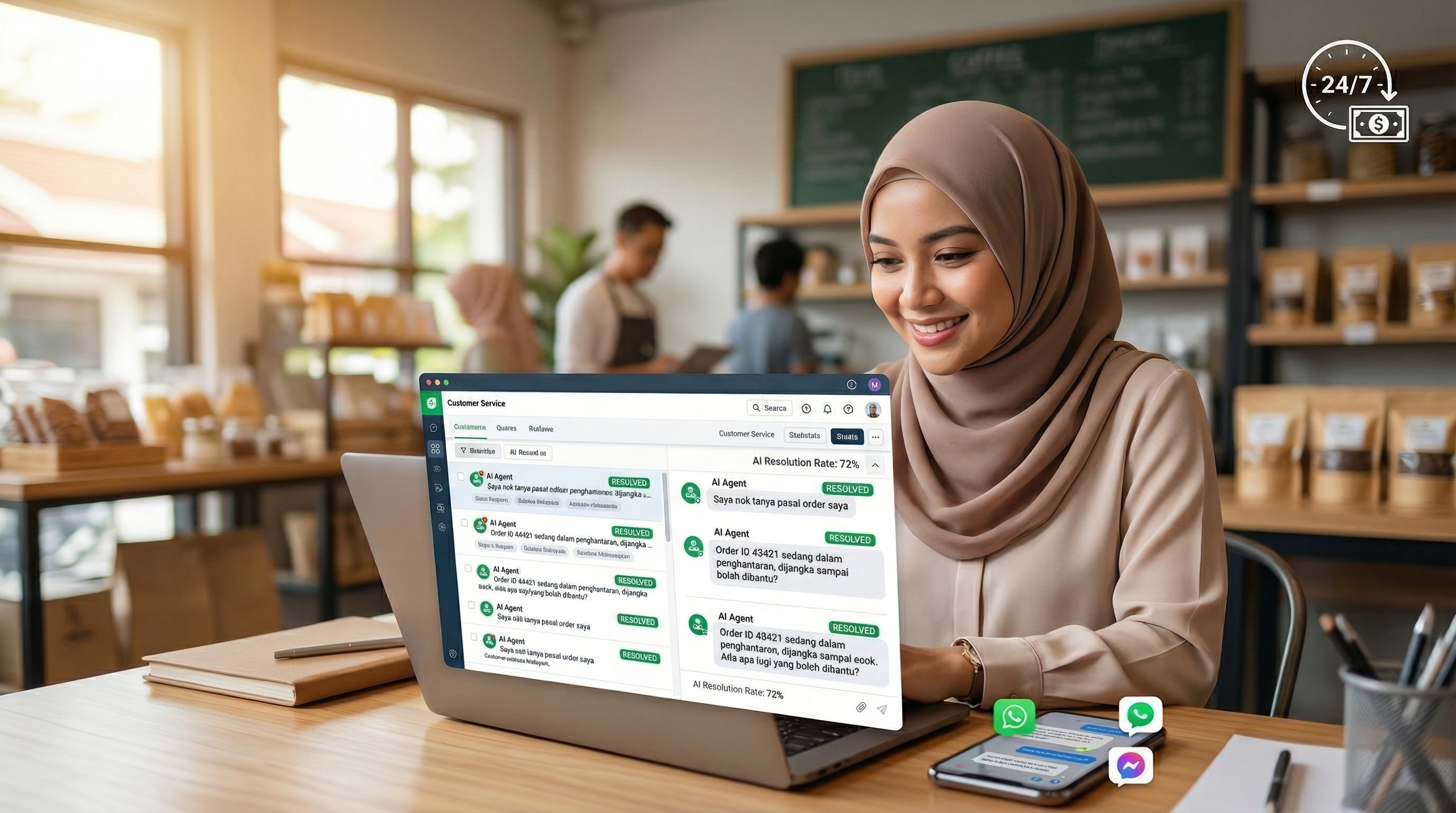
Featured image concept: A warm, well-lit photo of a Malaysian small business owner at a laptop — phone notifications visible, WhatsApp chat open — with a subtle AI interface overlay showing automated reply indicators and a green "resolved" badge on incoming customer messages.
Schema markup: HowTo (the 6-step setup process), FAQPage (for the key considerations section), Article