Why Your Small Business Needs an AI Strategy Before Another AI Tool
Nearly seven out of ten small businesses now use AI tools on a regular basis. Yet 77% of them have no written AI policy, no measurement framework, and no clear plan for what comes next. The result is predictable: wasted subscriptions, scattered workflows, and AI that adds noise instead of value. If your business is using AI without a strategy, you are not behind the curve — you are the curve.
The Strategy Gap Is the Real Problem
The numbers tell a compelling story about where small businesses stand with AI in early 2026.
According to the Small Business Expo's February 2026 survey of 693 business owners, 71.4% are actively using AI in some capacity. A Salesforce study found that 91% of SMBs with AI say it boosts revenue, and 87% say it helps them scale operations. The average small business worker saves 5.6 hours per week using AI, with managers saving more than seven hours.
Those are strong results. But they mask a deeper issue.
The same research reveals that most small businesses are experimenting with AI, but very few are doing it strategically. An estimated 77% have no written AI policy. That gap exposes businesses to data leaks, hallucinated outputs in client-facing materials, and growing vendor lock-in they may not even recognize.
The competitive advantage does not come from using AI. It comes from using AI well.
Why Tool Stacking Fails
The natural instinct when you hear about AI's potential is to sign up for everything. A chatbot here, an email writer there, a scheduling assistant, a social media generator, an analytics dashboard. Before long, you are paying for a dozen subscriptions that barely talk to each other.
This is tool sprawl, and it is one of the biggest traps small businesses fall into.
The Real Cost of No Strategy
Scattered AI adoption creates several problems that compound over time:
- Redundant capabilities — Multiple tools doing overlapping jobs, each with its own learning curve and monthly fee.
- Data silos — Customer information lives in five different platforms with no central source of truth.
- Inconsistent outputs — Your chatbot sounds nothing like your email campaigns because different tools use different models and prompts.
- Security blind spots — Without a policy, employees feed sensitive business data into free AI tools with no data protection guarantees.
- No measurable ROI — You cannot prove AI is helping if you never defined what success looks like.
The businesses that are winning with AI in 2026 are not stacking fifteen different subscriptions. They are picking three to five tools that integrate well and solve their specific bottlenecks.
What a Small Business AI Strategy Actually Looks Like
A useful AI strategy for a small business does not require a consultant, a committee, or a sixty-page document. It requires honest answers to five questions.
Define the Problem First
Start by identifying the workflows that consume the most staff time relative to their value. Common candidates include responding to routine customer inquiries, scheduling and follow-ups, invoice processing, content creation for marketing, and data entry across systems.
Document these workflows in detail before you shop for tools. The businesses seeing the strongest results from automation are the ones that identified one specific workflow consuming disproportionate staff time, built a focused solution, measured the result, and then expanded.
Set Measurable Goals
For each AI initiative, articulate what you want to achieve with specific numbers. Vague goals like "improve efficiency" do not work. Strong goals look like this:
- Reduce customer response time — from 4 hours to under 30 minutes using an AI agent that handles routine inquiries.
- Cut content production time — by 50% while maintaining brand voice consistency.
- Eliminate manual data entry — for order processing, targeting 80% automation within 90 days.
These targets give you something to measure against. Without them, you are spending money on hope.
Choose Integrated Solutions Over Point Tools
The defining shift in 2026 is the move from standalone AI tools to integrated AI workflows. Rather than buying a separate tool for every task, look for platforms and AI agents that handle multiple steps in a single workflow.
AI agents represent the clearest example of this shift. Unlike traditional software that waits for instructions, AI agents analyze context, make decisions based on your business data, and execute multi-step processes autonomously. A single well-configured AI agent can replace three or four disconnected tools by handling lead qualification, follow-up emails, appointment booking, and CRM updates in one connected flow.
Write a Simple AI Policy
Your AI policy does not need to be complex. It should cover four things:
- Approved tools — Which AI tools are sanctioned for business use and which are off-limits.
- Data boundaries — What information can and cannot be shared with AI tools, especially customer data and financial records.
- Quality checks — Who reviews AI-generated content before it reaches customers.
- Access controls — Who has permission to purchase new AI tools or change existing configurations.
This protects your business from the risks that come with unstructured adoption. It takes an afternoon to write and saves months of cleanup later.
Measure, Learn, Expand
Track your results weekly for the first 90 days of any AI implementation. The metrics that matter most for small businesses are time saved per task, cost reduction compared to the previous process, error rates before and after automation, and customer satisfaction scores.
Research shows that 78.6% of small businesses using AI report reduced costs or improved efficiency. But you can only claim that benefit if you are measuring it. Once you have proven ROI on one workflow, use that data to justify expanding to the next.
Where AI Agents Fit Into the Strategy
The most significant trend reshaping small business operations in 2026 is the rise of agentic AI — AI systems that do not just answer questions but take action on your behalf.
Gartner predicts that by the end of 2026, 40% of enterprise applications will include task-specific AI agents. For small businesses, this shift matters because agents collapse multiple tools into unified workflows.
High-Impact Use Cases for SMBs
The areas where AI agents deliver the fastest ROI for small businesses include:
- Customer service — AI voice agents now handle inbound calls with near-human fluency, booking appointments, answering questions, and escalating complex issues. Companies using AI-powered customer service report 20-30% reduction in operational costs while handling up to 80% of routine inquiries.
- Lead management — Agents that qualify inbound leads, send personalized follow-ups, and update your CRM without manual intervention.
- Operations — From automated invoice processing to inventory alerts, agents handle the back-office tasks that eat hours every week.
- Marketing — Agents that analyze campaign performance, adjust ad spend, and generate content briefs based on what is working.
The key distinction is that these agents work as part of your workflow, not alongside it. They connect to your existing systems, learn your business rules, and operate continuously.
Choosing the Right Agent Approach
Not every business needs a custom-built AI agent from day one. Consider a phased approach:
- Start with embedded AI — Use the AI features already built into your existing tools. Google Workspace, Microsoft 365, HubSpot, and Shopify have all integrated AI capabilities directly into their platforms.
- Add a focused agent — Once you have identified a workflow that embedded AI cannot handle, deploy a specialized agent for that specific task.
- Build connected workflows — As you gain confidence, connect agents together to handle end-to-end processes, creating what industry leaders call "digital assembly lines."
Key Considerations Before You Start
Budget Realistically
AI tools range from free tiers to enterprise pricing. For most small businesses, a focused AI stack costs between $200 and $1,000 per month. Research shows that 66% of small businesses using AI save between $500 and $2,000 monthly, meaning the ROI often covers the investment within the first month or two.
Address the Skills Gap
The U.S. Chamber of Commerce reports that AI literacy is emerging as a key competitive edge for small businesses. You do not need to become a data scientist, but your team should understand how to write effective prompts, evaluate AI outputs, and recognize when AI is producing unreliable results.
Start Before You Feel Ready
Waiting for the "perfect" AI tool or the "right time" is its own risk. With 71% of small businesses planning to increase their AI investment this year, staying on the sidelines means falling further behind competitors who are already building institutional knowledge with these tools.
Your Five-Step Action Plan for This Week
- Audit your current AI usage — List every AI tool your business pays for or uses freely. Note what each one does, who uses it, and what it costs. You will likely find overlap and waste.
- Identify your biggest bottleneck — Pick the single workflow that consumes the most staff time relative to its value. This is your first automation target.
- Set one measurable goal — Define what success looks like for automating that workflow. Use specific numbers and a 90-day timeline.
- Draft a one-page AI policy — Cover approved tools, data boundaries, quality checks, and access controls. Share it with your team.
- Evaluate integrated solutions — Before adding another point tool, look for AI agents or platforms that can handle multiple steps in your target workflow. Prioritize solutions that connect to the systems you already use.
The Bottom Line
The gap between small businesses that use AI and those that use it strategically is widening every month. With nearly three-quarters of SMBs already experimenting with AI tools, adoption alone is no longer a differentiator. The businesses that will pull ahead in 2026 are the ones that treat AI as a strategic capability — with clear goals, measured results, and workflows designed around outcomes rather than features. The best time to build your AI strategy was six months ago. The second best time is this week.
Internal linking opportunities:
- AI agents for small business: what they are and how they work — link from the "Where AI Agents Fit" section
- How to automate your customer service with AI — link from the customer service use case bullet
- Choosing the right AI tools for your business — link from the "Choose Integrated Solutions" section
- What is agentic AI and why it matters for SMBs — link from the agentic AI explanation
- ROI of AI automation: real numbers from real businesses — link from the ROI discussion
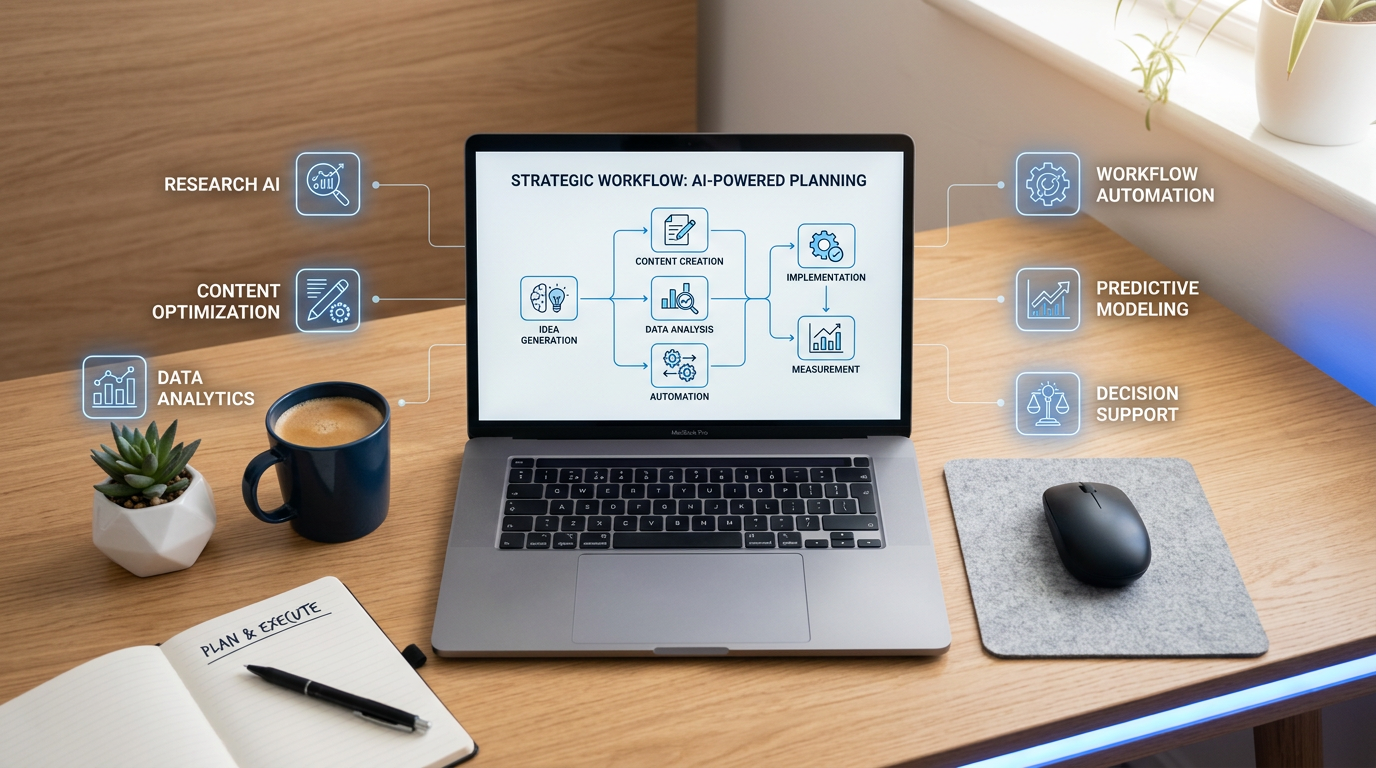
Featured image concept: A clean, modern workspace desk viewed from above with a laptop showing a simple flowchart or strategy diagram, surrounded by minimalist icons representing connected AI tools — conveying planning and intentionality rather than chaos. Warm lighting with blue accent tones.
Schema markup: Article, HowTo (for the five-step action plan), FAQPage (potential for adding FAQ section)