What Are AI Agents? Use Cases, Benefits, and Real-World Examples
Sixty-two percent of organizations are already experimenting with AI agents, according to McKinsey's 2025 state of AI survey. Gartner predicts that by the end of 2026, 40% of enterprise applications will embed task-specific AI agents — up from less than 5% in 2025. The AI agent market itself is projected to grow from roughly $7.8 billion in 2025 to over $52 billion by 2030.
This isn't a category that's emerging. It's one that's scaling fast. But the term "AI agent" gets thrown around loosely — often confused with chatbots, copilots, and standard automation. This guide clarifies what AI agents actually are, how they work under the hood, where businesses are deploying them today, and what kind of results they're producing.
What Is an AI Agent?
An AI agent is software that can autonomously perceive its environment, make decisions, and take actions to achieve specific goals — often across multiple tools and systems — with minimal human intervention.
The key word is autonomously. Traditional AI tools respond to a single prompt and return a single output. You ask a question, you get an answer. An AI agent operates differently. You give it an objective, and it figures out how to accomplish that objective on its own — planning the steps, making decisions at each stage, using external tools, and adapting when something unexpected happens.
Three capabilities separate AI agents from simpler AI tools:
Planning and reasoning. An AI agent can decompose a complex goal into a sequence of subtasks, determine the right order to execute them, and adjust the plan based on intermediate results. If step three fails, the agent doesn't stop — it reasons about alternatives and tries a different approach.
Tool use and system integration. AI agents connect to external software — CRMs, databases, email platforms, ERPs, APIs, calendars, payment systems — to take real actions in the world. They don't just generate text about what should happen. They make it happen.
Memory and context persistence. Unlike stateless AI tools that forget everything between interactions, agents retain context across sessions. They remember previous conversations, learn from past outcomes, and use accumulated knowledge to improve future performance.
This combination of reasoning, action, and memory is what makes AI agents fundamentally different from chatbots, copilots, and traditional automation. A chatbot responds to questions. A copilot suggests next steps for a human to execute. An AI agent pursues goals independently.
How AI Agents Work
Under the hood, most AI agents follow a loop that mirrors how a human professional approaches complex work:
- Observe — The agent receives input from its environment: a customer request, a data alert, a workflow trigger, or a direct instruction.
- Think — Using a large language model (LLM) as its reasoning engine, the agent analyzes the situation, considers available tools and information, and plans a course of action.
- Act — The agent executes its plan by calling external tools — sending an email, updating a database record, generating a document, querying an API.
- Reflect — The agent evaluates the result of its action. Did it achieve the intended outcome? If not, it loops back to the thinking step and adjusts.
This observe-think-act-reflect loop runs continuously until the agent accomplishes its goal or determines it needs human input. The sophistication of each step varies — some agents handle simple two-step workflows, while advanced multi-agent systems orchestrate dozens of specialized agents working in parallel.
Modern agent architectures are built on top of foundation models (GPT-4, Claude, Gemini) but extend them with frameworks like LangChain, AutoGPT, CrewAI, and Microsoft AutoGen that add planning, memory management, and tool integration capabilities.
Types of AI Agents
Not all agents operate the same way. Understanding the different types helps you match the right agent architecture to your business needs.
Reactive agents respond to immediate inputs based on predefined rules. They don't maintain memory or plan ahead. Think of a smart thermostat that adjusts temperature based on current readings — simple, fast, and reliable for narrow tasks.
Goal-based agents pursue specific objectives by planning sequences of actions. They evaluate different paths and choose the one most likely to achieve the goal. Most business AI agents fall into this category — they have a defined objective (resolve this support ticket, qualify this lead) and autonomy in how they reach it.
Learning agents improve over time by analyzing outcomes from their previous actions. AI sales agents that refine their outreach strategy based on which emails generate meetings, or fraud detection agents that get better at identifying new patterns, are examples of learning agents.
Multi-agent systems coordinate multiple specialized agents working together on complex tasks. Instead of one generalist agent doing everything, a team of focused agents each handle their domain — one manages data retrieval, another handles communication, a third processes payments — and an orchestrator coordinates them. This architecture mirrors how human teams solve complex problems, and it's the dominant pattern in advanced enterprise deployments. Roughly 66% of implementations now use multi-agent system designs.
AI Agent Use Cases by Business Function
AI agents are being deployed across virtually every business function. Here are the use cases producing the strongest results, organized by department.
Customer Service and Support
Customer service was the first major beachhead for AI agents, and it remains the most widely adopted use case. AI CX agents handle customer inquiries around the clock across websites, mobile apps, social media, and messaging platforms.
But modern AI agents go far beyond FAQ responses. They resolve issues end-to-end: verifying account details, processing refunds, updating orders, generating shipping labels, and sending confirmations — all within a single interaction. ServiceNow reported a 52% reduction in time required to handle complex customer service cases after integrating AI agents. Gartner projects that 68% of customer interactions will be handled by agentic AI by 2028.
The shift is from reactive support (wait for a ticket, respond) to proactive resolution (detect an issue before the customer notices, fix it automatically, notify them it's been handled).
Sales and Revenue Operations
Sales is one of the clearest examples of AI agents delivering measurable ROI. AI sales agents operate as learning agents — continuously analyzing customer data, past interactions, and outcomes to qualify leads, draft personalized outreach, book meetings, and follow up automatically.
Unlike traditional sales automation that follows static rules, these agents improve over time. They coordinate actions across CRMs, email platforms, and calendars, behaving more like junior sales development reps than scripted workflows. Companies using AI agents for sales report higher conversion rates, faster pipeline velocity, and significantly less time spent on manual data entry and follow-up coordination.
IT Service Management
AI agents in IT handle service desk tickets autonomously — diagnosing issues, attempting automated fixes, and escalating to human engineers only when the problem exceeds their capabilities. They proactively monitor network performance, detect anomalies, and take preemptive action.
For example, an IT agent that detects a storage issue can automatically procure additional cloud capacity or migrate data to free up space. If it encounters a known issue, it applies the fix automatically. If the problem is novel, it escalates with a complete log of everything it attempted, so the human engineer starts with full context rather than troubleshooting from scratch.
Human Resources
HR departments deploy AI agents to handle routine employee inquiries and transactions — questions about benefits, vacation requests, expense reports, tax withholding changes. Instead of waiting days for an HR response, employees interact with an agent that answers questions and makes changes immediately.
The impact goes beyond speed. AI agents in HR reduce administrative burden on HR teams, allowing them to focus on strategy, employee development, and organizational design rather than processing routine requests.
Finance and Accounting
Finance teams use AI agents for invoice processing, expense reconciliation, anomaly detection, and financial reporting. Agents extract data from documents, validate against purchase orders, flag discrepancies, route approvals, and update accounting systems — handling workflows that previously required multiple people touching multiple systems.
The strategic shift is significant: AI agents move finance departments from reactive oversight to proactive foresight, enabling real-time visibility into cash flow, spending patterns, and financial risks.
Software Development
AI coding agents autonomously write, debug, test, and refactor code. They compress development cycles from days to hours for many tasks. Tools like Claude Code, GitHub Copilot, and Cursor demonstrate how agents can handle substantial portions of the software development lifecycle with minimal human direction.
For businesses that rely on software — which is essentially every business today — this changes the math on development capacity, enabling smaller teams to ship faster and iterate more frequently.
Supply Chain and Logistics
AI agents track shipments across carriers, predict delays using weather and logistics data, adjust reorder points dynamically, and optimize routing. They ingest real-time data from inventory systems, demand forecasts, and supplier networks to make continuous adjustments that would be impossible for humans monitoring dashboards manually.
Real-World Results
The data from early adopters is compelling:
- 55% higher operational efficiency reported by businesses using AI agents across workflows
- 35% cost reductions in departments where agents handle routine cognitive tasks
- 52% reduction in complex case handling time (ServiceNow)
- 69% of retailers leveraging AI agents report significant revenue growth through personalized experiences
- 62% of companies expect 100%+ ROI from their AI agent deployments
- 90% of hospitals worldwide are expected to adopt AI agents by 2025 for predictive analytics and patient outcomes
These aren't theoretical projections. They're measured outcomes from organizations that have moved past pilots into production deployment.
Benefits of AI Agents for Businesses
Always-On Operations
AI agents work around the clock without fatigue, holidays, or shift changes. For customer-facing functions, this means instant response at any hour. For internal operations, it means processes don't stall overnight or over weekends.
Scale Without Proportional Headcount
As AI agents handle more routine cognitive work, businesses can scale operations without linearly scaling their workforce. The same team accomplishes significantly more — and spends their time on strategy, creativity, and the high-judgment work that requires human expertise.
Consistency and Error Reduction
Agents follow the same logic every time. They don't have off days, forget steps, or misread data due to fatigue. Early adopters report up to 60% fewer errors in agent-automated workflows compared to manual processes.
Faster Execution
Tasks that require coordinating across multiple systems — checking inventory, updating a CRM, sending an email, processing a payment — take minutes for an agent versus hours for a human juggling between tools.
Continuous Improvement
Learning agents get better over time. They analyze which approaches produce the best outcomes and adjust their behavior accordingly. This means your automated workflows improve without manual retuning.
Key Considerations Before Deploying AI Agents
Start with a specific, well-defined process. The organizations seeing the strongest results aren't deploying generalist agents. They're building specialized agents for specific, high-value workflows — then expanding. Only 15% of IT leaders are considering fully autonomous agents; most successful deployments are scoped and governed.
Data readiness matters more than model selection. If your enterprise data is siloed, inconsistent, or poorly structured, your agents will underperform regardless of which LLM powers them. Invest in data accessibility and quality before deploying agents.
Governance is non-negotiable. Define clear boundaries: what agents can and cannot do, which decisions require human approval, and how you audit agent behavior. Without governance, Gartner warns that over 40% of agentic AI projects may be canceled by 2027 due to lack of measurable ROI.
Security requires new thinking. AI agents that access and modify data across multiple systems introduce new attack surfaces. Seventy-four percent of organizations cite security as a top concern with agentic AI. Implement scoped permissions, audit trails, and data access controls from day one.
Buy before you build. Purpose-built agent platforms succeed at roughly twice the rate of internal builds. Unless agent development is your core competency, start with vendor solutions and customize from there. The 75% failure rate for DIY builds is a real barrier.
How to Get Started
- Identify one high-impact workflow — customer ticket resolution, lead qualification, invoice processing, or IT service desk are proven starting points.
- Define measurable success criteria — resolution time, error rate, cost per transaction, customer satisfaction.
- Choose a platform that offers pre-built agent capabilities and integrates with your existing tech stack.
- Run a 30–90 day pilot alongside your existing manual process, comparing agent performance against your baseline.
- Scale based on evidence — expand to adjacent workflows only after the pilot produces measurable ROI.
The Bottom Line
AI agents represent a fundamental shift from AI that generates to AI that acts. They plan, reason, use tools, and execute complex workflows autonomously — and the businesses deploying them are seeing measurable gains in speed, cost, accuracy, and scale. The technology is past the experimental phase. Sixty-two percent of organizations are already experimenting, and the market is projected to grow nearly sevenfold by 2030. The question isn't whether AI agents will reshape business operations — it's whether your organization captures that value now or plays catch-up later.
Suggested Internal Links:
- What Is Agentic AI and How It Can Help Your Business — Link from the opening section or "What Is an AI Agent" definition
- AI Agents vs Chatbots: Key Differences and Which One Your Business Actually Needs — Link from the section distinguishing agents from chatbots
Suggested External Linking Opportunities:
- McKinsey's 2025 State of AI report (62% experimentation stat)
- Gartner's prediction on 40% of enterprise apps embedding AI agents by 2026
- ServiceNow case study on 52% reduction in case handling time
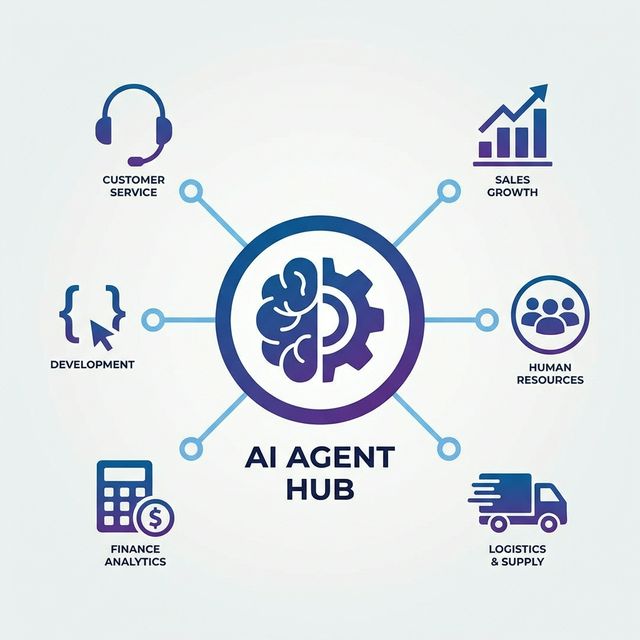
Suggested Featured Image Concept: A central AI agent icon (brain + gear) with connecting lines branching out to icons representing different business functions: customer service headset, sales graph, code brackets, HR people icon, finance calculator, logistics truck. Clean, modern, hub-and-spoke layout.
Suggested Schema Markup: Article, FAQ