AI Agents for Small Business: How to Build Your First Digital Workforce in 2026
Small business owners are no longer asking whether AI agents are worth it. With 68% of SMBs already using AI tools and companies reporting a 3.7x return on every dollar invested, the question has shifted to something more practical: how do you actually deploy AI agents for small business operations without burning time and money on the wrong approach?
This guide breaks down what AI agents are, where they deliver the fastest ROI, and how to get your first agents running in 90 days or less.
What Are AI Agents and Why Should Small Businesses Care?
AI agents are software programs that can perceive their environment, make decisions, and take actions to achieve specific goals — without needing a human to manage every step. Unlike traditional chatbots that follow rigid scripts, agentic AI systems can handle multi-step workflows from start to finish.
Think of them as digital employees. A customer support agent reads an incoming ticket, pulls the relevant order data from your CRM, drafts a response, and sends it — all without human intervention. A finance agent monitors your invoices, sends follow-up reminders at 30, 60, and 90 days, and flags high-risk accounts for your attention.
This shift from simple automation to autonomous workflows is why Mastercard launched its Virtual C-Suite in March 2026 — a suite of AI agents that give small businesses access to executive-level financial analysis and decision-making. When a payments giant builds AI agents specifically for SMBs, the signal is clear: this technology is ready for businesses of every size.
The Numbers Behind AI Agent Adoption
The data on AI agents for small business is hard to ignore. Here is where things stand in early 2026:
- 68% of small businesses now use AI in some capacity, up from roughly 40% in 2024, according to the U.S. Chamber of Commerce.
- 91% of SMBs with AI report that it boosts their revenue, per a Salesforce survey.
- 73% of SMBs that adopted AI agents in 2025 reported measurable productivity gains within 90 days.
- The average small business worker saves 5.6 hours per week using AI, while managers save over 7 hours.
- AI agents cost $0.25–$0.50 per interaction compared to $3.00–$6.00 for human agents — an 85–90% cost reduction in customer service.
Perhaps most telling: 80% of small businesses say competition is driving them to accelerate AI adoption. If your competitors are deploying agents and you are not, you are already falling behind.
Where AI Agents Deliver the Fastest ROI
Not every business process is a good fit for AI agents. The highest-impact starting points share three traits: they are repetitive, data-driven, and time-sensitive. Here are the workflows where small businesses are seeing the fastest payback.
Customer Service and Support
This is the number-one use case for a reason. AI agents can handle 60% or more of customer inquiries end-to-end, reducing first response times from over 6 hours to under 4 minutes. For a small business juggling support with everything else, that is transformative.
A typical customer service agent workflow looks like this: the agent receives a ticket, classifies it by type and urgency, pulls relevant customer data, drafts a response using your knowledge base, and either sends it directly or queues it for human review on sensitive issues.
Lead Response and Nurturing
Speed kills in sales — and not in a good way when you are slow. The highest-ROI workflow for most SMBs is automating lead response, which can cut response time from hours to 60 seconds. A lead scoring agent evaluates inbound leads against your ideal customer profile, enriches them with company data, routes qualified leads to the right person, and auto-responds to unqualified leads with helpful resources.
Financial Operations
AI agents excel at accounts receivable, invoice processing, and cash flow forecasting. An AR agent monitors aging invoices, sends escalating follow-ups on a schedule, flags high-risk accounts, and generates collection priority scores. Mastercard's new Virtual CFO takes this further by letting small business owners run "what if" scenarios — simulating a 10% revenue drop or a change in payment timing to see how it impacts their bottom line.
Content and Marketing
From drafting social media posts to personalizing email campaigns, marketing AI agents handle the repetitive 80% of content work. 84% of SMBs are willing to automate marketing content creation, and the tools available in 2026 make this more practical than ever.
How to Deploy Your First AI Agents: A Step-by-Step Plan
Getting started does not require a massive budget or a technical team. A typical SMB AI stack costs $200–$500 per month and most businesses go from zero agents to three production workflows in 90 days. Here is how to approach it.
Step 1: Audit Your Repetitive Workflows
Before choosing any tool, document where your team spends time on repetitive tasks. Look for patterns: tasks that follow predictable rules, involve pulling data from one system to another, or require fast response times. Common candidates include email responses, data entry, appointment scheduling, invoice follow-ups, and social media posting.
Step 2: Pick One High-Impact Workflow
Resist the urge to automate everything at once. Choose the single workflow where automation would save the most time or generate the most revenue. For most small businesses, that is customer support or lead response.
Step 3: Choose the Right Tools
The AI agent landscape in 2026 offers options at every price point. Here is how to evaluate them:
- No-code platforms like Sintra AI and Gumloop let you build agents through visual interfaces without writing code. Best for non-technical teams.
- Embedded AI comes built into tools you already use. Shopify Magic, HubSpot AI, and Freshworks AI add agent capabilities to your existing stack.
- Custom agents built by specialists deliver the most tailored results for complex workflows. This is where working with an AI solutions provider makes sense for businesses with specific needs.
Step 4: Start Semi-Autonomous, Not Fully Autonomous
The smartest approach is to deploy agents in a human-in-the-loop configuration first. Let the agent handle routine tasks automatically but require human approval for high-stakes decisions, emotionally sensitive interactions, or anything involving money. As you build confidence in the agent's accuracy, gradually expand its autonomy.
Step 5: Measure and Iterate
Track specific metrics from day one: response time, resolution rate, cost per interaction, customer satisfaction scores, and time saved. Review agent performance weekly for the first month, then monthly. Most businesses see clear ROI within the first 90 days, but fine-tuning improves results significantly over time.
Key Considerations Before You Start
Data Quality Matters More Than Tool Quality
AI agents are only as good as the data they work with. If your customer records are messy, your knowledge base is outdated, or your processes are not documented, fix those first. Clean data is the foundation of every successful AI deployment.
Governance Is Not Optional
Only 31% of SMBs using AI have formal policies in place. That is a risk. At minimum, establish clear guidelines on what agents can and cannot do, how customer data is handled, and who reviews agent decisions. The launch of open-source governance tools like Galileo's Agent Control in March 2026 shows that the industry recognizes this gap.
Your Team Needs Buy-In, Not Just Training
45% of small business workers worry that adopting too much AI could harm their company's reputation. Address these concerns directly. Position AI agents as tools that handle tedious work so your team can focus on higher-value tasks. The data supports this: only 12% of SMBs plan to reduce staff due to AI in the next 12 months.
What Is Coming Next for AI Agents
The pace of change in AI agents for small business is accelerating. Here are three trends shaping the rest of 2026:
Multi-agent orchestration is moving from enterprise-only to SMB-accessible. Instead of single agents handling single tasks, businesses will deploy teams of agents that coordinate across workflows — a marketing agent that triggers a sales agent that updates a finance agent, all working together.
Answer engine optimization (AEO) is becoming essential alongside traditional SEO. With Gartner predicting that 25% of organic traffic will shift to AI chatbots by the end of 2026, small businesses need to optimize their content for AI-driven search, not just Google.
Business users building AI is the biggest democratization shift. Roughly 40% of enterprise software is now expected to be built using natural-language "vibe coding." You do not need to be a developer to create agents that work for your business.
The Bottom Line
AI agents for small business are not a future trend — they are a present reality that 68% of SMBs have already embraced. The businesses seeing the strongest results are not the ones with the biggest budgets. They are the ones that start with a single high-impact workflow, deploy with human oversight, and iterate based on real data.
The cost of waiting is not standing still. It is falling behind competitors who are already saving 5+ hours per week per employee and seeing 3.7x returns on their AI investment. Pick one workflow. Deploy one agent. Measure the results. Then scale from there.
Internal links used: None — the blog directory at /Users/duxtonlimyeecheng/GitHub/dlyc_frontend/my-app/content/blog/2026 was not accessible during this run. Internal links should be added manually before publishing.
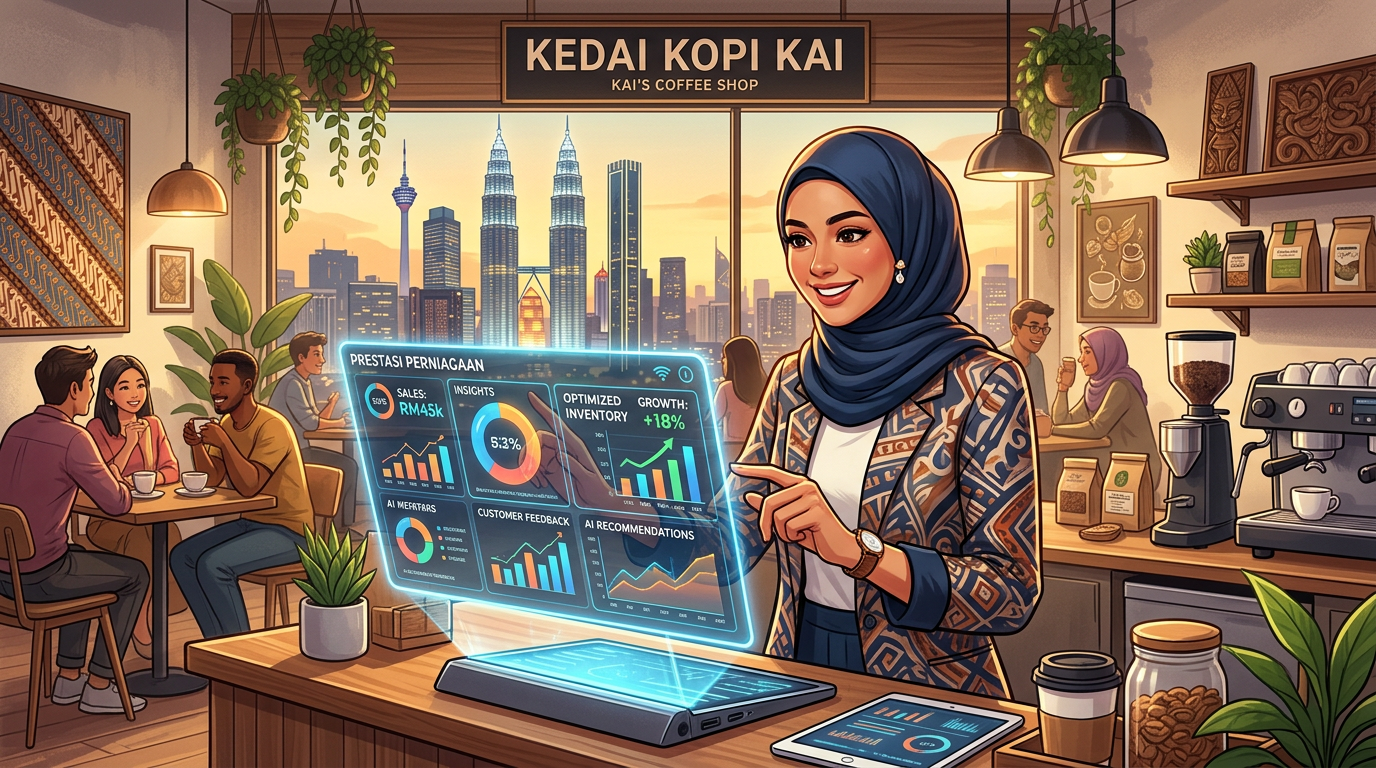
Featured image concept: A warm, modern illustration of a small business storefront with a friendly digital assistant hologram working alongside a human business owner at a desk — conveying partnership between humans and AI in a small business setting.
Schema markup: HowTo, Article, FAQPage (for potential FAQ additions), BreadcrumbList