AI for Tuition Centers in Malaysia: How to Automate Admin, Fill Classes, and Keep Parents Happy
Running a tuition center in Malaysia means wearing too many hats. You are the teacher, the admin, the marketer, and the customer service rep — often all before 9am. AI for tuition centers in Malaysia is changing that picture, giving even one-person operations the tools to handle parent inquiries, chase late fees, and fill up new classes without burning out in the process.
The Reality Behind the Classroom Door
Tuition is one of Malaysia's most resilient industries. The average Malaysian student spends six hours in supplementary tuition per week, according to a 2026 Malay Mail analysis, and parents across the country view after-school classes as a core investment in their children's future. That creates consistent, predictable demand — but it also creates a mountain of admin that most center owners never signed up for.
Consider a typical week. A center owner spends hours answering the same enrollment questions on WhatsApp, manually updating timetables when a teacher calls in sick, sending payment reminders by hand, and chasing parents about outstanding fees. None of this grows the center. It just keeps the lights on.
AI does not eliminate the human side of education. Great teaching, genuine student relationships, and academic progress conversations will always require a person. What AI eliminates is the administrative drag — the repetitive, rules-based work that eats into your most valuable hours.
Malaysia's AI adoption among SMEs reached 12% in 2024, up from just 4% in 2022, and is projected to hit 28-35% by 2026, according to MDEC. Tuition centers represent one of the clearest opportunities in that number — high admin volume, standardised processes, and a parent base already comfortable communicating via WhatsApp.
Five Ways AI Is Already Helping Malaysian Tuition Centers
1. Answering Parent Inquiries Around the Clock
The most common complaint among tuition center owners is the relentless volume of WhatsApp messages. Parents ask about available timeslots, subject combinations, teacher qualifications, and monthly fees — often at 10pm after their children are in bed. If you do not respond within a few hours, many of them move on to a competitor that does.
An AI-powered WhatsApp chatbot can handle these inquiries automatically. You configure a knowledge base that covers your subjects, schedule, fees, and policies, and the AI responds instantly — any time, any day. The chatbot also qualifies leads before passing them on, asking which standard the student is in, which subject they need help with, and what timeslots they prefer. Only serious, qualified inquiries reach you.
Malaysian SMEs using AI-driven customer service report handling 60-80% of routine inquiries without direct staff involvement. For a tuition center owner drowning in messages after school hours, this alone can reclaim two to three hours of personal time every evening.
2. Automating Class Scheduling and Enrollment
Manual timetabling is one of the most error-prone tasks in any service business. Double-bookings, room conflicts, and teacher unavailability create confusion that undermines your professional reputation with parents.
AI-powered appointment booking systems automate the entire enrollment flow. Parents select their preferred timeslot from a live calendar, the system confirms the booking, adds the student to the class roster, and sends a WhatsApp or email reminder 24 hours before the first session. When a class is cancelled or rescheduled, automated notifications go out immediately and offer rebooking options — all without a single manual message from you.
Several Malaysian tuition centers have paired this with a WhatsApp chatbot to create a fully seamless enrollment experience: parent inquires via WhatsApp, AI gathers requirements and checks availability, parent books via a link, confirmation arrives automatically. What previously took three to five manual exchanges now completes in under five minutes.
3. Collecting Fees Without the Awkwardness
Chasing late payments is one of the most uncomfortable parts of running a small education business. Most center owners send one reminder, feel the social tension, and then let the conversation drop — which means revenue leaks quietly out of the business every month.
Automated payment reminder systems eliminate the awkwardness entirely. The system sends polite, personalized messages via WhatsApp or email on a schedule you define: a friendly reminder three days before the fee is due, a confirmation message on the due date, and a follow-up if payment has not been received within five days. The message can include a direct payment link, reducing the gap between reminder and action to a single tap.
Businesses using automated payment reminders consistently report 30-50% reductions in late payments within the first three months of deployment. For a center with 60 students each paying RM250 per month, even a 20% improvement in on-time collection means RM3,000 per month that arrives on schedule rather than trickling in over six weeks.
This is also connected to broader AI customer service automation principles — the same technology that handles inquiries can handle follow-ups and payment chasing without needing a separate tool for each task.
4. Turning Inquiries Into Enrollments
Most tuition centers lose potential students not because of price or teaching quality, but because follow-up is inconsistent. A parent sends an inquiry, receives a reply, and then hears nothing more for two weeks. By that point, they have already enrolled their child elsewhere.
An automated lead nurturing flow fixes this gap. When a parent submits an inquiry through your website or Facebook page, the AI sends an immediate personalised response with information relevant to their specific inquiry — primary school subjects, secondary exam preparation, or online-only classes. If there is no response within 48 hours, the system sends a gentle follow-up. A third touchpoint at the five-day mark closes out the sequence.
AI lead generation and follow-up systems like this are no longer enterprise-only tools. Small tuition centers can configure a complete inquiry-to-enrollment flow using accessible tools at a fraction of what a part-time admin would cost. The result is a consistent, professional experience for every parent — not one that depends on whether you happened to see the message that evening.
5. Creating Marketing Content Without a Marketing Team
Most tuition centers have zero marketing budget and even less time. But parents today vet businesses on social media before making a decision. A center with no online presence looks like a center with nothing to say.
AI content tools can generate a week's worth of social media posts — study tips, upcoming exam reminders, subject explainers, student milestone messages — in under an hour. You review, lightly edit where needed, and schedule the posts. The result is a consistent, visible brand presence that builds parent trust before they ever message you.
This is part of a broader shift in how Malaysian SMBs are using AI content creation to compete online without dedicating headcount to marketing. For a tuition center, the content practically writes itself — the academic calendar gives you a ready-made content plan for every month of the year.
What to Automate First — and What to Keep Human
Not every part of running a tuition center should be automated. Good teaching is irreplaceable. Sensitive conversations with parents about a child who is struggling, or the encouragement a student needs when exams are approaching — those require a human being. AI works best at the operational edges: the touchpoints before a student enrols, the admin that runs in the background after they do, and the routine communication that keeps parents informed between sessions.
A practical prioritisation framework:
Automate these first:
- WhatsApp inquiry responses, especially outside business hours
- Enrollment confirmations and timetable change notifications
- Automated fee reminders with payment links
- Trial class follow-up sequences
- Attendance reminders sent to parents before each session
Keep human:
- Academic progress discussions and report delivery
- Handling complaints or sensitive parent concerns
- Teacher hiring and onboarding decisions
- Curriculum planning and subject selection
Understanding the Cost
AI tools suitable for tuition centers in Malaysia typically cost between RM150 and RM600 per month, depending on the number of students, channels integrated, and complexity of your automation. Many of these qualify for subsidy under the SME Digitalisation Grants available through MDEC and related government programs, which can cover up to 50-80% of qualifying digital tool costs.
The return on that investment tends to materialize quickly. If automation saves you or your staff 10 hours per week on admin tasks, and your time is realistically worth RM60-80 per hour, you are recovering RM2,400-3,200 per month in productive capacity. That is a strong return on a RM300-500 monthly tool subscription. For a structured approach to measuring your AI ROI, you need to track time savings, enrollment conversion rate changes, and late payment improvements together — not just one metric in isolation.
Getting Started: A Four-Week Action Plan
Most tuition center owners know they should be using AI but do not know where to begin. This four-week sequence gets you from zero to running your core automations without needing a technical background.
-
Week 1 — Audit your repetitive tasks — Write down every task you or your staff repeat more than twice a week that does not require judgment or relationship context. Inquiry replies, fee reminders, attendance notifications, schedule change messages, and trial class follow-ups are the usual suspects. These are your automation targets.
-
Week 2 — Deploy a WhatsApp chatbot — Start with the highest-volume channel. Malaysian parents communicate primarily on WhatsApp, so this is where automation delivers the fastest impact. A basic WhatsApp AI chatbot can be configured in a weekend with a clear FAQ document as the knowledge base. Test with a small group of incoming inquiries before going fully live.
-
Week 3 — Automate enrollment and scheduling — Connect your class timetable to an online booking system. Test the full flow with five to ten parents — inquiry, booking, confirmation, reminder — before rolling it out to your full student base. Fix any friction points at this stage.
-
Week 4 — Set up fee reminder automation — Configure WhatsApp or email reminders to trigger automatically based on your payment calendar. Most tools support this natively with no coding required. Add payment links to each reminder to reduce the steps between receiving a reminder and completing payment.
If you want a broader framework for implementing AI automation across your business beyond these four steps, structured implementation guides cover how to sequence changes, manage staff transitions, and avoid the common mistakes that stall automation efforts.
What About AI Replacing Teachers?
Worth addressing directly: AI is not going to replace a good teacher or the relationships that make a tuition center worth attending. Parents choose a center because of trust, academic results, and the learning culture — none of which can be automated. The best tuition centers are built on relationships, and relationships require human presence.
What AI does is remove the operational weight that stops good educators from being great ones. When you are not spending two hours every evening answering the same WhatsApp questions, you have two hours to prepare better lesson materials, support students who are falling behind, or simply rest.
Malaysia's growing AI governance framework also provides important guardrails. Any AI tools handling student or parent personal data must comply with Malaysia's Personal Data Protection Act (PDPA). Reputable AI vendors serving the Malaysian market handle this compliance as a baseline, not an optional extra.
The Bottom Line
The tuition centers that thrive in the next three years will not be the ones with the best teachers alone — they will be the ones that combine great teaching with lean, well-run operations. AI is what makes lean operations achievable for a two- or three-person team without hiring an admin department.
You do not need a technical background or a large budget to get started. You need a clear picture of where your time is going, a willingness to configure a few tools over a couple of weekends, and a clear AI strategy that ties each automation to a specific business outcome.
Malaysian tuition centers have a clear first-mover opportunity right now. Most of your competitors are still manually typing the same WhatsApp message for the hundredth time. The gap between those who automate and those who wait is widening every quarter. Start with one process this week — not everything at once — and build from there.
Internal links used:
- WhatsApp AI Chatbots for Small Business: How Malaysian SMEs Can Automate Sales and Support — used twice
- AI Appointment Booking for Malaysian Service Businesses: How to Automate Scheduling and Cut No-Shows
- AI Customer Service Agents for Malaysian SMBs: How to Cut Support Costs by 30%
- AI Lead Generation for Small Business: How to Build a Pipeline That Fills Itself
- AI Content Creation for Malaysian SMBs: How to Produce a Month of Social Media Posts in One Day
- Malaysia SME Digitalisation Grants in 2026: How to Fund Your AI Transformation
- How to Calculate AI ROI: A Framework for Getting Budget Approved
- How to Implement AI Automation in Your Business: A Practical Step-by-Step Guide
- Malaysia AI Governance 2026: What SMBs Need to Know Before the Rules Get Teeth
- Why Your Small Business Needs an AI Strategy Before Another AI Tool
Total internal links: 10 (one used twice = 11 link placements)
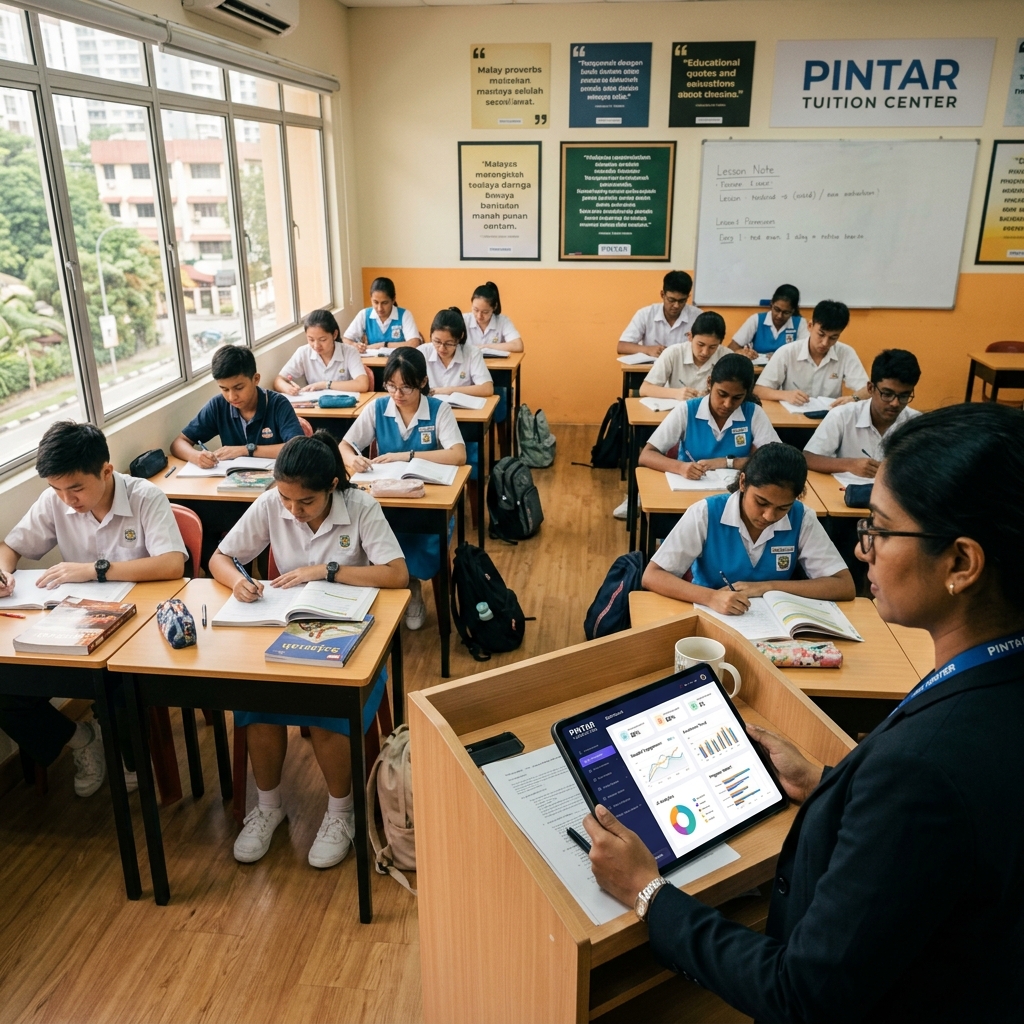
Featured image concept: A warmly lit Malaysian tuition center classroom — rows of students working at desks, textbooks open — with the center owner or teacher at the front using a tablet or laptop, reviewing an AI dashboard while students study independently. Natural daylight, organized and human-feeling space. Conveys productivity without sterility.
Schema markup: Article, HowTo (for the four-week action plan section), FAQPage (common questions about AI and teacher replacement, cost, PDPA compliance)