WhatsApp AI Chatbots for Small Business: How Malaysian SMEs Can Automate Sales and Support
Malaysia has over 24 million WhatsApp users — more than 80% of all smartphone owners in the country. If you run a small business here, your customers are already on WhatsApp. The question is whether you are making them wait for replies or letting an AI chatbot handle the heavy lifting around the clock.
WhatsApp AI chatbots have moved from novelty to necessity for Malaysian SMEs in 2026. With the government's RM1.5 billion digitalisation push and new tax incentives for automation, there has never been a better time to put your customer communication on autopilot.
Why WhatsApp Matters More Than Any Other Channel for Malaysian SMEs
Most small business owners in Malaysia already use WhatsApp informally — responding to customer inquiries between tasks, forwarding catalogue photos, and confirming orders through voice notes. The problem is that this manual approach does not scale.
Consider the numbers. A single business owner handling WhatsApp manually can manage roughly 20-30 conversations per day before response times start slipping. An AI chatbot running on WhatsApp handles hundreds of simultaneous conversations without breaking a sweat — and responds in under two seconds.
According to recent industry data, 58% of Malaysian consumers already use AI tools in their shopping journeys, and 57% purchase directly through social platforms. Your customers expect instant responses. When they message your business at 11pm asking about product availability, they expect an answer — not a "we'll get back to you during office hours" auto-reply.
WhatsApp vs Email vs Social Media: Where Malaysian Customers Actually Are
Malaysians overwhelmingly prefer messaging over calls or emails. WhatsApp's penetration rate in Malaysia dwarfs every other communication channel for business. While email open rates hover around 20-25% and social media organic reach keeps declining, WhatsApp messages achieve a 98% open rate and 45-60% click-through rate.
For small businesses competing against larger players with bigger marketing budgets, this is a significant advantage. A well-configured WhatsApp AI chatbot puts you on equal footing with enterprises that spend millions on customer service infrastructure.
What a WhatsApp AI Chatbot Actually Does for Your Business
A WhatsApp AI chatbot is not the clunky, menu-driven bot you might remember from a few years ago. Modern AI agents powered by large language models can understand natural language, remember context within a conversation, and handle complex multi-step interactions.
Here is what that looks like in practice for a typical Malaysian SME:
Automated Customer Support (24/7)
- FAQ handling — Business hours, location, parking, return policies, warranty information. Your chatbot answers these instantly instead of you typing the same response for the hundredth time.
- Order tracking — Customers type their order number and get real-time status updates pulled from your system.
- Appointment scheduling — The bot checks your calendar, offers available slots, and confirms bookings without human intervention.
- Multilingual support — The best WhatsApp AI chatbots detect whether your customer is writing in Bahasa Malaysia, English, or Mandarin and respond accordingly. This is critical in Malaysia's multicultural market.
Sales Automation
- Product recommendations — Based on what a customer asks about, the AI suggests relevant products from your catalogue.
- Lead qualification — The chatbot asks qualifying questions and routes hot leads to your sales team while nurturing cold leads automatically.
- Cart recovery — When a customer abandons a purchase, the bot follows up with a personalised reminder.
- Payment links — Send payment links directly in the chat so customers can complete purchases without leaving WhatsApp.
After-Sales and Retention
- Review requests — Automatically ask satisfied customers for Google reviews after delivery.
- Loyalty updates — Notify repeat customers about exclusive deals or new arrivals.
- Feedback collection — Run quick satisfaction surveys that feel like casual conversations, not corporate forms.
Industry data shows that businesses using WhatsApp chatbots see a 28% lead conversion rate and generate up to five times more leads than traditional marketing channels. The cost per interaction drops from RM25-100 (human agent) to RM2-8 (AI chatbot) — a reduction that matters when you are operating on tight margins.
The ROI Numbers That Matter
Before investing in any AI tool for your business, you need to understand the return. Here is what the data shows for WhatsApp AI chatbots specifically:
- $8 return for every $1 invested — The average ROI across businesses deploying chatbots.
- 340% first-year ROI — With leading implementations hitting 533% within nine months.
- 30-50% reduction in support costs — By automating routine inquiries that make up 60-80% of all customer messages.
- 8-12 hours saved per week — Time your team can redirect to high-value activities like closing deals and building relationships.
- 40% faster response times — Compared to manual WhatsApp handling.
For a Malaysian SME spending RM3,000-5,000 per month on a customer service team member, automating even half of routine inquiries with a RM200-500/month chatbot solution represents significant savings. Factor in the revenue from leads that would otherwise go unanswered outside business hours, and the case becomes even stronger.
You can learn more about measuring these returns in our guide on how to calculate AI ROI.
How to Set Up a WhatsApp AI Chatbot: Two Paths
There are two distinct approaches, and choosing the right one depends on your business size, message volume, and budget.
Path 1: WhatsApp Business App (Free, Basic Automation)
Best for: Solo entrepreneurs and micro-businesses handling fewer than 50 conversations per day.
What you get: The WhatsApp Business App is free and includes basic automation features — welcome messages, away messages, and quick replies. This is not true AI, but it handles the basics.
Setup steps:
- Download the WhatsApp Business App from Google Play or the App Store. Sign up with your business phone number.
- Complete your business profile — Add your business name, address, description, hours, website, and catalogue. A complete profile builds trust.
- Set up a welcome message — Go to Settings > Business Tools > Welcome Message. Write something that greets the customer, tells them what you can help with, and sets response time expectations.
- Configure away messages — These auto-send when you are unavailable, so customers know when to expect a reply.
- Create quick replies — Pre-written responses to common questions. Type "/" to access them during conversations.
- Build your product catalogue — Upload product photos, descriptions, and prices directly in the app so customers can browse without leaving WhatsApp.
Limitations: No AI understanding, no multi-agent access, no CRM integration, and a hard cap on broadcast lists. Once you consistently handle more than 50 conversations daily, you will hit a wall.
Path 2: WhatsApp Business API with AI (Paid, Full Automation)
Best for: Growing SMEs handling 50+ conversations daily who want genuine AI-powered automation.
What you get: A real AI agent that understands natural language, learns from your business data, and handles complex conversations autonomously.
Setup steps:
- Choose a Business Solution Provider (BSP) — You cannot access the WhatsApp API directly. You need a BSP. Top options for Malaysian businesses include:
- WATI — From $49/month. Strong in Southeast Asian markets with ChatGPT integration.
- Respond.io — Malaysia-based. Omnichannel messaging across WhatsApp, Messenger, Telegram from one dashboard.
- SleekFlow — Advanced AI with precise data extraction. Good for e-commerce.
- Wabot — Local Malaysian platform with sales-focused AI features.
- Verify your business with Meta — Submit your business documents through your BSP. This typically takes 2-7 business days.
- Train your AI on your business data — Upload your FAQ document, product catalogue, pricing, policies, and any standard operating procedures. The better your training data, the better your bot performs.
- Design conversation flows — Map out the most common customer journeys. Most platforms offer visual flow builders — no coding required.
- Set up human handoff rules — Define when the AI should escalate to a human agent. Complex complaints, high-value deals, and angry customers should always route to a person.
- Test extensively — Send test messages in Bahasa Malaysia, English, and other languages your customers use. Verify product recommendations, booking flows, and payment links work correctly.
- Launch with a soft rollout — Start with a subset of customers, monitor conversations, and refine before going fully live.
The complete setup typically takes 1-2 weeks for a basic implementation and up to a month for complex integrations with existing CRM or e-commerce systems.
Malaysia-Specific Advantages and Incentives
Malaysian SMEs have several tailwinds making 2026 the right year to adopt WhatsApp AI chatbots.
Government Tax Incentives
Budget 2026 introduced a 50% additional tax deduction for SMEs on AI and cybersecurity training programs. The new Outcome-Based Incentive Framework also offers targeted tax incentives for businesses that adopt automation and digitalisation practices. If you are investing in a WhatsApp AI chatbot, you may qualify for these deductions.
The RM1.5 Billion Digitalisation Push
The Business Digitalisation Initiative (BDI) from MDEC provides MSMEs with access to digital solutions, financing opportunities, and expert guidance. WhatsApp AI chatbot solutions fall squarely within this initiative's scope.
E-Invoicing Compliance Synergy
With LHDN's e-invoicing mandate now in Phase 4 for businesses with RM1-5 million turnover, Malaysian SMEs are already investing in digital infrastructure. Adding a WhatsApp AI chatbot to your digital stack while you are upgrading systems makes practical sense — you are already in "digital transformation mode."
Local Platform Ecosystem
Malaysia has a growing ecosystem of WhatsApp AI chatbot providers who understand the local market. Companies like Respond.io (headquartered in Malaysia), Wabot, and AI WhatsApp Malaysia offer solutions tailored to local business needs, payment systems, and multilingual requirements.
Common Mistakes to Avoid
Implementing a WhatsApp AI chatbot is straightforward, but these mistakes can undermine your results:
Not Training the Bot on Your Actual Business Data
A generic chatbot that cannot answer questions about your specific products, prices, or policies will frustrate customers more than no chatbot at all. Invest time upfront in feeding your bot accurate, comprehensive information about your business.
Hiding the Human Handoff Option
Customers should always be able to reach a human agent. The businesses that get the best results from AI chatbots are those that use AI and human agents together — let the AI handle volume and routine tasks while humans handle empathy and complexity.
Ignoring Multilingual Needs
In Malaysia, your chatbot must handle at least Bahasa Malaysia and English fluently. Mandarin support is a strong advantage, especially if you serve Chinese-Malaysian customers. Test your bot in all relevant languages before launch.
Setting and Forgetting
Your chatbot needs regular updates. Product changes, pricing updates, new policies, and seasonal promotions all need to be reflected in your bot's knowledge base. Schedule a monthly review to keep your bot current.
Over-Automating Sensitive Interactions
Complaints, refund disputes, and complex product issues should route to humans. An AI bot trying to handle an angry customer often makes things worse. Define clear escalation triggers in your AI strategy.
Getting Started This Week: Your 5-Step Action Plan
You do not need to overhaul your entire business to start. Here is a practical plan you can execute this week:
- Audit your current WhatsApp usage — Count how many customer messages you receive daily. Note the top 10 most common questions. Calculate how much time you spend responding manually.
- Choose your path — If you handle fewer than 50 conversations daily, start with the free WhatsApp Business App. If more, evaluate BSPs like WATI, Respond.io, or SleekFlow.
- Prepare your training data — Write out answers to your top 20 FAQs. Compile your product catalogue, pricing, and policies into a single document.
- Set up and test — Configure your chosen solution. Test with friends or team members before going live.
- Measure and iterate — Track response times, customer satisfaction, and conversion rates. Compare against your pre-chatbot baseline after 30 days.
If you want a more comprehensive approach to implementing AI automation in your business, including how WhatsApp AI fits into a broader digital strategy, our step-by-step guide covers the full picture.
The Bottom Line
WhatsApp AI chatbots are not a future technology for Malaysian small businesses — they are a present-day competitive advantage. With 24 million users on the platform, government incentives covering part of your investment, and solutions starting from under RM100 per month, the barrier to entry has never been lower.
The SMEs that will thrive in Malaysia's digital economy are the ones that meet customers where they already are — on WhatsApp — and respond instantly, accurately, and in the customer's preferred language, around the clock. Whether you start with the free Business App today or invest in a full AI-powered solution this month, the key is to start. Every day you respond to the same FAQ manually is a day your competitor's chatbot is closing a sale at midnight.
Internal links used:
- AI chatbot — "AI chatbot"
- AI agents — "AI agents"
- AI tool for your business — "AI tool for your business"
- how to calculate AI ROI — "how to calculate AI ROI"
- AI agent — "AI agent"
- AI and human agents together — "AI and human agents together"
- AI strategy — "AI strategy"
- implementing AI automation in your business — "implementing AI automation in your business"
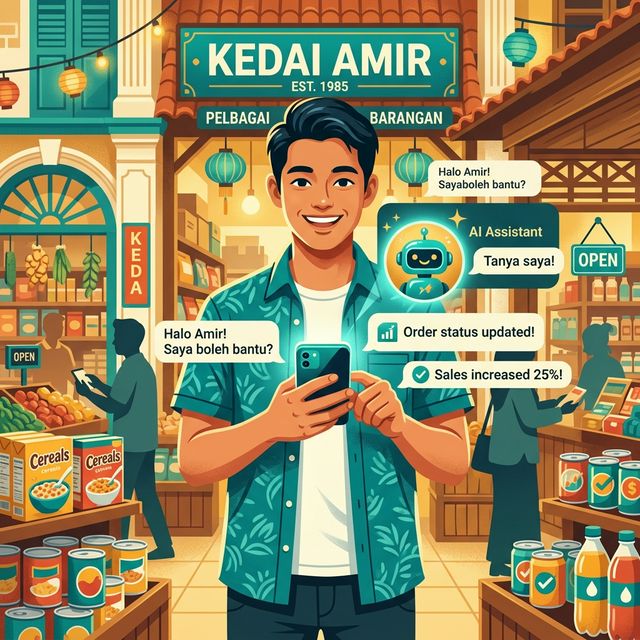
Featured image concept: A warm, modern illustration of a Malaysian small business owner (wearing casual business attire) smiling at their phone screen showing WhatsApp chat bubbles with an AI assistant icon, with a bustling Malaysian shophouse or kedai in the background. Warm golden tones, contemporary flat design style.
Schema markup: Article, HowTo, FAQPage