AI for Hotels in Malaysia: How to Win the Visit Malaysia 2026 Tourism Surge
Malaysia is expecting 47 million tourists this year. That is the official target for Visit Malaysia Year 2026 (VMY 2026) — a nationwide campaign backed by RM147.1 billion in projected tourism receipts. For small hotels, guesthouses, tour operators, and travel agencies across the country, this is the biggest revenue window in years. The question is whether your business is positioned to capture it. AI for hotels in Malaysia has moved from a nice-to-have to the clearest competitive edge available to independent operators right now.
The Opportunity Gap Most Malaysian Hotels Are Missing
The momentum is already here. Malaysia recorded 38 million visitor arrivals in 2024 — a 31.1% increase over 2023 that exceeded pre-pandemic levels by 8.3%. In March 2026, Malaysia was formally recognised as ASEAN's leading tourism market, with rising retail spend and premium travel demand. In the same month, the VMY 2026 campaign also targets 261 million domestic visitors contributing RM115.2 billion to the economy.
That growth should benefit small operators directly. Instead, most of the upside flows to OTA platforms like Booking.com, Agoda, and Airbnb — which charge commissions of 15–25% per booking. A small 20-room guesthouse doing RM600,000 in annual revenue could be paying RM90,000–150,000 per year in OTA fees alone.
The second problem is speed. International travellers — particularly from China, Singapore, Indonesia, and the Middle East — expect fast responses to booking inquiries. Most small hotel operations respond within hours, not minutes, especially outside business hours. Research consistently shows that leads contacted within five minutes convert at a significantly higher rate than those followed up an hour later. Every unanswered 11 PM inquiry is a booking that goes to the competitor with a chatbot.
These are precisely the problems AI solves.
5 AI Applications That Actually Move the Needle for Malaysian Hotels
1. AI Chatbots for 24/7 Guest Inquiries
The highest-ROI starting point for any hospitality business is an AI chatbot that handles guest inquiries around the clock. A well-configured chatbot manages room availability checks, pricing questions, local recommendations, check-in instructions, and booking confirmations — simultaneously, in multiple languages.
Hotels that deploy AI chatbots report that median response time drops from around 10 minutes to under one minute. One property reduced front desk call volume by 30% after deployment. Conversion rates on direct booking inquiries increase by 20–35% compared to static web forms or unanswered calls, according to industry benchmarks.
For Malaysian operators, the multilingual capability is particularly important. A properly trained AI chatbot responds fluently in English, Bahasa Malaysia, Mandarin, and Arabic — covering the majority of Malaysia's international visitor sources without additional headcount. The same scheduling automation logic described in AI Appointment Booking for Malaysian Service Businesses: How to Automate Scheduling and Cut No-Shows applies directly to hospitality: automatic confirmations, reminders, and follow-ups reduce no-shows the same way they do in service businesses.
2. AI-Powered Direct Booking Agents
Every direct booking you capture instead of an OTA booking saves you 15–25% in commission. An AI direct booking agent on your website or WhatsApp handles the full inquiry-to-confirmation flow without human intervention — while making it as seamless as booking through Agoda.
Research from Phocuswright shows that hotels using AI-powered direct booking tools achieve an average 15–20% uplift in direct booking revenue. If an AI agent converts just two or three additional direct bookings per week that would otherwise go to an OTA, the commission savings typically cover the tool's cost three to five times over.
This connects directly to the WhatsApp channel that most Malaysian hotels already use informally. A WhatsApp AI chatbot for your business converts those informal WhatsApp inquiries into structured, confirmed bookings — with payment links, confirmation messages, and reminders built in automatically.
3. AI for Social Media and Content Marketing
VMY 2026 is a content marketing opportunity that most small operators are underutilising. Every government campaign milestone, seasonal event, cultural festival, and travel trend is a chance to reach international travellers actively researching Malaysia.
Most independent hotels post inconsistently because producing content is time-consuming. AI content tools can generate a full month of captions, short-form video scripts, hashtag sets, and blog posts in a fraction of the time it takes manually. The AI Content Creation for Malaysian SMBs: How to Produce a Month of Social Media Posts in One Day workflow applies directly to hospitality businesses.
For hotels and guesthouses, the visual content angle is strong — property photos, local experiences, food, and culture perform well on Instagram, TikTok, and Xiaohongshu, which has become a key channel for attracting Chinese tourists. An AI content workflow keeps you visible on these platforms without hiring a full-time social media manager.
4. AI for Operational Efficiency
Behind the front desk, AI creates meaningful cost savings and service consistency improvements.
Housekeeping scheduling can be optimised using actual check-in and check-out data, reducing overtime and eliminating unnecessary room cleans. BCG's 2026 research on AI-first hotels found that properties implementing AI for operations achieve housekeeping efficiency improvements of 15–20% within the first quarter.
Dynamic pricing tools use real-time demand signals — local events, school holidays, competitor rates, and weather — to adjust room rates automatically. This was previously the domain of expensive revenue management consultants. AI brings that capability to a 10-room guesthouse at a fraction of the cost.
Maintenance and staff scheduling can both be partially automated, reducing the administrative load on owner-operators who typically handle everything themselves.
5. AI for Guest Personalisation and Upselling
The highest-margin revenue in hospitality is rarely the base room rate — it is everything around it. Room upgrades, airport transfers, local tours, F&B packages, and late checkout options can add 20–40% to average guest spend when offered at the right moment.
AI tools identify upsell opportunities from booking data and automatically send personalised offers at optimal times: upgrade offers the day before check-in, activity packages for long-stay guests, late checkout prompts on departure morning. This works through email, WhatsApp, or SMS, whichever channel each guest prefers.
The AI customer service infrastructure described in AI Customer Service Agents for Malaysian SMBs: How to Cut Support Costs by 30% doubles as a revenue engine when configured for upselling. The same agent that handles complaints and requests can proactively surface the right offer at the right time.
What the Numbers Actually Look Like
For a small Malaysian hotel or guesthouse, the math is straightforward.
A direct booking chatbot that converts three additional bookings per week at an average room rate of RM350 per night for a two-night stay generates approximately RM109,200 in additional annual revenue — before accounting for the 15–25% commission saving on each of those bookings. A 150-room property implementing AI across chatbot, direct booking, and dynamic pricing can realistically project RM180,000 in additional annual revenue from direct bookings, plus RM75,000 in customer service cost savings, based on 2026 hotel technology benchmarks.
Payback on most small hotel AI implementations is two to three months. Use the How to Calculate AI ROI: A Framework for Getting Budget Approved framework to model the numbers for your specific property before committing to any tool.
Your 5-Step AI Roadmap for VMY 2026
1. Audit your current booking mix — Calculate what percentage of bookings arrive via OTAs versus direct channels. This baseline tells you exactly how much commission you are paying and sets the revenue target for your direct booking initiative.
2. Deploy a website chatbot — This is the highest-ROI starting point. A properly configured AI chatbot on your website captures after-hours inquiries, handles FAQs, and drives direct bookings. The AI Chatbots for Small Business Websites: The Complete Guide covers setup options suitable for operators without a technical background.
3. Activate WhatsApp as a booking channel — Malaysian travellers are comfortable booking over WhatsApp. Automating the inquiry-to-confirmation workflow with an AI agent ensures no inquiry goes unanswered, even at midnight.
4. Build a consistent content engine — Set up an AI-assisted social media workflow targeting two to three posts per week across Instagram and TikTok. For Chinese tourist acquisition, add Xiaohongshu. This is a medium-term investment that compounds into organic traffic throughout the VMY 2026 campaign period.
5. Add dynamic pricing — Once your direct booking engine is running, layer in a dynamic pricing tool to maximise RevPAR during peak demand periods — public holidays, school breaks, VMY campaign milestones, and local events.
For a full step-by-step framework on rolling out AI automation across your business, read How to Implement AI Automation in Your Business: A Practical Step-by-Step Guide.
Government Support Available Right Now
Malaysian hospitality SMEs can significantly reduce AI implementation costs through existing government programmes.
The Malaysia Digital Catalyst Grant provides up to RM1 million for eligible SMEs running AI pilots. The Domestic Investment Accelerator Fund (DIAF) supports Malaysian-owned SMEs and mid-tier companies on technology and sustainability projects. Investment Tax Allowances (ITA) and Pioneer Status incentives are available for hotel modernisation and expansion projects.
On April 2, 2026 — just one week ago — MyDIGITAL Corporation and Oracle formalised a partnership to train 300,000 tourism industry professionals in AI, advanced data science, and Oracle Cloud Infrastructure over the next three years. The national infrastructure for AI-enabled Malaysian tourism is not a future promise. It is being built right now.
The Malaysia SME Digitalisation Grants in 2026: How to Fund Your AI Transformation post covers the full list of available programmes, eligibility criteria, and application steps. If you are a hotel or tourism operator, this should be required reading before you spend a single ringgit of your own capital on AI tools.
The Bottom Line
Visit Malaysia Year 2026 is a once-in-a-generation tourism surge — 47 million arrivals targeted, RM147.1 billion in projected receipts, and the government committed to making it happen. The businesses that capture a disproportionate share of that traffic will not be the ones with the largest advertising budgets. They will be the ones that respond fastest, book most frictionlessly, personalise most effectively, and retain guests most reliably.
AI is how independent Malaysian hotels and tourism operators compete with the larger chains. Not because it is fashionable, but because it directly addresses the operational gaps — slow response times, OTA commission drain, inconsistent service, missed upsells — that are costing small operators real money today.
The tools are accessible. The government support is in place. The tourists are already arriving. If you are ready to start, the AI Agents for Small Business: How to Build Your First Digital Workforce in 2026 guide is the right next step.
Internal links used:
- AI Appointment Booking for Malaysian Service Businesses: How to Automate Scheduling and Cut No-Shows — scheduling automation parallels
- WhatsApp AI Chatbots for Small Business: How Malaysian SMEs Can Automate Sales and Support — direct booking via WhatsApp
- AI Content Creation for Malaysian SMBs: How to Produce a Month of Social Media Posts in One Day — content marketing workflow
- AI Customer Service Agents for Malaysian SMBs: How to Cut Support Costs by 30% — guest service and upselling
- How to Calculate AI ROI: A Framework for Getting Budget Approved — ROI modelling
- AI Chatbots for Small Business Websites: The Complete Guide — website chatbot setup
- How to Implement AI Automation in Your Business: A Practical Step-by-Step Guide — full implementation roadmap
- Malaysia SME Digitalisation Grants in 2026: How to Fund Your AI Transformation — government funding
- AI Agents for Small Business: How to Build Your First Digital Workforce in 2026 — getting started with AI
Total internal links: 9
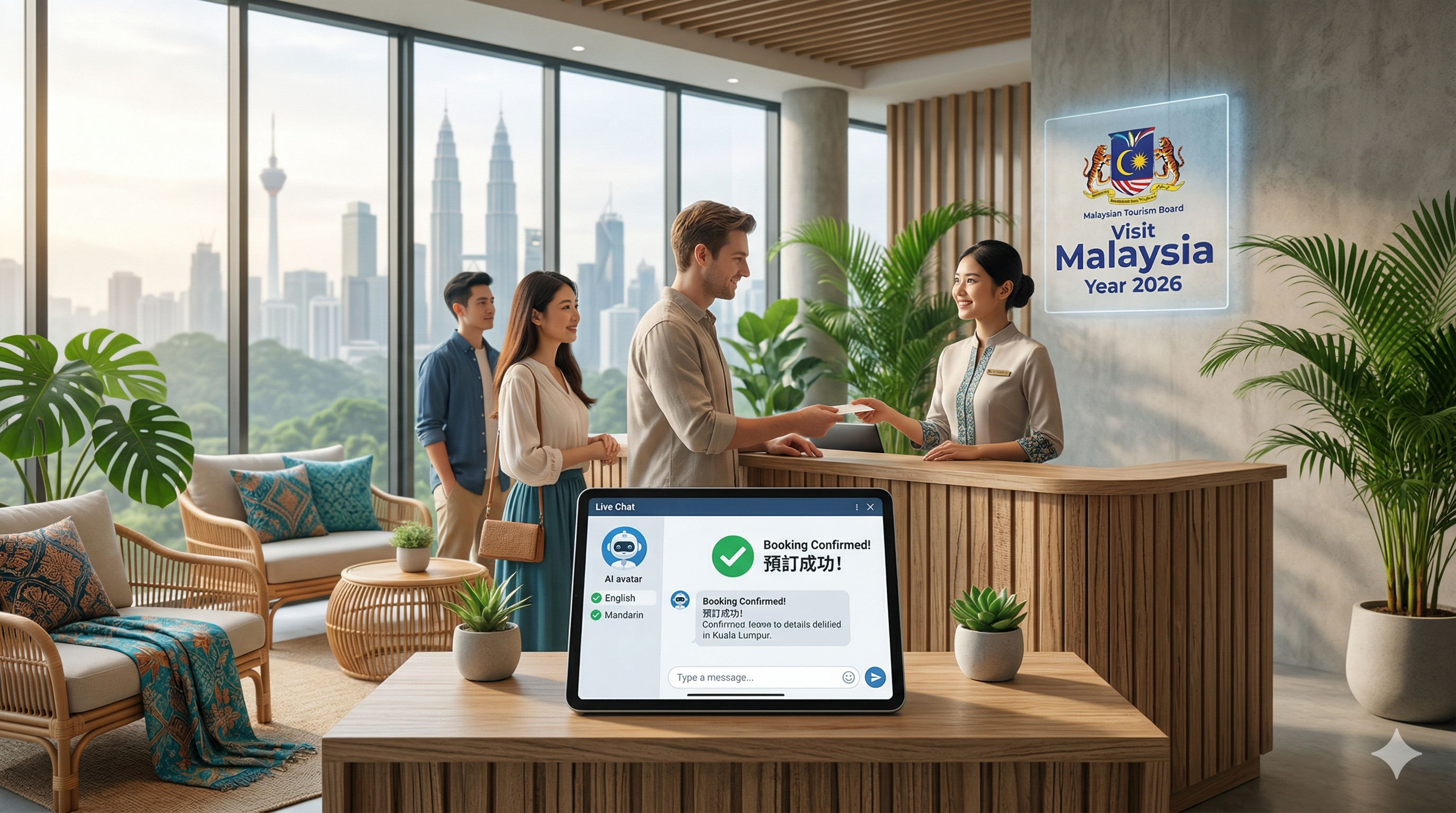
Featured image concept: A warmly lit boutique hotel lobby in Malaysia — rattan furniture, tropical plants, and batik accent pieces — with a front desk tablet displaying a live chat booking confirmation in English and Mandarin. The scene feels distinctly Malaysian but modern, suggesting seamless AI integration into a welcoming, independent hospitality setting.
Schema markup: Article, HowTo (for the 5-step roadmap section), FAQPage (recommended addition), LocalBusiness