Primary Keyword: AI agents vs chatbots Secondary Keywords: agentic AI, AI chatbot differences, AI agents for business, autonomous AI tools Meta Title: AI Agents vs AI Chatbots: Key Differences Explained (2026) Meta Description: Learn how AI agents differ from AI chatbots, what each can do, and which one fits your business needs. Clear comparison with real examples. Suggested URL Slug: ai-agents-vs-ai-chatbots Target Word Count: 1,800–2,200 Suggested Schema Markup: Article, FAQ
AI Agents vs AI Chatbots: What's the Difference and Why It Matters
Every software company is racing to slap the word "agent" onto their product. What used to be a chatbot is now, apparently, an AI agent. But the distinction between AI agents and AI chatbots is real, and it has serious implications for how you spend money, build workflows, and set expectations across your team.
Gartner projects that 40% of enterprise applications will use task-specific AI agents by the end of 2026, up from less than 5% in 2025. That kind of growth means you'll encounter both categories constantly. Understanding where one ends and the other begins will save you from buying the wrong tool — or expecting too much from the right one.
What Is an AI Chatbot?
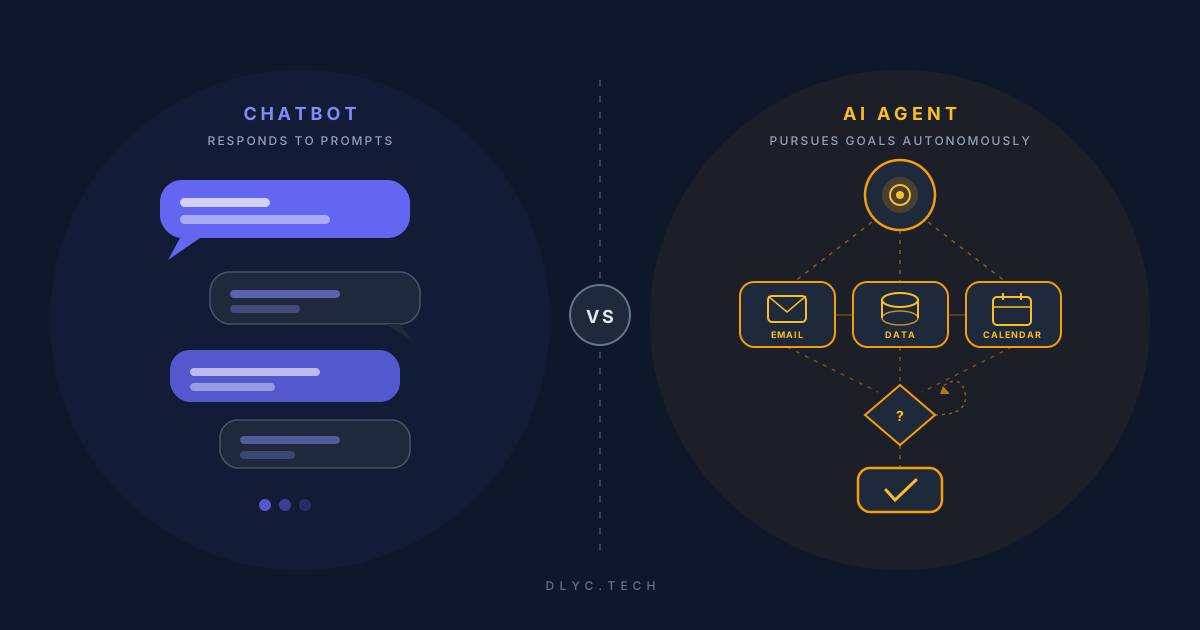
An AI chatbot is a conversational interface designed to respond to questions, follow instructions, and generate text based on prompts. Modern chatbots powered by large language models (LLMs) like GPT-4, Claude, and Gemini are remarkably capable, but they share a fundamental trait: they respond. They don't act.
A chatbot waits for your input, processes it, and returns an output. That's the full cycle. It doesn't go off on its own to complete a multi-step project, check back with you halfway through, or decide which tool to use for a particular subtask. Every exchange is a single turn — you ask, it answers.
Common chatbot use cases include:
- Customer support — answering FAQs, troubleshooting common issues, routing tickets to the right department
- Content generation — drafting emails, blog posts, social media copy, and product descriptions
- Research assistance — summarizing documents, explaining concepts, comparing options
- Internal Q&A — helping employees find information in company knowledge bases
Chatbots excel when the task has a clear input and a clear output with nothing ambiguous in between.
What Is an AI Agent?
An AI agent is a system that can independently plan, execute, and adjust multi-step tasks with minimal human input. Where a chatbot responds to a single prompt, an agent receives a goal and figures out how to achieve it.
The critical difference is autonomy. An AI agent can break a complex objective into subtasks, decide which tools to use for each step, execute those steps in sequence, evaluate whether the results meet the goal, and adjust its approach if something goes wrong.
For example, if you tell a chatbot "find me three suppliers for custom packaging under $2 per unit," it might suggest where to look. If you give that same goal to an AI agent connected to the right tools, it could search supplier databases, compare pricing, check minimum order quantities, and return a shortlist with a recommendation — all without you intervening between steps.
Key characteristics of AI agents include:
- Goal-oriented behavior — they work toward an outcome, not just a response
- Tool use — they can interact with APIs, databases, browsers, email, and other software
- Multi-step reasoning — they plan sequences of actions and execute them
- Self-correction — they can recognize when something failed and try a different approach
- Memory across steps — they retain context throughout a workflow, not just within a single conversation turn
A Side-by-Side Comparison
| Feature | AI Chatbot | AI Agent |
|---|---|---|
| Input | Single prompt or question | Goal or objective |
| Output | Text response | Completed task or deliverable |
| Autonomy | None — waits for each instruction | High — plans and executes independently |
| Tool access | Limited or none | Connects to multiple tools and systems |
| Error handling | Returns an answer (may be wrong) | Detects failures and retries or adjusts |
| Memory | Within conversation only | Across steps and sometimes across sessions |
| Best for | Q&A, content, conversation | Workflows, automation, complex research |
Where Each One Actually Excels
When a Chatbot Is the Right Choice
Not everything needs an autonomous agent. Chatbots are faster, cheaper, and simpler to deploy for tasks that fit a request-response pattern. If your customer service team needs to deflect common questions, a well-configured chatbot with access to your help docs will handle 60–80% of inbound tickets without the complexity of an agentic system.
Chatbots also shine for creative and collaborative work where you want to stay in the loop. Writing a blog post, brainstorming campaign ideas, or drafting a proposal are all tasks where human judgment at every step is the point, not a limitation.
When You Need an Agent
Agents earn their keep on tasks that involve multiple steps, multiple tools, and a clear definition of "done." Think of processes you currently handle with a checklist or a standard operating procedure — those are strong candidates for agentic AI.
Real-world examples include: scheduling a meeting by checking calendars across three people, finding a time that works, drafting the invite, and sending it. Or monitoring a competitor's pricing page daily, flagging changes, and updating a shared spreadsheet. Or processing incoming invoices by extracting key data, matching it to purchase orders, flagging discrepancies, and routing approvals.
Each of these involves multiple systems, conditional logic, and a result that's more than text on a screen.
The Risks You Should Know About
The excitement around AI agents is warranted, but the technology is not mature. Research from both Anthropic and Carnegie Mellon has found that AI agents still make too many errors for high-stakes, unsupervised business processes. Prompt injection attacks — where malicious inputs trick an agent into taking unintended actions — remain a real cybersecurity concern.
MIT Sloan's 2026 AI predictions placed agentic AI squarely in the "overhyped" category, noting that agents are heading toward what Gartner calls the "trough of disillusionment." That doesn't mean they're useless. It means the gap between marketing claims and real-world reliability is still wide.
Practical advice: start agents on low-risk, internal workflows where a mistake costs time, not money or customer trust. Keep humans in the loop for anything involving financial transactions, customer communications, or data that feeds into critical decisions.
How to Decide What Your Business Needs
Before you evaluate specific products, answer three questions:
-
Is the task conversational or procedural? If someone on your team currently handles it through back-and-forth conversation (like answering customer questions), a chatbot fits. If they follow a repeatable process with defined steps, an agent is worth exploring.
-
How many tools are involved? If the task lives entirely within one platform — like answering questions from a knowledge base — a chatbot is sufficient. If it requires pulling data from a CRM, updating a spreadsheet, and sending an email, you need an agent that can connect to those systems.
-
What's the cost of a mistake? For tasks where errors are easily caught and corrected (drafting an internal email), a chatbot with light oversight works well. For tasks where an uncaught error creates real damage (sending the wrong invoice to a client), you want human checkpoints regardless of which tool you use.
What's Coming Next
The line between chatbots and agents is blurring fast. Most major AI platforms are adding agentic capabilities to their chatbot products. OpenAI, Anthropic, and Google are all building frameworks that let conversational AI tools take actions, use tools, and maintain persistent memory.
By late 2026, the distinction may matter less as a product category and more as a capability spectrum. The question won't be "do I need a chatbot or an agent?" but rather "how much autonomy should I give this AI for this specific task?"
For now, the smartest approach is to use chatbots where you want human collaboration and agents where you want human delegation — and keep a close eye on the error rates of both.
The Bottom Line
AI chatbots and AI agents solve fundamentally different problems. Chatbots are conversational partners that help you think and create. Agents are autonomous workers that help you execute and automate. Conflating them leads to either overspending on capabilities you don't need or underestimating what's possible with the right setup.
Start by auditing your team's most repetitive, multi-step workflows. Those are your agent candidates. Everything else — the creative work, the strategic thinking, the customer conversations that require nuance — that's where chatbots still deliver the most value.
Suggested Internal Links:
- What Are AI Agents? — link from the "What Is an AI Agent?" section
- What Is Agentic AI? — link when first mentioning "agentic" capabilities
- What Is Multi-Agent AI? — link from the "What's Coming Next" section when discussing expanding agent ecosystems
- AI Agents in Enterprise — link from the Gartner stat about 40% enterprise adoption
- How to Implement AI Automation in Your Business — link from the "How to Decide What Your Business Needs" section
- What Is RAG? — link when discussing chatbots accessing knowledge bases
Suggested External Links:
Featured Image Concept: A clean split-screen illustration — on the left, a simple chat bubble interface representing a chatbot; on the right, a flowchart with interconnected nodes and tool icons (calendar, database, email) representing an AI agent. Minimal color palette, modern flat design.
FAQ Section (Optimized for Featured Snippets)
What is the main difference between an AI agent and an AI chatbot? An AI chatbot responds to individual prompts with text-based answers. An AI agent independently plans, executes, and adjusts multi-step tasks using multiple tools to achieve a defined goal.
Are AI agents better than chatbots? Neither is universally better. Chatbots excel at conversational tasks like answering questions and generating content. Agents are better suited for repeatable, multi-step workflows that involve multiple tools and systems.
Can a chatbot become an AI agent? Major AI platforms are adding agentic features to chatbot products, including tool use, memory, and multi-step planning. Over time, many chatbots will gain agent-like capabilities that users can enable for specific tasks.
Are AI agents safe to use for business? AI agents can be effective for low-risk internal workflows, but they still have notable error rates and cybersecurity vulnerabilities like prompt injection. Human oversight remains essential for any process involving financial data, customer communications, or critical decisions.