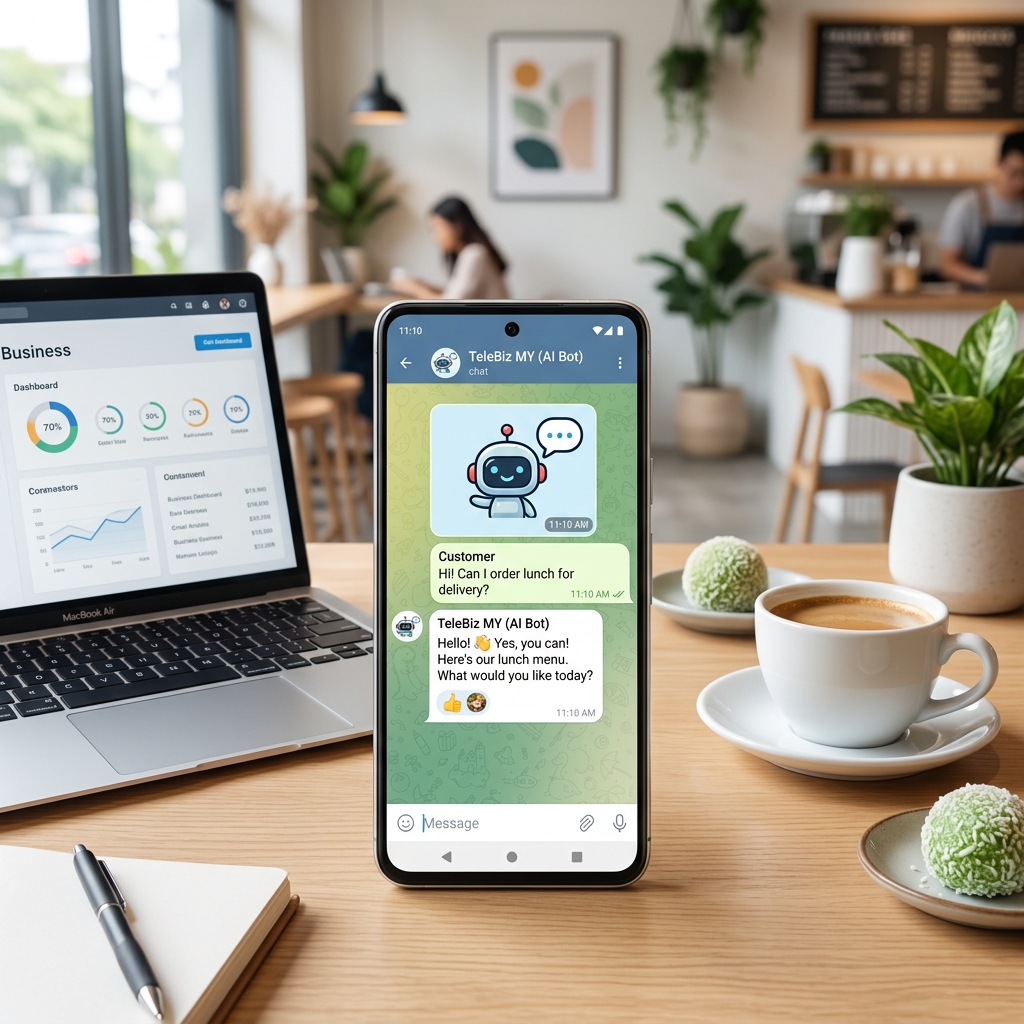
Telegram AI Chatbots for Malaysian Businesses: The Channel Your Competitors Haven't Cracked Yet
Most Malaysian business owners have WhatsApp sorted. A decent chatbot, auto-replies, maybe a broadcast list. But Telegram? The typical approach is to set up a channel, post a few promotions, get a handful of subscribers, and quietly give up when nothing converts. This guide covers why that approach misses the point entirely — and how a Telegram AI chatbot can become your most efficient sales and support channel.
Why Telegram Deserves a Serious Look for Malaysian Businesses
The numbers are harder to ignore than most business owners realise. Telegram now has over 900 million monthly active users globally, with particularly strong penetration across Southeast Asia. Unlike Instagram or Facebook, Telegram delivers your message to 100% of your subscribers — there is no algorithm throttling your reach, no organic post decay, no paying to boost.
Compare that to the alternatives. Email marketing in Malaysia achieves 15-25% open rates on a good day. SMS marketing clocks in at 30-45%. Telegram messages? Open rates consistently exceed 80-90%.
Malaysian brands have quietly figured this out. Watsons Malaysia runs a Telegram channel with over 39,000 members where it distributes deal alerts and product launches. Property developers use Telegram groups to manage buyer communities. F&B businesses push daily specials to channels where every subscriber actually sees them. The gap between the businesses doing this well and those ignoring the platform is widening fast.
The reason most SMBs stop short is that they treat Telegram like a broadcast tool — a cheaper SMS. They miss the AI layer entirely: the automated bot that qualifies leads at 2am, answers product questions before a competitor does, and builds a database of high-intent customers without any human involvement.
Channels vs Groups vs Bots: Getting the Structure Right
Before building an AI automation layer, you need to understand Telegram's three distinct tools — because they serve different purposes and combining them strategically is where the real value lives.
Telegram Channels
A channel is a one-to-many broadcast tool. You post, your subscribers receive. They cannot reply. Think of it as a highly deliverable email newsletter with no spam filter and a 90% open rate. Use channels for deal announcements, new arrivals, service updates, and exclusive offers. A channel is your content pipeline.
Telegram Groups
A group allows two-way conversation — members can post, reply, and interact with each other. Groups work well for customer communities, after-sales support, loyalty programmes, and product feedback. Malaysian buyers trust peer recommendations heavily, and a well-managed Telegram group can become a powerful word-of-mouth engine for your brand. Groups can scale to 200,000 members.
Telegram Bots
This is where AI agents enter the picture. A bot is an automated programme running inside Telegram that responds to messages, executes commands, processes orders, qualifies leads, and integrates with your business systems. Unlike a chatbot on your website, a Telegram bot lives inside an app your customers already use every day. The friction to engage is near zero — they message your bot the same way they message a friend.
The smart strategy is to run all three together: a channel for broadcasting, a group for community, and a bot for automated engagement and sales.
What a Telegram AI Chatbot Can Do for Your Business
The difference between a basic Telegram bot and an AI-powered chatbot is the same as the difference between a vending machine and a skilled salesperson. Here is what the AI layer unlocks.
24/7 Customer Support
A Telegram AI chatbot handles incoming queries at any hour without a human on standby. It reads the customer's message, understands intent, accesses your product or service database, and responds with accurate information — in Bahasa Malaysia, English, or Mandarin. When the question exceeds its ability, it escalates cleanly to a human agent with full conversation context attached.
A software company deploying this approach saw the bot handle 70% of common inquiries automatically, customer satisfaction scores climb from 78% to 92%, and support costs fall by 40%.
Lead Qualification and Pipeline Management
Your Telegram channel attracts interested people. The bot converts them into qualified leads. When someone clicks a link from your channel and messages your bot, the AI asks qualifying questions, captures contact details, scores their intent, and either books a call directly into your calendar or notifies your sales team with a full profile. This is the same workflow described in our AI lead generation guide — applied natively to Telegram.
Order Processing and Follow-Ups
E-commerce businesses and F&B operators use Telegram bots to take and confirm orders directly in the chat. The bot presents a menu or catalogue, records selections, captures delivery details, integrates with your payment gateway, and sends confirmation — all within Telegram. Post-purchase follow-up sequences run automatically, from delivery updates to review requests to reorder reminders.
Community Management
In busy Telegram groups, a bot can moderate content, answer repeated questions, send scheduled announcements, and tag members based on their behaviour or purchase history. This frees your human team to handle the interactions that actually require judgement and relationship-building.
Real Numbers: What to Expect When You Deploy
The performance data from businesses that have deployed Telegram AI automation is consistent enough to use as a planning baseline.
A retail business that previously had two staff spending four hours daily handling Telegram messages — with an average response time of 45 minutes during peak hours — saw the bot take over 80% of queries (160 out of 200 daily messages). Human agents handled the remaining 40 complex cases. Response time dropped to under 10 seconds. Staff time freed up was redirected to fulfilment and outbound sales.
On the conversion side, properly optimised Telegram bots achieve conversion rates of 15-25% — significantly higher than traditional social media marketing, according to Conferbot's platform data. Businesses report ROI of 300-800% within 90 days of deployment when the bot handles lead qualification and follow-up.
For a Malaysian SMB owner, even conservative numbers are compelling. If your business currently handles 100 Telegram queries per week through manual effort, a bot handling 70% of those saves roughly 10-15 hours weekly. At the RM27 average cost per customer interaction cited in our customer service guide, that is RM1,890 in monthly cost savings from a channel most businesses are not even optimising.
How to Build Your Telegram AI Bot: A Step-by-Step Setup
You do not need a developer to get started. Here is the practical path.
1. Create your bot with BotFather — Open Telegram, search for @BotFather, type /newbot, and follow the prompts. BotFather will assign you an API token that connects to your chosen platform. This takes five minutes.
2. Choose your automation platform — This is where capabilities diverge based on your business needs. No-code tools like ManyChat and BotHelp are good for basic FAQ automation and broadcasts. For more complex workflows — lead qualification connected to a CRM, order processing tied to inventory, or multi-step sales sequences — low-code tools like n8n or Make give you significantly more control. AI-native builders like Chat Data or YourGPT let you train the bot on your own documents and product knowledge so responses are genuinely informed by your business context.
3. Map your top 20 customer questions — Before building a single flow, collect your most common incoming messages. For most Malaysian SMBs, these cluster around: pricing, availability, delivery time, return policy, how to order, and business hours. Your bot should handle all 20 fluently before you launch.
4. Connect to your business systems — A bot that cannot access live inventory data or booking calendars has a ceiling. Integration is what separates a useful tool from a frustrating one. Connect your bot to your CRM, inventory system, and calendar. Tools like n8n make this achievable without custom code if you already use common platforms like Google Sheets, Notion, or Shopify.
5. Test with real messages — Run through every question on your list as if you were a customer. Then give it to someone outside your business to test. Edge cases you did not anticipate will surface immediately.
6. Announce to your audience — Once live, broadcast to your channel and existing customer list. Explain what the bot does and how to use it. Framing it as faster service (not automation) tends to get better adoption.
Platforms Worth Considering for Malaysian Businesses
The bot ecosystem has matured enough that Malaysian SMBs have real choices at multiple price points.
DahReply and Respond.io are both Malaysia-connected platforms that handle Telegram alongside WhatsApp and other messaging channels from a single dashboard. If you want omnichannel management without maintaining separate tools, these are practical starting points.
Chat Data and YourGPT are AI-native and allow you to train a bot on your own product knowledge, FAQ documents, and business policies. Pricing starts around $18-19 per month for entry-level deployments covering 2,000 messages.
n8n gives you the most flexibility for complex workflows — the same tool already covered in our workflow automation comparison. It has a pre-built template specifically for Telegram AI support bots with lead management built in.
For most SMBs starting out, the recommendation is to begin with a simple AI FAQ bot on Chat Data or YourGPT, validate that the core flows work, then migrate to n8n or a full omnichannel platform once your use case demands it.
Key Considerations Before You Start
What Telegram Bots Cannot Do
No AI bot — however good — handles nuanced negotiations, complex customer complaints requiring empathy, or sensitive service recovery situations. These need human attention. Build your escalation flow first, not as an afterthought. Every bot interaction should have a clear path to a human agent when needed.
Telegram bots also cannot initiate messages to users who have not messaged your bot first. This is Telegram's anti-spam policy. You can broadcast to channel subscribers and message group members via admin tools, but cold outreach through bots is not supported. Plan your funnel to drive inbound messages — not outbound.
WhatsApp vs Telegram: Which Should You Prioritise?
If you are starting from scratch, build WhatsApp first. Malaysia has over 24 million WhatsApp users, and for customer support and conversational commerce, the audience concentration is unmatched. Our WhatsApp AI chatbot guide covers that setup in detail.
Telegram is the better second investment, particularly if you want to build a community, run a loyalty programme, or maintain a content broadcast channel. The two platforms complement each other rather than compete. Many Malaysian SMBs run WhatsApp for direct customer conversations and Telegram for their subscriber community.
Funding Your Implementation
If cost is a blocker, the Malaysia SME Digitalisation Grant currently subsidises up to 80% of approved automation costs for eligible SMEs. A Telegram AI chatbot implementation through a registered technology provider qualifies under the digital customer engagement category. Check with MDEC or SME Corp Malaysia for current eligibility criteria.
Your Action Plan: Getting Started This Week
Getting a functioning Telegram AI bot live does not require weeks of planning. Here is a realistic five-day path.
1. Day 1 — Set up your Telegram business presence — Create your bot via BotFather, set up or refresh your channel, and post a pinned message explaining your business. Takes under an hour.
2. Day 2 — Audit your incoming messages — Look at the last 30 days of messages across all channels (WhatsApp, email, DMs) and list every question that appeared more than twice. These are your bot training priorities.
3. Day 3 — Choose and sign up for a platform — Most tools offer free trials. Sign up for Chat Data or YourGPT and upload your product/service information, pricing, and FAQ content. Let the AI train on your material.
4. Day 4 — Build your first three flows — Start with: FAQ answering, lead capture (name, contact, interest), and an escalation path to a human. Do not try to build everything at once.
5. Day 5 — Test and soft launch — Test every flow personally, then share the bot link with five trusted customers or colleagues for feedback before your full announcement.
From this foundation, you can layer in order processing, booking automation, and community management over the following weeks. The key is to start simple and validate before expanding.
The Bottom Line
Telegram is not replacing WhatsApp for most Malaysian businesses. But it is filling a gap that WhatsApp cannot close: a community and content channel where your audience actually reads what you send, and an AI-powered engagement layer that qualifies leads and answers queries without human intervention at any hour.
The businesses moving on this now — setting up bots, building subscriber communities, connecting automation to their sales and support systems — will have a six to twelve month head start on every competitor who waits. The tools are affordable, the barrier to entry is low, and the ROI data is clear.
If you want to understand how Telegram automation fits into a broader AI strategy for your business, read our AI implementation guide for the full picture on where to start and how to sequence your investments. And if you want to understand the difference between a basic bot and a true AI agent — and why it matters for your results — this breakdown explains it clearly.
The channel is open. The tools are ready. The only variable is whether you act on it before your competitors do.
Internal links used:
- AI agents — introducing concept of AI agents for Telegram
- AI-powered chatbot — connecting Telegram bots to broader chatbot category
- AI lead generation guide — Telegram bot lead qualification context
- RM27 average cost per customer interaction — cost data reference
- n8n or Make — automation platform recommendation
- workflow automation comparison — second reference to n8n guide
- WhatsApp AI chatbot guide — complementary channel reference
- Malaysia SME Digitalisation Grant — grant funding reference
- AI implementation guide — broader strategy context
- this breakdown — agents vs chatbots distinction
Featured image concept: Warm flat-lay styled image of a smartphone displaying a Telegram chat interface with a friendly AI bot conversation in Bahasa Malaysia and English, set against a wooden desk background with Malaysian batik fabric — conveying approachable automation for local businesses.
Schema markup: Article schema (primary), HowTo schema (for the five-day setup action plan), FAQPage schema (for the WhatsApp vs Telegram and What Bots Can't Do sections)