Open-Source AI and Small Language Models: A Smarter Alternative for Business
There's a default assumption in most AI adoption conversations: you pick a proprietary model — GPT, Claude, Gemini — sign an API agreement, and start building. For many use cases, that works. But for a growing number of businesses, it's the wrong starting point. Open-source AI models have matured rapidly, and in 2026, they represent a genuine alternative — not a compromise — for production workloads.
Smaller, domain-specific open-source models are now matching or outperforming general-purpose proprietary models on targeted tasks. The economics are different. The control is different. The risk profile is different. And for businesses concerned about AI costs, vendor dependency, or data sovereignty, the open-source path deserves serious evaluation before you lock into a proprietary contract.
What "Open-Source AI" Actually Means in Practice
The term "open-source AI" covers a spectrum. Not all models marketed as open-source offer the same freedoms. Understanding the distinctions matters for business decision-making.
Fully open-source models release their weights, training code, training data documentation, and allow unrestricted commercial use. Examples include models from AI2 (OLMo) and some configurations of Mistral.
Open-weight models release trained model weights for download and fine-tuning but may restrict commercial use, withhold training data details, or limit redistribution. Meta's Llama family falls into this category — the weights are freely available, but the license includes usage thresholds and restrictions for very large-scale deployments.
Open-ish models release partial information or provide access through managed APIs while branding themselves as open. DeepSeek's models, for example, release weights and achieve remarkable performance, but the training data and full methodology remain proprietary.
For business purposes, the critical questions are:
- Can you download and run the model on your own infrastructure? (data sovereignty)
- Can you fine-tune it on your domain-specific data? (customization)
- Can you use it commercially without per-token fees? (cost control)
- What are the license restrictions at your scale? (legal compliance)
Most open-weight and fully open-source models answer "yes" to the first three. The fourth varies by license and deployment size.
The Models That Matter in 2026
The open-source AI ecosystem has expanded dramatically. Here are the models businesses should evaluate.
Meta's Llama Family
Llama 3 and its variants remain the most widely adopted open-weight models in enterprise settings. Available in sizes from 8B to 405B parameters, Llama models offer strong general-purpose performance and are supported by virtually every major cloud platform and inference provider.
Best for: General-purpose tasks, customer support, content generation, and internal knowledge assistants. The 70B parameter version hits a strong balance between capability and cost for most business applications.
Watch for: Meta's community license includes a usage threshold — organizations with over 700 million monthly active users need a separate commercial license. For the vast majority of businesses, this isn't a constraint.
Mistral
The French AI company Mistral has built a reputation for producing efficient, high-performance models. Mistral Large competes with proprietary frontier models on reasoning and multilingual tasks, while smaller variants like Mistral 7B offer exceptional performance-per-parameter for resource-constrained deployments.
Best for: European deployments with data sovereignty requirements, multilingual applications, and scenarios where inference cost per token is a primary concern.
DeepSeek
DeepSeek's R1 reasoning model sent shockwaves through the industry in early 2025 by demonstrating that a relatively small Chinese lab could achieve frontier-level reasoning performance at a fraction of the training cost. The model's weights are publicly available, and its performance on math, coding, and logical reasoning benchmarks rivals or exceeds much larger proprietary models.
Best for: Technical and analytical tasks — coding assistants, data analysis, mathematical reasoning, and structured problem-solving. Particularly compelling for businesses that need strong reasoning capabilities without frontier-model pricing.
Watch for: Geopolitical considerations around Chinese-developed models are real, particularly for government, defense, and regulated industries. Evaluate your risk tolerance and data handling requirements before deployment.
IBM Granite
IBM's Granite models are purpose-built for enterprise use, with strong emphasis on transparency, licensing clarity, and domain-specific performance. Granite models are trained on curated data with documented provenance — a significant advantage for businesses facing regulatory compliance requirements.
Best for: Regulated industries (financial services, healthcare, legal) where training data provenance and model auditability are requirements, not preferences.
Domain-Specific Fine-Tuned Models
Beyond the general-purpose models, a thriving ecosystem of fine-tuned variants exists for specific industries and tasks. Medical coding, legal document analysis, financial modeling, and customer service models built on top of open-source foundations frequently outperform larger general-purpose models on their target tasks.
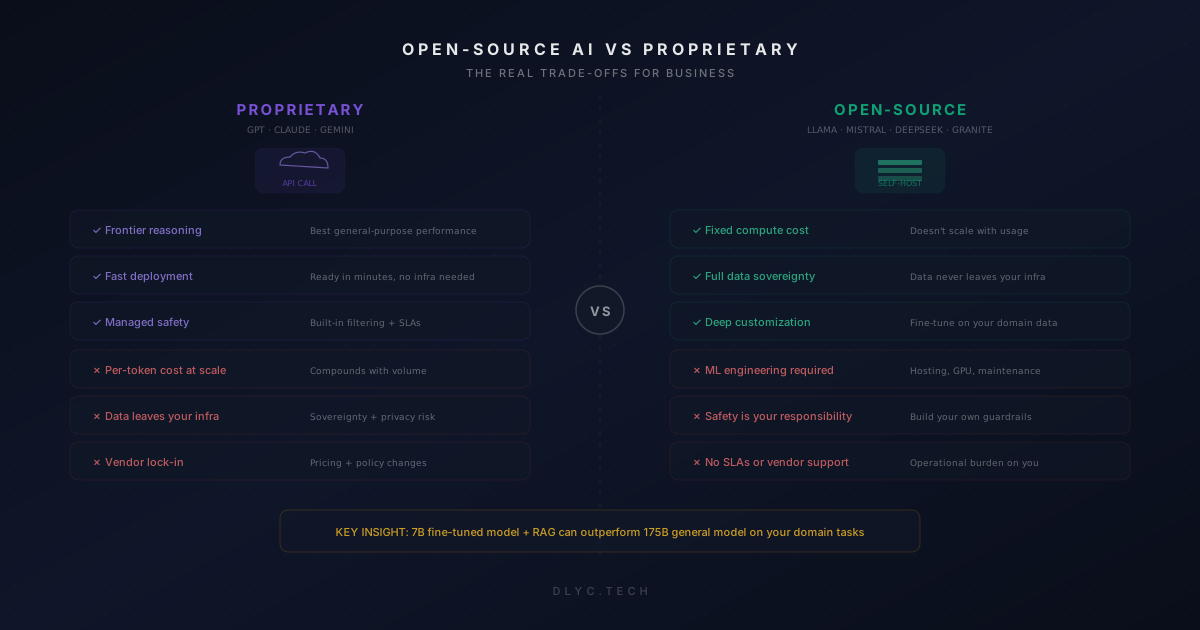
This is the key insight: a 7B parameter model fine-tuned on your domain data can outperform a 175B parameter general model on your specific use case — at a fraction of the inference cost.
Open-Source vs. Proprietary: The Real Trade-Offs
The decision isn't binary. Many businesses will use both. But understanding the trade-offs is essential for making informed architecture decisions.
Where Open-Source Wins
Cost at scale. Proprietary models charge per token — input and output. At low volume, this is negligible. At enterprise scale, it compounds fast. A business processing millions of documents, customer interactions, or data records can see API costs reach tens of thousands of dollars per month. Open-source models running on your own infrastructure (or rented GPU instances) have a fixed compute cost that doesn't scale linearly with usage.
Data control and sovereignty. When you use a proprietary API, your data — prompts, context, and outputs — passes through a third-party's infrastructure. For businesses handling sensitive customer data, proprietary IP, or regulated information, this creates a risk surface. Open-source models can run entirely within your own environment. Your data never leaves your infrastructure.
Customization depth. Proprietary models offer limited fine-tuning options. You can adjust behavior through prompting and, in some cases, fine-tuning APIs — but you're constrained by what the provider allows. With open-source models, you can fine-tune on your own data, modify training procedures, and optimize for your specific task. Combined with RAG architecture, a fine-tuned small model can deliver accuracy that rivals frontier models on domain-specific work.
No vendor lock-in. If OpenAI changes pricing, deprecates a model version, or modifies usage policies, businesses built entirely on their API have limited options. Open-source models can be hosted on any infrastructure, migrated between providers, and archived for long-term reproducibility.
Where Proprietary Models Still Win
Frontier capabilities. For the most complex general-purpose tasks — advanced creative writing, nuanced multi-step reasoning across unfamiliar domains, or multimodal understanding — the largest proprietary models still hold an edge. That edge is narrowing rapidly, but it exists.
Speed to deployment. Proprietary APIs are ready to use in minutes. Open-source models require infrastructure decisions — hosting, GPU provisioning, inference optimization, and ongoing maintenance. For businesses without dedicated ML engineering resources, the operational overhead of self-hosting is real.
Managed safety and alignment. Proprietary model providers invest heavily in safety testing, content filtering, and alignment. Open-source models require you to implement and maintain your own safety guardrails — which adds engineering responsibility and security considerations.
Support and SLAs. Enterprise API contracts come with uptime guarantees, dedicated support, and contractual liability. Self-hosted open-source deployments put the operational burden entirely on your team.
The RAG + Small Model Strategy
One of the most effective architectures in 2026 combines a small open-source model with a RAG (Retrieval-Augmented Generation) pipeline. This approach is increasingly popular because it solves three problems simultaneously.
Accuracy. RAG grounds the model's responses in your actual data — company documents, product databases, support tickets, knowledge bases. The model doesn't need to "know" the answer from training. It retrieves the relevant information and generates a response based on verified sources.
Cost. A 7B or 13B parameter model running inference on modest GPU hardware costs a fraction of per-token API calls to a frontier model. For high-volume, domain-specific tasks (internal search, customer support, document processing), the savings compound quickly.
Control. Your data stays in your environment. Your model runs on your infrastructure. You can update the knowledge base without retraining the model. You can swap models without rebuilding your pipeline.
The combination is particularly powerful for businesses that have already built a solid data foundation. If your organization has structured knowledge bases, documented processes, and clean data, RAG + small models can deliver production-grade results with surprisingly low infrastructure requirements.
A Decision Framework: When to Go Open-Source
Not every use case warrants open-source. Here's a practical framework for deciding.
Choose open-source when:
- You're processing high volumes (cost sensitivity)
- Your use case is domain-specific and benefits from fine-tuning
- Data sovereignty or regulatory compliance requires on-premise processing
- You want to avoid vendor dependency on a single provider
- You have (or can hire) ML engineering resources for deployment and maintenance
- Your task is well-defined and a smaller model can handle it effectively
Choose proprietary when:
- You need frontier-level general-purpose reasoning
- Speed to deployment matters more than cost optimization
- You lack internal ML engineering capacity
- Your volume is low enough that per-token pricing is economical
- You need managed safety and content filtering out of the box
Use both when:
- Different tasks in your workflow have different requirements
- You want a proprietary model for complex reasoning and an open-source model for high-volume, routine processing
- You're prototyping with APIs and plan to migrate to self-hosted for production scale
Getting Started With Open-Source AI
If you're considering open-source models, here's a practical path forward.
-
Start with a specific use case. Don't try to replace your entire AI stack at once. Pick one high-volume, domain-specific task — internal search, document classification, customer FAQ automation — where a smaller model could perform well.
-
Evaluate models on your data. Download 2–3 candidate models and test them against your actual use case. Benchmarks are useful, but performance on your specific data and task is what matters. A model that tops academic leaderboards may underperform on your domain if it wasn't exposed to similar content during training.
-
Choose your deployment path. Options range from self-hosted on your own GPUs, to managed inference providers (Replicate, Together AI, Fireworks), to cloud-native solutions (AWS Bedrock, Azure AI, Google Cloud Vertex). Managed providers reduce operational overhead while still giving you model portability.
-
Layer RAG on top. Connect the model to your knowledge base through a RAG pipeline. This immediately improves accuracy on domain-specific queries without fine-tuning. RAG is model-agnostic — you can swap the underlying model without rebuilding the retrieval layer.
-
Fine-tune if needed. If RAG alone doesn't hit your accuracy targets, fine-tuning the model on your domain data is the next step. Start with parameter-efficient methods like LoRA, which require less data and compute than full fine-tuning.
-
Build monitoring and evaluation. Track accuracy, latency, cost, and user satisfaction from day one. Open-source deployments require you to own the observability stack — build it into your agent infrastructure from the start.
The Bottom Line
The narrative that businesses must choose between expensive proprietary models and inferior open-source alternatives is outdated. In 2026, open-source AI offers genuine production-quality performance for a growing range of business applications — at lower cost, with greater control, and without vendor lock-in.
The shift isn't about ideology. It's about economics and engineering. Smaller models fine-tuned on domain data, paired with RAG pipelines, can match or exceed the performance of models ten times their size on specific tasks. For businesses watching their AI investment ROI carefully, this is a strategic advantage worth pursuing.
The era of "one model to rule them all" is ending. The future belongs to businesses that match the right model to the right task — and increasingly, that right model is open-source.
Suggested Internal Links:
- What Is RAG (Retrieval-Augmented Generation) — The architecture that makes small models competitive
- AI Agent Infrastructure Explained — Where model selection fits in the 6-layer stack
- Is the AI Bubble About to Burst? — Why cost optimization and ROI focus matters now
- How to Implement AI Automation in Your Business — The broader implementation framework
- Semiconductor Tariffs and AI — How hardware costs affect the build-vs-buy decision
- AI Regulation in 2026 — Why data sovereignty and model auditability are regulatory requirements
Suggested External Links:
- Meta Llama model documentation and license terms
- Hugging Face Open LLM Leaderboard
- LMSYS Chatbot Arena (real-world model comparison)
- Together AI inference pricing calculator
Suggested Featured Image: A clean diagram showing two paths — a proprietary API cloud on one side and self-hosted infrastructure on the other — converging on the same business outcome (a dashboard or output). Visual emphasis on the open-source side having more control levers (fine-tuning, data privacy, cost controls). Dark background, minimal style, brand colors.
Suggested Schema Markup: Article, FAQPage