Semiconductor Tariffs and AI: What the New Exemptions Mean for Tech Costs
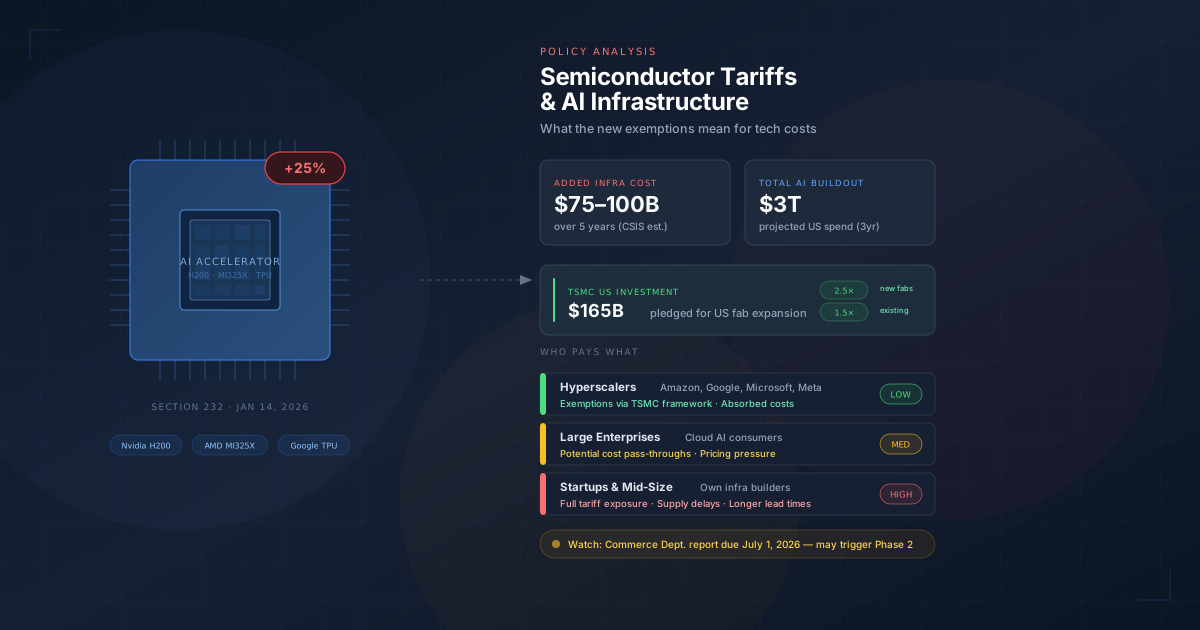
On January 14, 2026, the Trump administration imposed a 25% tariff on advanced AI semiconductors under Section 232 of the Trade Expansion Act. The targets: high-performance chips like Nvidia's H200 and AMD's MI325X — the processors that power virtually every major AI data center in the country. But the real story isn't the tariff itself. It's the exemptions being carved out for Big Tech, and what those exemptions mean for everyone else.
What Happened: The Tariff in Plain English
The Section 232 proclamation applies a 25% import duty on a narrow category of advanced computing chips that meet specific technical thresholds. These are the GPUs and accelerators that drive AI training and inference at scale — the same hardware that Amazon, Google, Microsoft, and Meta are buying in enormous quantities to power their cloud AI services.
The critical detail: chips imported for domestic use are largely exempt. The tariff primarily targets chips imported into the US and then re-exported to China. Chips used in US data centers, for domestic R&D, by startups, for public sector applications, and for consumer products are all carved out.
Legal analysts at Gibson Dunn and Pillsbury Law have noted that when you read the tariff alongside the Bureau of Industry and Security's export control rules (also finalized January 15, 2026), the 25% levy functions more like a fee on AI chip sales to China than a broad import tax. The administration essentially formalized what it announced in September 2025: the US government would collect a percentage of advanced AI chip sales destined for Chinese buyers.
The TSMC Exemption Framework: How Big Tech Gets Protected
The bigger development landed this week. According to the Financial Times, the Commerce Department is preparing a system of tariff carve-outs for US hyperscalers — Amazon, Google, and Microsoft — tied to TSMC's investment in American chip manufacturing.
Here's how it works: Under a US-Taiwan trade agreement finalized in January 2026, Taiwanese companies investing in US semiconductor production get tariff relief. TSMC, which supplies the vast majority of advanced AI chips globally, has pledged $165 billion to expand its US manufacturing footprint. In return, the framework allows:
- Companies building new fabs in the US can import up to 2.5 times the planned capacity of those facilities tariff-free during construction
- Companies with existing US plants can import up to 1.5 times their current capacity tariff-free
- The broader US-Taiwan deal reduced tariffs on Taiwanese goods from 32% (later adjusted to 20%) down to 15%
The practical effect: TSMC's biggest American customers — the hyperscalers building AI data centers at breakneck speed — get to keep importing advanced chips at favorable rates as long as TSMC keeps building on US soil.
This isn't a simple giveaway. One administration official told the Financial Times they would be monitoring the outcome closely to avoid creating the appearance of a free pass for TSMC. But the structure is clear: the tariff regime is being used as a negotiating lever to extract manufacturing commitments, not as a blunt protectionist barrier.
Why This Matters for Cloud AI Costs
Semiconductors represent more than half the total cost of an AI server, according to SemiAnalysis. GPUs alone make up the majority of that semiconductor content in systems like Nvidia's DGX platforms. And currently, none of these advanced AI chips are manufactured in the United States. Every one of them is imported.
That means tariff policy directly impacts the economics of AI infrastructure. The CSIS (Center for Strategic and International Studies) estimated that proposed tariff policies could add $75–100 billion in additional AI infrastructure costs over five years — equivalent to 15–20 fewer hyperscale data center facilities.
For the major cloud providers, the exemption framework provides a buffer. Google, Amazon, and Microsoft have massive cash reserves and can absorb cost increases in the short term. Google reportedly runs large language models at a 40–50% lower fully loaded cost than competitors using third-party GPU infrastructure, thanks partly to its custom TPU chips and vertical integration.
But not every company building with AI has those advantages. The tariff landscape creates a tiered system:
- Hyperscalers (Amazon, Google, Microsoft, Meta) get exemptions tied to their purchasing relationships with TSMC and their own data center investment commitments
- Large enterprises using cloud AI services face potential cost pass-throughs if cloud providers adjust pricing to reflect higher input costs
- Startups and mid-sized companies building their own AI infrastructure face the full weight of any tariffs that aren't exempted, plus supply chain delays and longer lead times on advanced chips
Morgan Stanley projects the total AI buildout in the US could cost up to $3 trillion over the next three years. Hyperscalers alone plan to spend over $350 billion on AI-related data centers in 2025. TSMC is boosting its capital expenditure budget to $52–56 billion for 2026, up from roughly $40 billion in 2025. These are staggering numbers, and even small percentage changes in input costs ripple through the entire ecosystem.
The Downstream Effects You Should Watch
The tariff story extends well beyond chip prices. Several second-order effects are already materializing:
Cloud Pricing Pressure
If tariffs raise the cost of the hardware underneath cloud AI services, providers will eventually pass some of that cost downstream. AWS, Azure, and Google Cloud haven't announced AI-specific price increases tied to tariffs yet, but the economic logic is straightforward. Businesses that depend on cloud-based AI agents and automation should monitor their compute costs closely over the next 6–12 months.
Supply Chain Bottlenecks
High-bandwidth memory (HBM) and advanced compute components already face lead times stretching beyond 40 weeks as fabrication facilities prioritize AI accelerators over traditional processors. Tariff uncertainty compounds this: companies may stockpile inventory to hedge against future duties, creating the same supply distortions that plagued the industry during COVID-era chip shortages.
Deloitte's 2026 semiconductor outlook notes that while AI chips account for roughly 50% of industry revenues, they represent less than 0.2% of total chip volume. That concentration means any disruption to this small category of chips has outsized effects on the AI ecosystem.
The Build-in-America Incentive
The tariff-plus-exemption structure creates a powerful incentive for semiconductor companies to invest in US manufacturing. Intel is expanding operations in Arizona, New Mexico, Oregon, and building a new campus in Ohio. TSMC is building multiple fabs in Arizona. Samsung has committed to facilities in Texas.
For businesses, this means the US chip supply chain will look meaningfully different in 3–5 years. But the transition period creates uncertainty. Domestic fabs take years to build and ramp to full production. In the meantime, the industry remains dependent on chips fabricated in Taiwan, South Korea, and elsewhere.
Retaliatory Risk
Trade tensions don't move in one direction. Retaliatory tariffs from the EU, China, or other trading partners could affect US exports of data center technology, AI chips, and cloud services. Some governments may introduce countermeasures that favor domestic cloud providers over US-based firms, fragmenting the global market further.
What Businesses Should Do Now
You don't need to be a trade policy expert to prepare for the practical effects of semiconductor tariffs on your AI strategy. Here are the steps worth taking:
-
Audit your AI compute costs. Know exactly what you're spending on cloud AI services and what percentage of your operating costs it represents. This gives you a baseline to track if pricing shifts. If you're early in your AI journey, our SEO fundamentals guide and AI automation implementation guide can help you build a cost-effective foundation.
-
Diversify your cloud providers. Single-provider dependency increases your exposure to pricing changes. Multi-cloud strategies add complexity but provide negotiating leverage and fallback options.
-
Evaluate smaller models. The tariff pressure on high-end GPUs makes the trend toward smaller, fine-tuned models even more compelling. AT&T's chief data officer recently told TechCrunch that fine-tuned small language models match larger models in accuracy for enterprise applications while being far cheaper to run. If a 7-billion-parameter model can handle your use case, you don't need to pay for 70-billion-parameter inference.
-
Lock in pricing where possible. If your cloud provider offers committed-use contracts or reserved capacity at fixed rates, now is a reasonable time to evaluate those options — particularly for workloads you know will persist through 2026 and beyond.
-
Watch the July 2026 deadline. The Commerce Department is required to report to the President on the data center semiconductor market by July 1, 2026. That report could trigger broader tariffs, modified exemptions, or new incentive programs. Budget planning should account for potential changes in the second half of the year.
The Bigger Picture
The semiconductor tariff story is ultimately about a collision between two administration priorities: reshoring manufacturing and maintaining America's lead in AI. The exemption framework is an attempt to thread that needle — extracting factory investments from TSMC and others while keeping Big Tech's supply chains intact during the most aggressive AI infrastructure buildout in history.
For now, the direct impact on most businesses using cloud AI is limited. The 25% tariff targets a narrow category of chips, and domestic-use exemptions cover the majority of AI workloads running in US data centers. But the policy is explicitly designed as a Phase 1 — with broader tariffs, additional negotiations, and potential modifications all on the table before year's end.
The businesses best positioned to navigate this are the ones paying attention now: tracking their AI infrastructure costs, diversifying suppliers, and building flexibility into their AI implementation strategies. The tariff landscape will keep shifting. Your ability to adapt shouldn't depend on guessing where it lands.