What Is AI Agent Infrastructure? The Hidden Layer Behind Every AI Agent
Everyone's talking about AI agents. Few are talking about what actually makes them work. The models get the headlines, but the infrastructure beneath them — the retrieval pipelines, orchestration layers, memory systems, and execution environments — is where agents succeed or fail. And in 2026, this "hidden layer" is rapidly becoming its own market.
Why AI Agent Infrastructure Matters Now
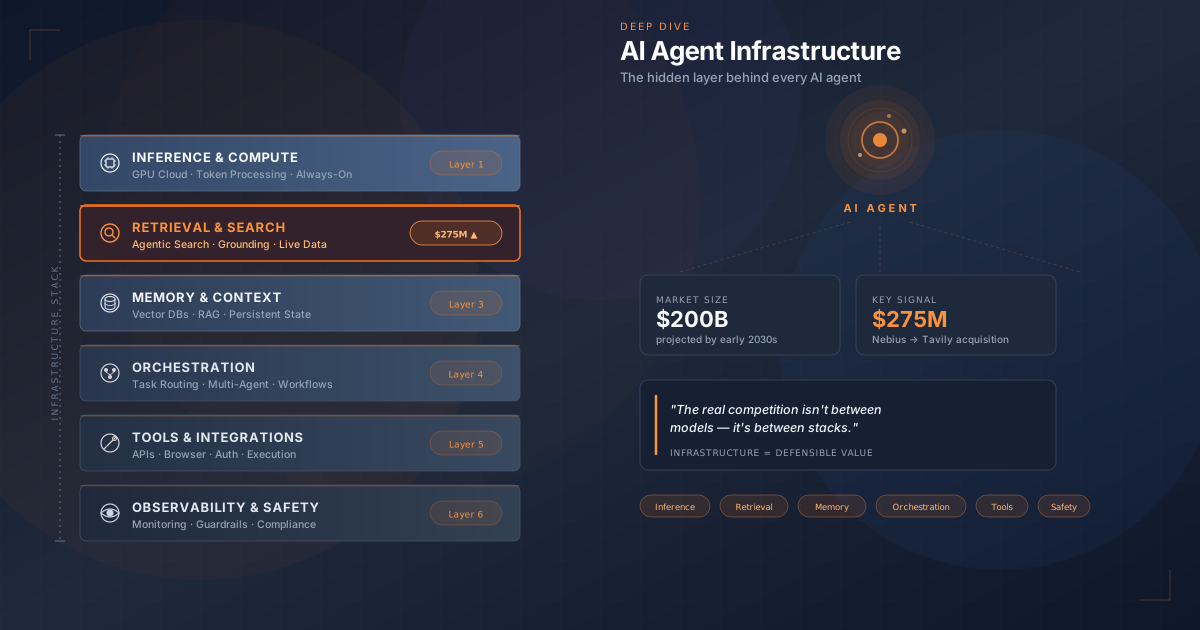
Two days ago, Nebius acquired Tavily for $275 million. Tavily builds agentic search — the technology that gives AI agents live access to the web so they can retrieve current, verified information instead of hallucinating outdated answers. The deal wasn't about buying a model. It was about buying a piece of the stack.
This acquisition signals a broader shift in how the industry thinks about AI agents. The conversation has moved past "which model is smartest?" to a harder question: what does an agent need around it to actually work in production?
The agentic AI market is projected to grow from roughly $7 billion in 2025 to between $140 billion and $200 billion by the early 2030s, according to industry forecasts cited in Nebius's acquisition announcement. Within that market, infrastructure — not applications — is where the defensible value is being built.
What AI Agent Infrastructure Actually Includes
Think of AI agent infrastructure as everything an autonomous system needs beyond the language model itself. A model can reason and generate text. But an agent that books flights, processes invoices, or monitors competitors needs much more than that.
The stack breaks down into several distinct layers:
1. Inference and Compute
This is the foundation: the hardware and cloud services that run the models. In 2026, the focus has shifted from massive training runs to cost-effective, always-on inference — because agents don't run once and stop. They run continuously, processing tasks around the clock.
Companies like Nebius (through its Token Factory product), along with hyperscalers like AWS, Google Cloud, and Azure, provide the high-performance compute that agents depend on for reasoning. The economics here matter enormously: Google's fully loaded cost of running a large language model is reportedly 40–50% lower than competitors using third-party GPU infrastructure, according to industry analysts. That kind of cost gap determines who can deploy agents profitably at scale.
2. Retrieval and Search (Grounding)
This is the layer Tavily occupies — and the one Nebius just paid $275 million for. AI agents need access to real-time, accurate information. Without it, they hallucinate. With it, they can verify facts, pull current pricing, check inventory, or research a prospect before sending an email.
Agentic search is different from traditional search. It's optimized for machine consumption, not human browsing. The results need to be structured, source-attributed, and delivered fast enough for an agent to use mid-workflow. Tavily built exactly this, serving Fortune 500 companies like IBM and AI firms like Cohere and Groq, with over 3 million monthly SDK downloads.
Industry forecasts suggest AI agents will issue more internet queries than humans within the next few years. That makes the retrieval layer one of the highest-value components in the entire stack.
3. Memory and Context
Agents need to remember. Not just what happened five seconds ago in a conversation, but what happened yesterday, last week, or across a multi-step workflow that spans hours.
This is where agent memory systems come in. Tools like Zep and Mem0 give agents persistent memory — the ability to store dialogue history, track goals, and retain context across sessions. Without memory, every interaction starts from zero. With it, agents can maintain continuity, learn from past actions, and build something closer to a working relationship with the systems and people they serve.
Vector databases like Pinecone act as the knowledge backbone, storing embeddings that let agents retrieve relevant context quickly. This is the technical foundation behind RAG (Retrieval-Augmented Generation), which most production agents rely on to stay grounded in real data.
4. Orchestration and Workflow
An agent that can reason, search, and remember still needs something to coordinate its actions. That's the orchestration layer — the brain that manages the plan → act → observe loop.
Frameworks like LangGraph, CrewAI, and Microsoft AutoGen handle task routing, error recovery, multi-step planning, and coordination between multiple agents. In a multi-agent system, orchestration becomes critical: agents need to communicate, divide work, avoid conflicts, and escalate when they're stuck.
Low-code platforms like n8n and Make have evolved from simple workflow automation into full agent orchestrators, letting businesses chain AI reasoning with hundreds of native integrations without writing extensive code.
5. Tools and Integrations
Agents act on the world through tools — APIs, browser automation, database connectors, CRM integrations, email systems. The tools layer has seen the most dramatic expansion in the past year.
Key battlegrounds include:
- Browser infrastructure — companies like Browserbase and Lightpanda build the systems that let agents interact with the visual web, not just APIs
- Authentication for agents — startups like Clerk and Anon manage permissions and credentials in agent-native ways, because when an agent acts on your behalf, security takes on new dimensions
- Execution environments — Docker, Kubernetes, and specialized platforms like E2B and Modal provide the sandboxed environments where agents run safely
6. Observability, Safety, and Governance
The final layer is oversight. Production agents need monitoring, logging, guardrails, and compliance controls. Tools like Langfuse provide real-time visibility into agent performance. Safety frameworks like Lakera enforce output rules and block harmful responses.
This layer matters more than most teams realize. As agents gain autonomy, the security risks — prompt injection, misalignment, unauthorized actions — become operational concerns, not theoretical ones. Anthropic, Carnegie Mellon, and MIT Sloan have all flagged that current agents make too many mistakes for unsupervised use in high-stakes business processes.
Why the Infrastructure Layer Is Where the Real Value Lives
Not every layer of the agent stack is equally defensible. According to a framework published by AIMultiple Research, the stack breaks into commoditized layers, defensible layers, and application layers:
- Commoditized: Foundation model infrastructure (dominated by hyperscalers) and interoperability protocols (they standardize quickly and offer little differentiation)
- Defensible: Agent runtime, orchestration, memory, and specialized tooling — these take 6–18 months to build properly and are moderately hard to replicate
- Low moat: Horizontal applications like general-purpose copilots, which are already crowded
The Nebius-Tavily deal confirms this pattern. Nebius didn't buy an application. It bought a critical infrastructure component — the search layer — and folded it into its platform so developers wouldn't need to stitch together multiple vendors.
This "platform consolidation" trend is accelerating. The companies that own multiple infrastructure layers will have the strongest position as agentic AI moves into enterprise adoption.
What This Means for Businesses Evaluating AI Agents
If you're considering deploying AI agents — or already experimenting — the infrastructure layer deserves as much attention as the model choice. A few practical takeaways:
-
Evaluate the full stack, not just the model. When comparing agent platforms, ask what's included: retrieval, memory, orchestration, monitoring? Or are you expected to build those yourself?
-
Prioritize grounding and retrieval. The single biggest failure mode for agents is acting on bad information. A solid retrieval layer — whether through RAG, agentic search, or both — is non-negotiable for production use.
-
Plan for observability from day one. You need to see what your agents are doing, catch errors early, and maintain audit trails. Bolting on monitoring later is significantly harder than building it in.
-
Watch the build-vs-buy tradeoff. Assembling your own stack from open-source components gives flexibility but demands engineering resources. Integrated platforms reduce complexity but create vendor dependency. There's no universal right answer — it depends on your team's capabilities and your tolerance for lock-in.
-
Start with the implementation fundamentals. Before investing in sophisticated infrastructure, make sure your data, integrations, and processes are ready for automation. The best infrastructure in the world can't fix broken workflows.
The Bottom Line
AI agents are only as good as the infrastructure beneath them. As the agentic AI market scales toward $200 billion, the real competition isn't between models — it's between stacks. The Nebius-Tavily acquisition is one of the first major signals that infrastructure is becoming the strategic battleground.
For businesses, this means thinking beyond "which AI model should we use?" and asking a harder, more productive question: what does our agent actually need to work reliably, safely, and at scale? The answer to that question lives in the infrastructure layer — and it's worth getting right.