Is the AI Bubble About to Burst? What Businesses Should Prepare For
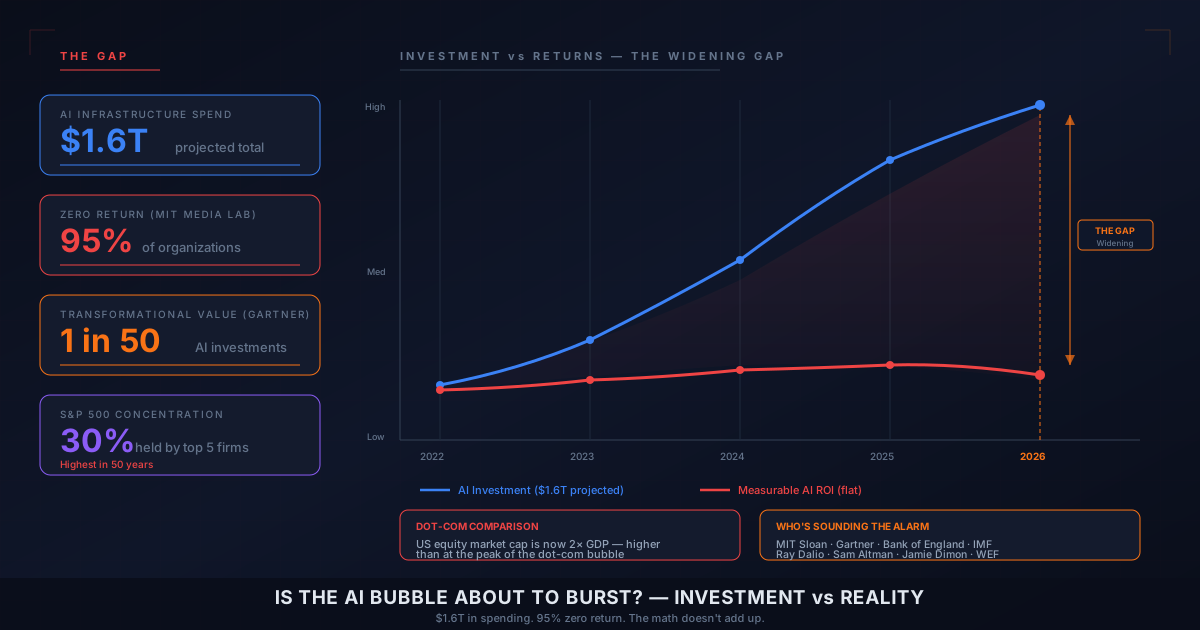
An MIT Media Lab report dropped a statistic in August 2025 that should have been a wake-up call: despite $30–40 billion in enterprise investment into generative AI, 95% of organizations are getting zero return. Not poor returns. Zero. Meanwhile, US mega caps are expected to spend $1.1 trillion on AI between 2026 and 2029, total AI spending is projected to surpass $1.6 trillion, and the five largest AI-driven companies now account for 30% of the S&P 500 — the greatest concentration in half a century. Whether this is a bubble or a boom depends on who you ask. But the data suggests businesses need a plan either way.
The Case That This Is a Bubble
The parallels to the dot-com era are difficult to ignore, and they're being drawn by people who lived through it.
MIT Sloan columnists Thomas Davenport and Randy Bean — two of the most cited voices in enterprise AI — wrote in January 2026 that "it's hard not to see the similarities to today's situation, including the sky-high valuations of startups, the emphasis on user growth over profits, the media hype, the expensive infrastructure buildout." Both openly compared today's AI market to the lead-up to the 2001 crash.
They're not alone. Ray Dalio, co-chief investment officer at Bridgewater Associates, called current AI investment levels "very similar" to the dot-com bubble in early 2025. Sam Altman, OpenAI's own CEO, acknowledged that an AI bubble is ongoing. Jamie Dimon, head of JPMorgan — the largest bank in the US — said he believes some money invested now will be wasted and warned of a higher chance of a meaningful market drop.
The financial structure reinforces the concern. Harvard economist Jason Furman estimated that AI-driven infrastructure investment accounted for 92% of US GDP growth in the first half of 2025. When a single sector drives that much of an economy's expansion, any slowdown in that sector creates outsized ripple effects.
The valuation numbers are stretched. The "Magnificent Seven" tech stocks (Apple, Microsoft, Amazon, Alphabet, Meta, Nvidia, and Tesla) have increased nearly eightfold in total return since January 2020, while the rest of the S&P 500 hasn't even doubled. US equity market capitalization is now nearly twice GDP — higher than it was at the peak of the dot-com bubble.
The Bank of England, the International Monetary Fund, and the World Economic Forum have all issued warnings about overvaluation risk. The IMF's managing director explicitly drew comparisons to 2001 and warned that a correction could stunt global growth.
The Case That This Is Not a Bubble
The counter-argument is equally data-driven, and it centers on one claim: AI's economic potential is real, even if adoption is lagging.
Cognizant's research estimates AI could add $1 trillion to US GDP and influence $4.4 trillion in consumer purchases. Their analysis of the O*NET labor database found that the value of work AI could perform or assist with constitutes $4.5 trillion in the US alone. Gartner projects worldwide AI spending will reach $2.5 trillion in 2026, up roughly 44% from 2025.
Torsten Slok, chief economist at Apollo Global Management, argued in February 2026 that AI infrastructure investment is already committed and largely paid for, making a dot-com-style collapse less likely. His view: data center financings are locked in for 2026, US reindustrialization is accelerating, and the physical economy is strong enough to absorb a software sector correction.
Google, Amazon, and Meta announced a combined $660 billion in capital expenditure plans for 2026 in their latest earnings. Bank of America forecasts AI capex quadrupling to $1.2 trillion by 2030. These aren't speculative bets from startups burning through seed money — they're committed infrastructure spending from profitable companies.
The strongest argument against the bubble narrative: unlike dot-com companies that had no revenue models, today's AI leaders are generating massive cash flows. Microsoft, Google, and Amazon are integrating AI into existing products with billions of paying users. The technology has a revenue base the dot-com era never had.
Where the Real Risk Lives
The bubble-or-not debate misses the more actionable question: where exactly is the risk concentrated, and who's most exposed?
Overvalued Startups
Single-purpose AI startups face the highest risk. Tools built around one capability — email drafting, scheduling, image generation — get commoditized overnight when a frontier model update adds the same feature for free. OpenAI's valuation tripled from $157 billion to $500 billion in a single year, but smaller AI startups without defensible moats or proprietary data are most vulnerable to a correction.
Forrester predicted an AI market correction in 2026 specifically because fewer than one-third of decision-makers can tie AI value to their organization's financial growth. The era of funding AI projects on hype alone is ending. CFOs are now gate-keeping AI budgets, demanding 90-day ROI proof.
Enterprise AI Projects Without Clear ROI
Gartner's data is sobering: only 1 in 50 AI investments deliver transformational value, and only 1 in 5 delivers any measurable return. The problem isn't the technology — it's how organizations deploy it.
Most companies are running AI experiments that never ship. Audits consistently find that 80% of enterprise AI spending goes to pilots and proofs of concept that never reach production. The organizations getting value are the ones treating AI as an operational tool, not a science project.
Infrastructure Concentration
Over $1 trillion in AI-related debt is expected to flow through private credit markets. Meta's $27.2 billion data center financing with Blue Owl combined aspects of asset-backed securities, commercial mortgage-backed securities, and investment-grade debt in off-balance-sheet structures. Oliver Wyman's analysis warns that banks may discover they own far more AI infrastructure risk than internal reports suggest — echoing how banks discovered hidden housing risk exposure in 2008.
What a Correction Would Actually Look Like
A bubble burst wouldn't kill AI. It would kill unrealistic expectations and redirect capital toward projects that work. Based on analysis from the World Economic Forum, Oliver Wyman, and TechTarget, here's the likely sequence:
Phase 1: Financial market correction. AI stock valuations compress. Smaller AI companies face funding crunches. S&P Global models suggest up to 2.5 million jobs could be affected in a full deflation scenario, with ripple effects beyond tech into finance, manufacturing, and services.
Phase 2: Enterprise budget tightening. CFOs accelerate the shift from speculative AI spending to ROI-justified investments. The 80% of AI budgets going to experiments that never ship gets slashed. Organizations double down on the 20% that delivers measurable value.
Phase 3: Market maturation. Surviving companies focus on real problems with defensible solutions. Just as Amazon, Google, and eBay emerged stronger from the dot-com bust by focusing on tangible user value, the AI companies that solve specific, measurable business problems will thrive post-correction.
The consensus among economists and analysts is that a correction would be healthy. As MIT Sloan's Davenport and Bean put it, "the AI industry and the world at large would probably benefit from a small, slow leak in the bubble."
How to Invest Wisely in AI Right Now
Whether the bubble bursts or deflates slowly, the same principles protect your organization:
-
Demand measurable ROI within 90 days. If an AI vendor can't show you hours saved, errors prevented, or revenue generated within a quarter, walk away. The era of open-ended AI experimentation is over.
-
Favor narrow, focused solutions. A tool that does one thing exceptionally well beats a general-purpose platform that does everything poorly. The AI agents vs chatbots distinction matters here — purpose-built agents with clear use cases outperform generic AI deployments.
-
Don't assume you need frontier models. Many production AI applications work fine with smaller, open-source models that run at the edge. IBM reports that smaller reasoning models tuned for specific domains can match or exceed frontier model performance at a fraction of the cost.
-
Audit your current AI spending. Most organizations find that 80% of their AI budget goes to experiments that never ship. Identify the 20% delivering value and redirect resources accordingly.
-
Invest in your people, not just your tools. The AI skills gap is the silent killer of AI ROI. Every $1 invested in AI upskilling returns $3.70 in productivity gains, but most organizations still treat training as optional.
-
Build on open standards. Protocols like MCP reduce vendor lock-in and ensure your AI integrations survive market consolidation. If your AI vendor goes under or pivots, open standards let you migrate without rebuilding from scratch.
-
Look at who's profitable. An AI company losing billions quarterly is not building sustainable technology. Partner with companies that have actual business models, not just growth narratives.
The Bottom Line
The AI bubble debate is a distraction from the real question: are you building AI capabilities that create measurable value, or are you spending money on the AI equivalent of a dot-com domain name? MIT's 95% failure rate isn't a condemnation of AI — it's a condemnation of how most organizations approach AI. The technology works. The infrastructure is maturing. The integration standards are consolidating. What's missing is disciplined execution, clear success metrics, and the organizational will to kill projects that don't deliver.
A correction is coming — slowly or suddenly. The organizations that survive it won't be the ones that spent the most on AI. They'll be the ones that spent most wisely.
Suggested Internal Links:
- How to Implement AI Automation in Your Business — actionable steps for readers ready to invest wisely
- AI Agents vs Chatbots — helps readers choose the right tool for their needs
- The AI Skills Gap — addresses the human capital side of AI ROI
- AI Agent Infrastructure — the infrastructure stack that separates serious deployments from science projects
- Semiconductor Tariffs and AI — cost pressures compounding the ROI challenge
Suggested External Links:
- MIT Sloan: Five Trends in AI and Data Science for 2026 — source analysis from Davenport and Bean
- World Economic Forum: Anatomy of an AI Reckoning — scenario planning for a correction
Suggested Schema Markup: Article, FAQ
Suggested Featured Image: A data-driven visualization showing two diverging lines — one representing AI investment (steeply rising) and one representing AI ROI (flat or barely rising) — with the widening gap between them highlighted in red. Dark background with a cracked or fractured overlay suggesting tension. Key data points annotated: "$1.6T total spending," "95% zero return," "1 in 50 transformational." Style consistent with previous posts but with a more cautionary red/amber color palette.