AI Regulation in 2026: What New Laws Mean for Your Business
For the past three years, "AI regulation" was mostly hypothetical for most businesses. Governments debated. Frameworks were proposed. Voluntary commitments were signed. That era is over. In 2026, enforceable AI laws are going into effect across the United States and Europe, with real compliance requirements, real deadlines, and real consequences for businesses that aren't prepared. If your company develops, deploys, or even uses AI in decision-making, you likely have new legal obligations taking effect this year.
The regulatory landscape is moving on multiple fronts simultaneously — state-level laws in the US, the EU AI Act's enforcement timeline, federal agency scrutiny, and a rapidly evolving cyber insurance market that now treats AI governance as a prerequisite for coverage. This guide breaks down what's actually happening, what you need to comply with, and how to build a readiness plan.
The US Regulatory Landscape: State Laws Lead the Way
In the absence of comprehensive federal AI legislation, US states have taken the lead. The result is a patchwork of laws that varies by jurisdiction — which creates complexity but also means businesses operating across states need to meet the highest common standard.
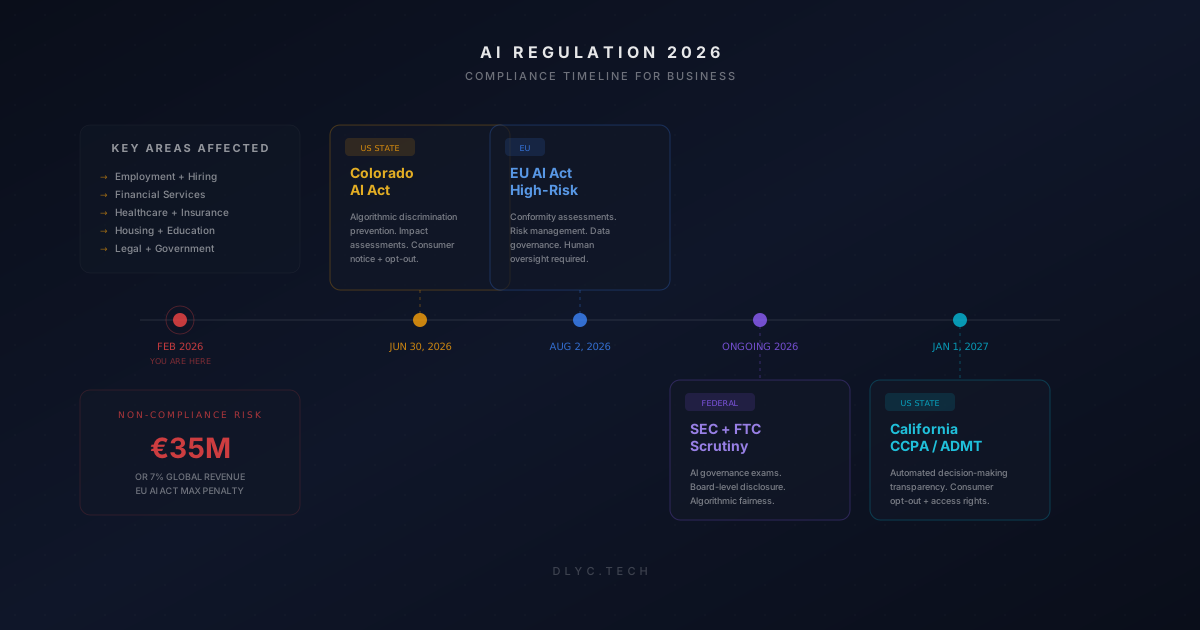
The Colorado AI Act (Effective June 30, 2026)
The Colorado AI Act is the most significant US state-level AI law to date. It applies to businesses that develop or deploy "high-risk AI systems" — defined as systems that make or substantially contribute to consequential decisions about consumers.
Consequential decisions include determinations related to:
- Employment, hiring, and promotion
- Education enrollment and opportunities
- Financial services and lending
- Healthcare services and coverage
- Housing availability
- Insurance underwriting and pricing
- Legal services and access to government benefits
If your business uses AI in any of these decision areas, the Colorado AI Act imposes specific obligations.
For AI deployers (businesses using AI systems):
- Implement a risk management policy that identifies and mitigates algorithmic discrimination
- Provide consumers with notice that AI is being used in consequential decisions
- Give consumers the ability to opt out or appeal AI-assisted decisions
- Maintain documentation of the AI system's purpose, data inputs, and known limitations
- Conduct periodic impact assessments evaluating the system for bias and discrimination
For AI developers (companies building AI tools):
- Provide deployers with sufficient documentation to enable compliance
- Disclose known limitations, intended use cases, and training data characteristics
- Report any discovered instances of algorithmic discrimination to the Colorado Attorney General within 90 days
The enforcement mechanism includes both Attorney General action and a private right of action for consumers who suffer harm from algorithmic discrimination. The law includes an affirmative defense for businesses that can demonstrate they made reasonable efforts to comply — which makes documentation and proactive governance essential.
California's Automated Decision-Making Rules (Effective January 1, 2027 — Prepare Now)
California's new regulations under the California Consumer Privacy Act (CCPA) introduce specific requirements for businesses using "automated decision-making technology" (ADMT) to make significant decisions about consumers.
While the compliance deadline is January 2027, the preparation timeline starts now. The rules require:
- Pre-use notice to consumers before ADMT is used in significant decisions
- Consumer right to opt out of ADMT use
- Right to access information about how ADMT was used in decisions affecting them
- Businesses must maintain documentation of their ADMT logic, data inputs, and outputs
Given California's market size and the CCPA's broad applicability to businesses handling California residents' data, these rules effectively function as a national standard for many companies.
Other State Activity to Monitor
Several other states have introduced or are advancing AI-specific legislation, including:
- Illinois — Expanding its existing AI Video Interview Act with broader AI employment provisions
- New York — The Responsible AI Safety and Education Act introduces requirements for frontier model developers
- Texas, Connecticut, and Virginia — Various proposals targeting AI transparency and bias in specific sectors
The direction is consistent: more states, more obligations, more enforcement. Businesses that build compliance infrastructure for Colorado and California will be well-positioned to absorb additional state requirements as they emerge.
Federal Oversight: No Comprehensive Law, but Increasing Scrutiny
Congress has not passed a comprehensive federal AI law, and the current administration's executive orders have focused more on deregulation than restriction. But that doesn't mean federal agencies are sitting idle.
SEC: AI Governance as a Board-Level Priority
The Securities and Exchange Commission has identified AI governance as a focus area for examinations in fiscal year 2026. The SEC's Division of Examinations is scrutinizing how boards oversee AI-related risks, particularly around data integrity, third-party vendor risk, and the cybersecurity implications of AI deployments.
The SEC's Investor Advisory Committee has also recommended enhanced disclosures about how boards govern AI use. For publicly traded companies, this means AI governance documentation isn't just a compliance exercise — it's a disclosure obligation.
FTC: Algorithmic Fairness and Deceptive AI Practices
The Federal Trade Commission continues to enforce against deceptive AI practices under its existing authority. The FTC has taken action against companies that make misleading claims about AI capabilities, use AI in ways that harm consumers, or deploy algorithmic systems that produce discriminatory outcomes.
Even without new AI-specific legislation, the FTC's enforcement framework covers AI harms through existing consumer protection and anti-discrimination law.
Federal Preemption Debate
A significant tension is brewing between federal and state regulation. The current administration has signaled interest in preempting state AI laws to create a unified national framework — arguing that a patchwork of state regulations will stifle innovation. States are pushing back, arguing that federal inaction has left consumers unprotected.
This tug-of-war will define the US regulatory environment for the next several years. For businesses, the practical implication is clear: comply with state laws now, because waiting for federal preemption is a gamble with poor odds and high stakes.
The EU AI Act: Enforcement Accelerates
The EU AI Act is the world's most comprehensive AI regulation, and its enforcement timeline is accelerating through 2026.
Key Deadlines
- February 2, 2025 — Prohibitions on unacceptable-risk AI systems took effect (social scoring, real-time biometric surveillance, manipulative AI)
- August 2, 2025 — Obligations for general-purpose AI model providers and national governance structures activated
- August 2, 2026 — The big one. Full obligations for high-risk AI systems take effect, including conformity assessments, risk management, data governance, human oversight, and transparency requirements
Who Is Affected
The EU AI Act applies to any business that places on the market, puts into service, or uses AI systems within the EU — regardless of where the company is headquartered. If your AI-powered product or service touches EU customers, employees, or data subjects, you're in scope.
High-risk AI systems under the EU framework include AI used in:
- Recruitment and workforce management
- Credit scoring and financial assessments
- Education and vocational training
- Healthcare and medical devices
- Law enforcement and border control
- Critical infrastructure management
Practical Compliance Requirements
For high-risk AI systems, the EU AI Act requires:
- A risk management system maintained throughout the AI system's lifecycle
- Data governance practices ensuring training data quality, relevance, and representativeness
- Technical documentation detailing the system's design, development, and intended purpose
- Record-keeping and logging of the system's operations for traceability
- Transparency — users must be informed they're interacting with AI
- Human oversight mechanisms allowing humans to intervene and override AI decisions
- A conformity assessment before the system enters the market
Penalties for non-compliance are significant: up to €35 million or 7% of global annual turnover, whichever is higher.
The Cyber Insurance Factor
Beyond direct regulation, the cyber insurance market is creating its own compliance pressure. Insurers have begun introducing AI-specific riders that condition coverage on documented AI governance practices.
Increasingly common requirements include:
- Evidence of adversarial red-teaming and penetration testing on AI systems
- Documented model-level risk assessments
- Alignment with recognized AI risk management frameworks (NIST AI RMF, ISO/IEC 42001)
- Proof of incident response plans covering AI-specific failure modes
For many mid-market businesses, the insurance requirements will be the first tangible financial pressure to formalize AI governance — even before regulatory enforcement actions begin.
Building Your AI Compliance Readiness Plan
Compliance with multiple overlapping frameworks sounds overwhelming, but the core requirements across US state laws, the EU AI Act, and insurance expectations are remarkably consistent. A single governance foundation can address the majority of obligations.
Step 1: Inventory Your AI Systems
Before you can comply, you need to know what you're working with. Audit every AI system your organization uses — including third-party tools, embedded AI features in SaaS products, and any AI agents operating in your workflows. Classify each system by risk level based on the decisions it influences.
Step 2: Conduct Impact Assessments
For every high-risk AI system, perform a documented impact assessment covering:
- Purpose and scope — What decisions does this system influence?
- Data inputs — What data does the system use, and where does it come from?
- Bias and fairness — Has the system been tested for discriminatory outcomes across protected characteristics?
- Transparency — Can you explain to a consumer or regulator how the system reaches its outputs?
- Human oversight — Is there a mechanism for human review and override?
Step 3: Implement a Risk Management Policy
Both the Colorado AI Act and the EU AI Act require documented risk management. Your policy should include:
- Defined roles and responsibilities for AI governance (who owns this?)
- Procedures for evaluating new AI systems before deployment
- Ongoing monitoring for bias, drift, and performance degradation
- Incident response procedures for AI failures or discovered discrimination
- Regular review cycles (at minimum, annually)
Step 4: Build Consumer-Facing Transparency
Multiple regulations require consumer notice and opt-out mechanisms. Design these into your product and service flows now rather than retrofitting later:
- Pre-use disclosure that AI is involved in decision-making
- Opt-out mechanisms that are accessible and functional
- Explanation capabilities — the ability to provide a plain-language explanation of how AI influenced a specific decision
Step 5: Document Everything
Documentation is the single most important compliance activity across every framework. If you can demonstrate that you identified risks, took reasonable steps to mitigate them, tested for bias, and maintained oversight — you have a strong compliance posture regardless of which specific regulation applies.
This documentation also serves as your affirmative defense under the Colorado AI Act and your evidence base for cyber insurance underwriting.
Step 6: Train Your Team
AI compliance isn't just a legal or IT responsibility. The people building, deploying, and managing AI systems need to understand the regulatory requirements that apply to their work. Investing in AI skills development that includes governance and compliance knowledge is no longer optional — it's a business requirement.
Key Dates to Mark
| Date | What Happens |
|---|---|
| June 30, 2026 | Colorado AI Act takes effect |
| August 2, 2026 | EU AI Act high-risk system obligations activate |
| January 1, 2027 | California ADMT rules take effect |
| Ongoing 2026 | SEC AI governance examinations; insurance requirements tighten |
The Bottom Line
AI regulation in 2026 isn't a distant concern — it's a current operational requirement. The Colorado AI Act, California's ADMT rules, the EU AI Act's high-risk obligations, and SEC scrutiny are all converging within the same twelve-month window. Businesses that wait for clarity will find themselves scrambling to comply under pressure.
The good news is that the core requirements overlap significantly. A business that inventories its AI systems, conducts impact assessments, documents its governance practices, and implements consumer transparency will be substantially compliant with most frameworks. The companies that built their AI implementation foundation with governance in mind are already halfway there.
Regulation isn't the enemy of AI adoption. It's the framework that makes sustainable adoption possible. The businesses that treat compliance as a strategic investment — not a checkbox — will be the ones that deploy AI with confidence, earn customer trust, and avoid the enforcement actions that will inevitably come for those who ignored the deadlines.
Suggested Internal Links:
- How to Implement AI Automation in Your Business — Where governance fits in the implementation process
- AI Agent Security — The technical security controls that complement regulatory compliance
- The AI Skills Gap — Why compliance training is part of workforce development
- Is the AI Bubble About to Burst? — How regulation affects AI investment risk
- What Is Agentic AI — Context on the autonomous systems regulators are targeting
Suggested External Links:
- Colorado AI Act full text (SB 24-205)
- EU AI Act official documentation (EUR-Lex)
- NIST AI Risk Management Framework (AI RMF 1.0)
- SEC 2026 Examination Priorities
Suggested Featured Image: A clean, modern illustration showing a compliance shield or governance framework overlaying a stylized AI neural network. Visual elements suggest balance between innovation (flowing data, connected nodes) and control (structured grid, checkpoint markers). Dark background with your brand accent colors.
Suggested Schema Markup: Article, FAQPage