AI Recruitment for Malaysian SMBs: How to Hire Smarter Without an HR Department
Malaysia's talent crunch is getting worse, and small businesses are feeling it hardest. According to Randstad's 2026 hiring data, 68% of businesses in Malaysia report struggling to find skilled workers. For SMBs without a dedicated HR team, the process is especially painful: post a job, drown in irrelevant applications, spend weeks scheduling interviews, and watch your best candidates accept offers elsewhere while you're still deliberating. AI recruitment changes this equation — not through hype, but through practical automation that handles the parts of hiring that drain your time and money the most.
Why Hiring Is Broken for Malaysian SMBs
The numbers describe a problem most small business owners already feel.
48% of Malaysian companies report active talent shortages in 2026, with the challenge sharpest in Selangor, Johor, and Kuala Lumpur. 61% of SMEs cite a shortage of skilled applicants as their top hiring challenge, and 75% of employers now list AI literacy as a required skill in job postings — raising the bar on what "qualified" even means.
For SMBs, the operational cost of bad hiring processes compounds quickly. A typical hire takes 3-6 weeks from first posting to signed offer letter. A strong candidate usually has two or three competing offers within ten days. Hiring through a recruitment agency costs 15-20% of the candidate's first-year salary — for a RM4,000/month role, that's RM7,200 to RM9,600 per placement. And if the hire doesn't work out within the first 90 days, you start again.
Most SMB owners already know their hiring process is inefficient. What they haven't had is a clear picture of where AI actually fits — and where it doesn't.
What AI Recruitment Actually Does
AI recruitment is not a single product. It's a category of tools that automate specific, repetitive tasks in the hiring workflow. Understanding what AI handles — and what it doesn't — is what separates useful implementation from expensive disappointment.
Screening CVs Without Reading 200 Resumes
The average Malaysian job posting attracts 100-300 applications. The majority are irrelevant. AI screening tools parse each CV against a defined set of criteria — years of experience, specific skills, previous job titles, location — and return a ranked shortlist in minutes instead of days.
With AI workflow automation tools like n8n or Make, you can connect your inbox to an AI screening prompt that runs automatically when a new application arrives. The shortlist lands in a shared folder or Slack channel, pre-ranked, with no manual reading required. This single workflow typically saves 8-12 hours per hire.
Automating Interview Scheduling
Scheduling interviews is one of the most time-consuming low-value tasks in hiring. A Phenom study found that companies using AI for interview scheduling saved 36% of their scheduling time compared to manual coordination. For an SMB owner running operations while trying to hire, those hours matter.
Self-scheduling tools like Calendly and Cal.com integrate with your calendar and send candidates a booking link. They handle timezone conflicts, send automated reminders, and cancel or reschedule without your involvement. Add this link to your job postings and eliminate the three-email ping-pong on every candidate.
Answering Candidate Questions Around the Clock
Strong candidates ask questions during the hiring process — about the role, the team, the salary range, what the first week looks like. If they don't get answers within a day, many move on. An AI customer service agent configured for your hiring process can respond to common candidate inquiries instantly via WhatsApp, email, or a web form — 24 hours a day, without your involvement.
This is particularly valuable for Malaysian SMBs hiring across regions. A candidate in Penang applying for a role in KL wants answers the same evening they apply, not three business days later.
AI for Onboarding: The Part Most Businesses Skip
Hiring is only half the problem. Research shows that the first 90 days determine whether a new employee stays or starts looking for their next role. Yet most Malaysian SMBs have no structured onboarding process — new hires figure things out by interrupting busy colleagues or waiting for the owner to be available.
AI makes structured onboarding achievable without an HR department.
Building a First-Week Experience Without HR
On Day 1, a new hire can receive a structured sequence of messages, documents, and tasks — all automated. A WhatsApp AI chatbot configured for onboarding can deliver:
- A first-week checklist with daily tasks
- Answers to common questions about payroll, leave policies, and tools
- Automated document collection for employment forms, bank details, and certifications
- Links to training materials and SOPs
Most Malaysian employees are already on WhatsApp. An onboarding sequence running through a familiar channel removes friction and works across all demographics. You write the content once. The system delivers it consistently to every new hire, at the right intervals, without anyone on your team manually sending anything.
SOPs and Training That Don't Require You to Be Present
The most time-consuming part of onboarding is knowledge transfer — explaining processes, answering the same questions repeatedly, and correcting mistakes that could have been prevented with better documentation.
AI tools can help you turn rough notes into structured SOPs in minutes. A properly configured AI agent doesn't just deliver static documents — it answers follow-up questions, confirms that required reading has been completed, and flags when a new hire hasn't finished a required step. This works especially well for F&B, retail, and service businesses in Malaysia that onboard frontline staff frequently and can't afford to dedicate a full day to each new hire.
For teams already implementing AI automation in other parts of their operations, connecting your onboarding workflow to the same system adds minimal overhead and delivers immediate payback on every hire.
Tools Worth Knowing in 2026
This is not an exhaustive software guide. Tools evolve quickly and the right choice depends on your existing stack. But here are the categories where AI is delivering measurable results for SMBs today.
AI-Assisted Job Descriptions and CV Scoring
Large language models — Claude, ChatGPT, Gemini — write better job descriptions than most hiring managers do under time pressure. Feed them the role requirements, the team context, and the type of candidate you want. You get a clean, specific, compelling draft in under two minutes that would otherwise take an hour. For CV scoring at volume, HireVue, Fetcher, and custom automations in n8n or Make can handle the shortlisting step automatically.
Scheduling and Communication
Calendly and Cal.com cover interview scheduling at the SMB level. For end-to-end automation — from application receipt through screening, scheduling, and candidate notification — n8n and Make can chain the full workflow into a single automated system. This is where AI workflow automation pays off most clearly in hiring.
Onboarding Agents
Purpose-built onboarding tools include Enboarder and BambooHR's AI onboarding features. For phone-based onboarding check-ins, AI voice agents can call new hires on Day 3 to confirm they've completed required steps and answer common questions. For Malaysian SMBs on tight budgets, a WhatsApp-connected AI agent built on existing platforms replicates most of this functionality at a fraction of the cost.
Key Considerations Before You Start
AI Screening Can Reflect Bias
AI tools learn from the data they're trained on and the criteria you set. If your past hires skewed toward certain educational backgrounds or experience profiles, an AI configured to replicate that pattern will perpetuate it. Use competency-based screening signals — specific skills, demonstrated experience, proven outputs — rather than proxy signals like institution name or years of total experience.
What AI Cannot Replace
AI handles volume and logistics. It cannot assess cultural fit, evaluate motivation, or determine whether someone will thrive in your specific business environment. Use AI to narrow the field efficiently and get to fewer, better final-stage conversations. The goal is 5 high-quality interviews instead of 20 mediocre ones — not removing human judgment from the final decision.
PDPA Compliance
Malaysia's Personal Data Protection Act applies to candidate data the same way it applies to customer data. If you're using AI tools to process CVs and contact information, confirm your providers comply with PDPA, that candidates are informed their data is being processed, and that you have a data retention policy in place. This is a step most businesses using AI overlook until it becomes a problem.
Your Action Plan: Getting Started This Week
You do not need to overhaul your entire hiring process at once. Start with one workflow and build from there.
- Write your next job description with AI — Use Claude, ChatGPT, or Gemini. Paste in the role requirements, team context, and candidate profile. Review and refine the output. This alone produces noticeably better postings.
- Set up a self-scheduling link — Calendly or Cal.com takes 20 minutes to configure. Add the link to your next job posting. Eliminate scheduling emails entirely.
- Build a WhatsApp onboarding sequence — Document your new hire's first five days. What do they need to know on Day 1? Day 3? Day 5? Configure a WhatsApp AI chatbot to deliver this automatically on schedule.
- Automate CV routing — Connect your application email to an AI screening prompt using n8n or Make. Set your criteria. Let the tool sort the pile before you open a single resume.
- Measure time-to-hire — Track the days from job post to signed offer for your next three hires. That number is your baseline. After implementing the automations above, you'll see the reduction clearly.
Knowing how to calculate the ROI of hiring automation is straightforward: multiply hours saved per hire by your hourly rate, then multiply by your annual hire count. For most Malaysian SMBs making 6-10 hires per year, the payback on setup time is measured in weeks, not months.
The Bottom Line
Finding good people is one of the hardest parts of running a small business in Malaysia. AI does not solve the underlying talent shortage — that's a structural challenge that will take years to address through education, policy, and industry development. What AI does is remove the friction from your process so you can move faster, respond quicker, and onboard better than the larger companies you're competing against for the same candidates.
Every week you spend manually screening applications and scheduling interviews is a week a stronger competitor is spending on something that actually grows the business. Fix the process first — then focus on the people.
Internal links used:
- AI workflow automation — "AI workflow automation tools" (x2)
- AI customer service agents for Malaysian SMBs — "AI customer service agent"
- WhatsApp AI chatbots for small business Malaysia — "WhatsApp AI chatbot" (x3 placements)
- What are AI agents — "AI agent"
- AI voice agents for small business — "AI voice agents"
- How to implement AI automation in your business — "implementing AI automation"
- SMB AI adoption gap — "most businesses using AI"
- How to calculate AI ROI — "how to calculate the ROI"
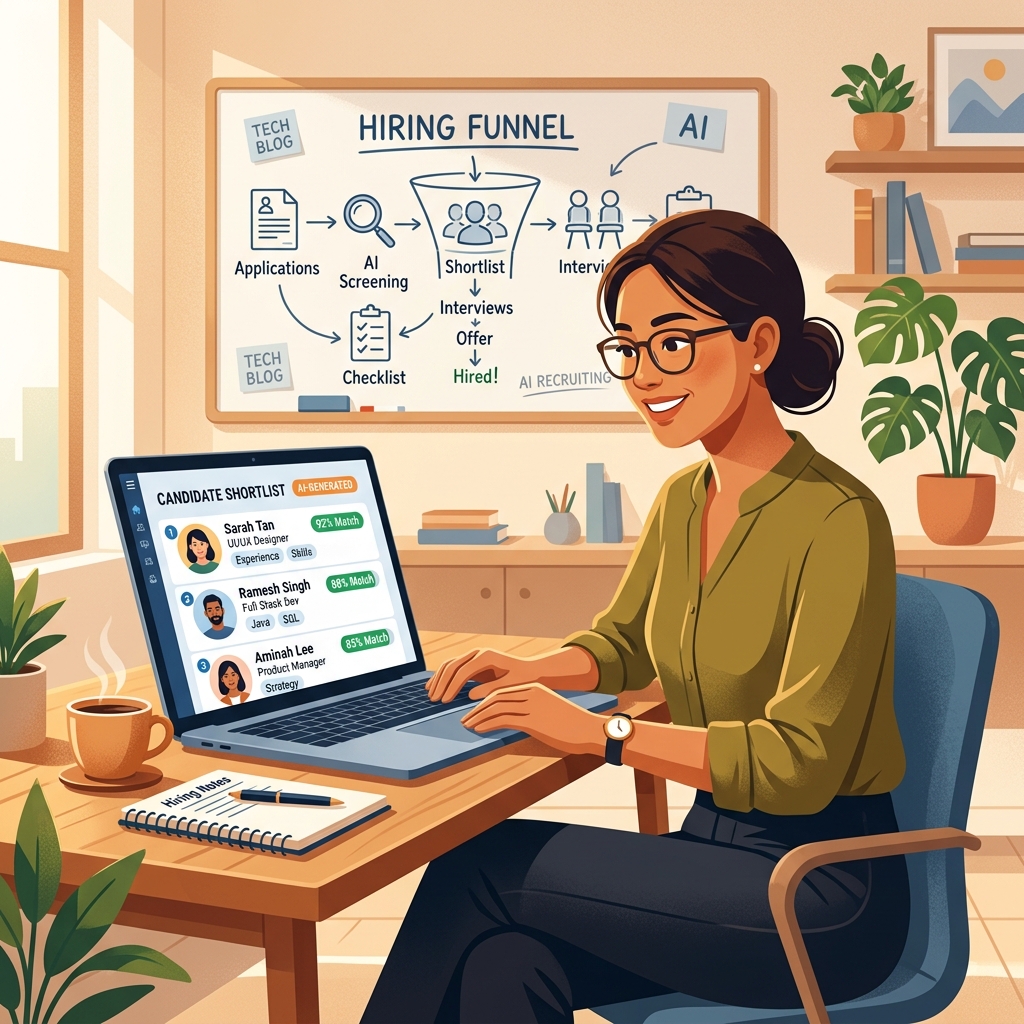
Featured image concept: A Malaysian SMB owner reviewing a clean AI-generated shortlist of candidates on a laptop screen in a bright, modern small office — a coffee cup nearby, a whiteboard with a hiring funnel sketch on the wall behind them.
Schema markup: HowTo schema (for the action plan section), Article schema (for the main post), FAQPage schema (for the key considerations section).