68% of Small Businesses Use AI — But Most Are Winging It
A brand-new report from ECI Software Solutions, released just this week on March 12, paints a fascinating picture of where small and medium businesses stand with AI in 2026. The headline stat is encouraging: more than 70% of SMB leaders hold a positive view of AI. Adoption is real — roughly 68% of small businesses now use AI tools regularly.
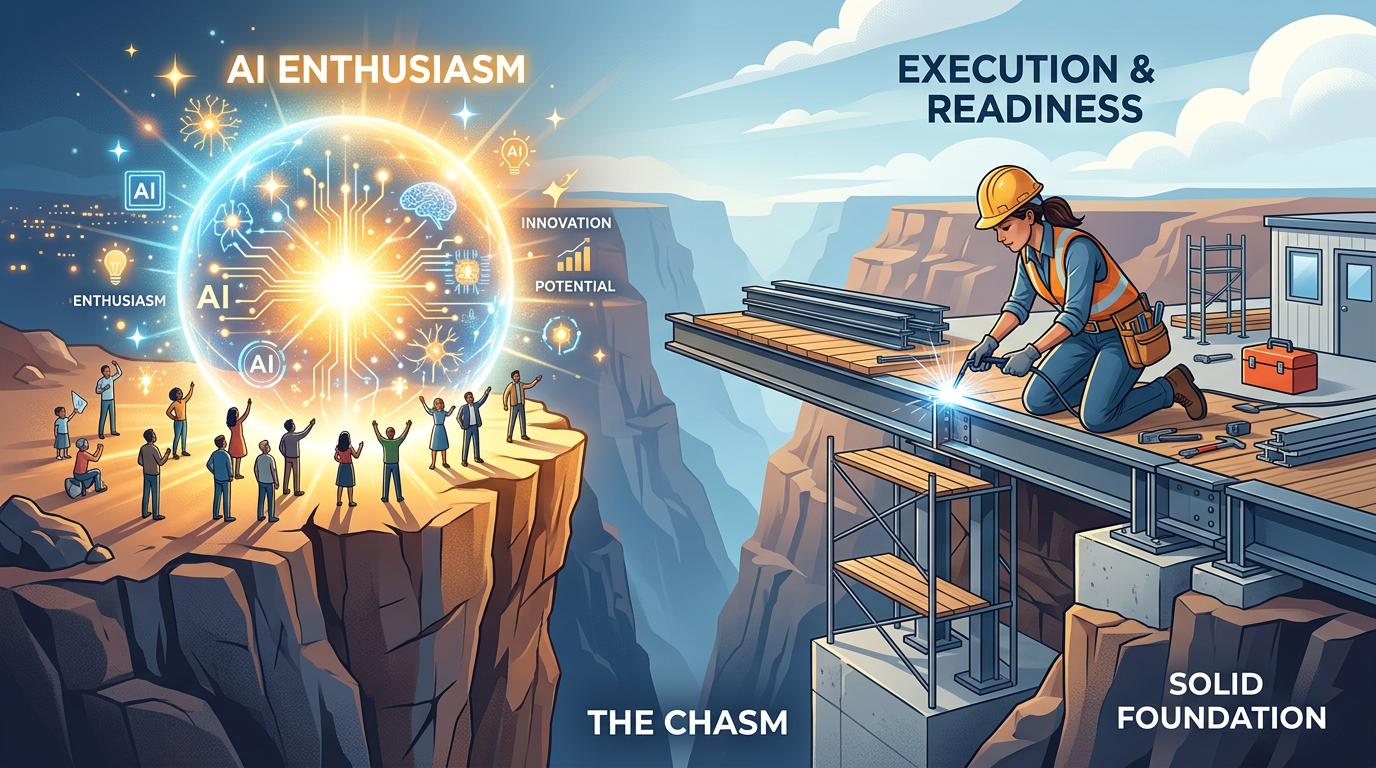
But here's the catch: most of them are winging it.
The same report, based on a survey of over 550 SMB leaders across the U.S., Canada, and Australia, found that gaps in data readiness, internal expertise, and formal strategy are slowing the path from adoption to actual impact. It's a story we keep seeing play out — enthusiasm outpacing execution.
The Numbers Tell a Clear Story
Let's stack up what we know heading into mid-March 2026:
- 71.4% of small businesses are actively using AI in some capacity (Small Business Expo, February 2026)
- 78.6% of those using AI report that it has reduced costs or improved efficiency
- 60% of SMBs identified data analysis and reporting as their top AI priority
- Yet the vast majority lack formal policies, training programs, or measurement frameworks
The gap between "using AI" and "getting measurable ROI from AI" is the defining challenge for small businesses right now. And it's not a technology problem — it's a strategy problem.
Why Enthusiasm Alone Doesn't Cut It
It's easy to sign up for ChatGPT, paste a few prompts, and call yourself an AI-powered business. But as PwC's 2026 AI Predictions report notes, technology delivers only about 20% of an initiative's value. The other 80% comes from redesigning work — rethinking which tasks should be automated, which processes need restructuring, and how your team actually integrates AI into their daily rhythm.
Here's what we're seeing go wrong at most small businesses:
Tool overload without focus. The average SMB now spends $50–$300 per month across 3–5 AI tools. But many of those subscriptions overlap, go underused, or were adopted in a burst of excitement without a clear use case.
No measurement framework. If you can't quantify the time saved, the errors prevented, or the revenue influenced, you can't tell whether AI is helping or just adding complexity.
Skipping the data foundation. AI is only as good as the data it works with. The ECI report highlights that data readiness remains one of the biggest barriers — and it's one that many SMBs haven't even begun to address.
A Simple Framework That Actually Works
We've found that the small businesses getting real, measurable results from AI follow a remarkably consistent pattern. It's not about being the most technical or having the biggest budget. It's about discipline.
Step 1: Pick One Pain Point
Not five. One. What is the single biggest time sink, bottleneck, or source of errors in your business right now? Common starting points include lead follow-up that falls through the cracks, manual data entry and invoice processing, answering the same customer questions repeatedly, and writing marketing content from scratch every week.
Step 2: Run a 30-Day Pilot
Choose one AI tool that directly addresses your pain point. Set it up, train your team on it, and commit to using it consistently for 30 days. Document your baseline metrics before you start — how long does this task take today? How many errors occur? What's the current cost?
Step 3: Measure Before You Scale
After 30 days, compare your results against the baseline. The businesses in the surveys reporting 3–5x ROI didn't get there by adopting everything at once. They got there by proving value with one tool, then building on that foundation.
Step 4: Formalize and Expand
Once you have a win, document the process. Create a simple AI policy for your team (it doesn't need to be complicated — even a one-page doc works). Then, and only then, add a second tool.
The Agentic AI Opportunity
There's a second wave building beneath the surface that's worth watching. The most significant AI development for SMBs in 2026 is the rise of agentic AI — autonomous systems that don't just respond to prompts but actively make decisions, take actions, and adapt workflows without constant human supervision.
Gartner predicts that by the end of 2026, 40% of enterprise applications will include task-specific AI agents. But this isn't just an enterprise play. Tools like Lindy AI are already bringing agent capabilities to small businesses — managing emails, scheduling meetings, qualifying leads, and handling internal tasks with minimal human intervention.
The businesses that master the basics now — clean data, clear processes, measurable outcomes — will be the ones best positioned to ride the agentic wave as it matures.
The Real Competitive Advantage
Here's what makes this moment so interesting for small businesses: 82% of small businesses using AI have actually increased their workforce, according to the U.S. Chamber of Commerce. AI isn't replacing people at SMBs — it's amplifying them.
The competitive advantage isn't having AI. At 68% adoption, almost everyone has it. The competitive advantage is having a strategy for it. It's the difference between a tool that sits unused after the first week and a system that saves your team 20+ hours per month.
If you're in the 68% using AI but the 80%+ without a formal strategy, this is your wake-up call. The gap between AI enthusiasm and AI results is where opportunity lives — and closing it doesn't require a bigger budget. It requires a clearer plan.
The data referenced in this post comes from ECI Software Solutions' AI Readiness Report (March 2026), the Small Business Expo AI Survey (February 2026), PwC's 2026 AI Predictions, IDC's SMB 2026 Digital Landscape report, and the U.S. Chamber of Commerce.