AI for Malaysian Restaurants: How F&B Owners Can Cut Costs and Scale in 2026
Malaysia's F&B industry has a numbers problem. There are 136,453 food and beverage establishments competing for the same customers — and input costs, labour shortages, and supply chain pressure are squeezing margins from every direction. Meanwhile, Visit Malaysia 2026 is targeting 47 million tourists, which means the next 12 months represent a rare window: the customer demand is coming. The question is whether your restaurant will be ready to capture it, or whether your competitors will.
AI for restaurants in Malaysia is no longer a futuristic investment. Across the industry — from chain operators like Secret Recipe to independent kopitiam owners — AI tools are delivering measurable outcomes: less food waste, higher customer retention, and leaner operations. This guide covers the practical applications, real Malaysian examples, funding options, and a step-by-step action plan you can start this week.
Why 2026 Is a Defining Year for Malaysian F&B
Malaysia's foodservice market was valued at USD 14.75 billion in 2025 and is forecast to reach USD 16.67 billion in 2026, growing toward USD 30.74 billion by 2031 at a CAGR of 13.05%. The structural tailwinds are strong: rising consumer spending, a recovering tourism sector, and a government that is actively investing in SME digitalisation.
But the same forces that make 2026 an opportunity also make it unforgiving. Rising ingredient costs, tightening labour policies around foreign worker quotas, and increasingly demanding customers are compressing already-thin margins. The Malaysian F&B sector contributes 3.3% of national GDP and employs nearly 1.08 million people.
The government has allocated RM550 million for Visit Malaysia 2026 tourism promotion, and the country had already reached 40 million tourist arrivals as of October 2025. That influx creates a direct multiplier effect for restaurants, cafes, and hospitality businesses — but only if operations can absorb the volume without hiring proportionally more staff.
AI is the mechanism that makes that possible.
Where AI for Restaurants in Malaysia Makes the Biggest Difference
Not all AI use cases deliver equal returns. For F&B businesses, the highest-ROI applications share a common trait: they attack the cost lines that hurt the most.
Demand Forecasting and Inventory Management
Food waste is one of the single largest cost drivers in any restaurant. AI systems that connect your point-of-sale data, historical sales patterns, seasonal trends, and weather data can predict demand with dramatically higher accuracy than any spreadsheet or experienced gut feel.
According to IBM research, businesses using AI-driven forecasting see an 85% improvement in accuracy. Capgemini puts demand forecasting error reduction at up to 50%, with lost sales from stockouts dropping by as much as 65%. Applied to a restaurant context, this translates directly into fewer spoiled ingredients, less over-ordering, and tighter inventory turns — the difference between a 5% food cost improvement and a five-figure annual saving.
Modern AI-powered POS systems do not just record transactions. They suggest real-time menu changes, flag underperforming dishes, and recommend first-in-first-out picks for at-risk stock before it spoils. The connection between your kitchen inventory and your sales data, managed automatically, is where most cost savings live.
Customer Loyalty and Retention
Attracting a new customer costs five to seven times more than retaining an existing one. AI loyalty systems change the economics by automating what human staff can never do consistently: personalizing every customer interaction at scale.
Mulah, a Malaysian loyalty platform used by over 500 local eateries and retailers, has demonstrated a 6–8% sales lift by automating visit and purchase pattern capture, running targeted SMS campaigns, and reducing customer churn. The system identifies at-risk customers before they stop returning and triggers the right incentive at the right moment.
Secret Recipe embedded generative AI and cloud-based tools to analyze sales patterns, automate inventory planning, and craft personalized loyalty offers — improving engagement across its entire chain while managing costs. For independent operators, this level of capability used to require a data science team. Today it runs from a subscription platform integrated with standard Malaysian POS systems.
AI-Powered Marketing and WhatsApp Automation
Malaysian consumers are among the highest WhatsApp users in Southeast Asia. A WhatsApp AI chatbot handles reservations, answers menu questions, sends loyalty reminders, and follows up after visits — without adding headcount. WhatsApp AI chatbots for Malaysian SMEs can typically be deployed within days and immediately cut inbound response times from hours to seconds.
On the marketing side, AI content creation tools for Malaysian SMBs generate a full month of social media posts, promotional graphics, and campaign copy in a single session. For a restaurant marketing to both local regulars and Visit Malaysia 2026 tourists arriving from China, India, and the broader ASEAN region, this eliminates the constant bottleneck of content production.
Personalized promotions tied to customer behavior — the birthday offer, the midweek slow-period discount sent to high-value customers, the post-visit re-engagement message — all run automatically once the system is configured.
Staffing and Scheduling Optimization
Labour is the second-largest cost line for most restaurants, and also the hardest to manage. Malaysia's tightening foreign worker policies have left many F&B operators shorthanded, with no clear path to hiring out of the problem.
AI scheduling tools analyze historical foot traffic, booking data, and seasonal patterns to generate optimal shift schedules — reducing overtime costs and ensuring coverage without padding headcount. If you have been exploring how to hire smarter without a dedicated HR department, AI scheduling is the natural companion: once you have the right people, AI ensures you are deploying them efficiently.
AI voice agents for small businesses are also entering the F&B space, handling phone-in reservations and takeaway orders automatically — freeing front-of-house staff for the in-person experience where human presence actually matters.
Customer Service and Online Reputation
Every unanswered review on Google or Foodpanda, every WhatsApp query that goes three hours without a reply, is a customer quietly deciding to try somewhere else. AI customer service agents trained on your menu, policies, and FAQs respond in seconds — in Bahasa Malaysia, English, Mandarin, or all three simultaneously.
The operational model shifts from reactive firefighting to proactive relationship management. Issues escalate to human staff when they require judgment; routine queries never reach a human queue at all. For restaurants with aspirations to capture tourist trade during Visit Malaysia 2026, multilingual AI support is not a nice-to-have — it is a competitive baseline.
Key Considerations Before You Start
Start with a Real Problem, Not a Tool
The F&B operators who get poor ROI from AI are almost always those who bought a tool without a clear use case and success metric attached to it. Before choosing any platform, identify which cost centre or revenue gap you are solving. Build your AI strategy before adding more tools — the principle applies to restaurateurs as much as any other business owner.
Your Data Quality Matters
AI forecasting is only as good as the data it ingests. If your POS data is inconsistent, your inventory tracking is manual, or your customer records are incomplete, the AI recommendations will reflect that. Cleaning up your data foundation is not glamorous work, but it is the prerequisite for everything else.
Integration with Existing Systems
Most Malaysian restaurants run on local POS platforms such as StoreHub, Eats365, or iMakan. Before committing to any AI tool, confirm that it integrates natively with your existing stack — or factor in the switching costs honestly. The best AI solution is the one that works within your current workflow, not despite it.
How to Fund Your AI Transformation
Cost is the most common objection, but Malaysian restaurant owners have more government support than most realize.
The government has made SME AI adoption a national priority. Under MDEC, a RM53 million AI adoption grant is available for SMEs deploying AI in forecasting, marketing, and customer support. The TECHAD Fund offers up to RM10 million per company for automation and technology integration. A 50% additional tax deduction for AI and cybersecurity training is available under the National AI Office.
A full breakdown of available programmes — including eligibility criteria and application steps — is covered in the Malaysia SME digitalisation grants guide for 2026. Many qualifying F&B operators are not applying simply because they are unaware these programmes exist.
Before investing your own capital, it is worth understanding how to calculate AI ROI for your specific use case. The framework helps you project payback periods and present the business case internally — or to a bank or grant committee.
Malaysia's broader digital investment landscape, shaped by RM87.4 billion in committed foreign investment, continues to drive down the cost and increase the availability of AI tools designed for SME budgets. What required enterprise-level spending two years ago is now accessible on a RM500–RM2,000 per month subscription.
Your 5-Step Action Plan for AI Adoption
Most F&B operators who successfully implement AI do it incrementally — solving one expensive problem at a time rather than replacing all systems simultaneously.
-
Start with demand forecasting — Connect your POS data to an AI forecasting tool and identify your highest-waste ingredient categories. Most platforms offer a free trial or pilot period. A 10% reduction in food waste in the first month typically covers the tool cost in full.
-
Deploy a WhatsApp AI chatbot — Configure it for reservations, menu enquiries, and post-visit follow-up. Set escalation rules for complaints or unusual requests. This is typically deployable within a week and immediately reduces inbound response time to near-zero.
-
Set up an AI loyalty program — Use a platform that integrates with your POS to capture purchase patterns automatically. Define three customer segments — new, regular, and at-risk — and configure automated re-engagement messages for the at-risk segment first. Measure redemption rates and retention weekly.
-
Automate your social media and marketing content — Use AI to plan and draft one month of content in a single session. This removes one of the most time-consuming manual tasks from your weekly routine and maintains consistent brand visibility online, including for tourists discovering your restaurant through social channels.
-
Review results and expand — After 60–90 days, review cost savings and revenue impact before adding the next layer. The AI workflow automation guide for small businesses covers how to connect multiple tools into a unified system once the individual pieces are working.
Do not overlook the back-office side. AI accounting for small businesses handles GST reporting, payroll, and supplier reconciliation — directly relevant to the MyInvois e-invoicing requirements now in effect for businesses above certain revenue thresholds. The administrative time savings free up attention for the parts of running a restaurant that actually require your judgment.
The Bottom Line
Malaysia's F&B sector is entering a period of genuine opportunity: a USD 16.67 billion market, 47 million projected inbound tourists, and a government actively funding digital transformation. The restaurants that capture this wave will not necessarily be those with the biggest marketing budgets — they will be the ones whose operations can handle increased volume without proportional increases in headcount or cost.
AI for restaurants in Malaysia is no longer a future investment. The tools exist. The local case studies are documented. The government funding is available. The competitive gap between operators who have adopted and those who have not is already widening. The decision now is simply how quickly you want to close that gap.
Internal links used:
- WhatsApp AI Chatbots for Small Business: How Malaysian SMEs Can Automate Sales and Support
- AI Content Creation for Malaysian SMBs: How to Produce a Month of Social Media Posts in One Day
- AI Recruitment for Malaysian SMBs: How to Hire Smarter Without an HR Department
- AI Voice Agents for Small Business: How to Automate Phone Calls and Save Thousands
- AI Customer Service Agents for Malaysian SMBs: How to Cut Support Costs by 30%
- Why Your Small Business Needs an AI Strategy Before Another AI Tool
- Malaysia SME Digitalisation Grants in 2026: How to Fund Your AI Transformation
- How to Calculate AI ROI: A Framework for Getting Budget Approved
- Malaysia's RM87.4 Billion Digital Investment Boom: What It Really Means for Your Small Business
- AI Workflow Automation for Small Business: n8n vs Make vs Zapier (2026 Guide)
- AI Accounting for Small Business: How to Automate Your Bookkeeping and Save Hours Every Week
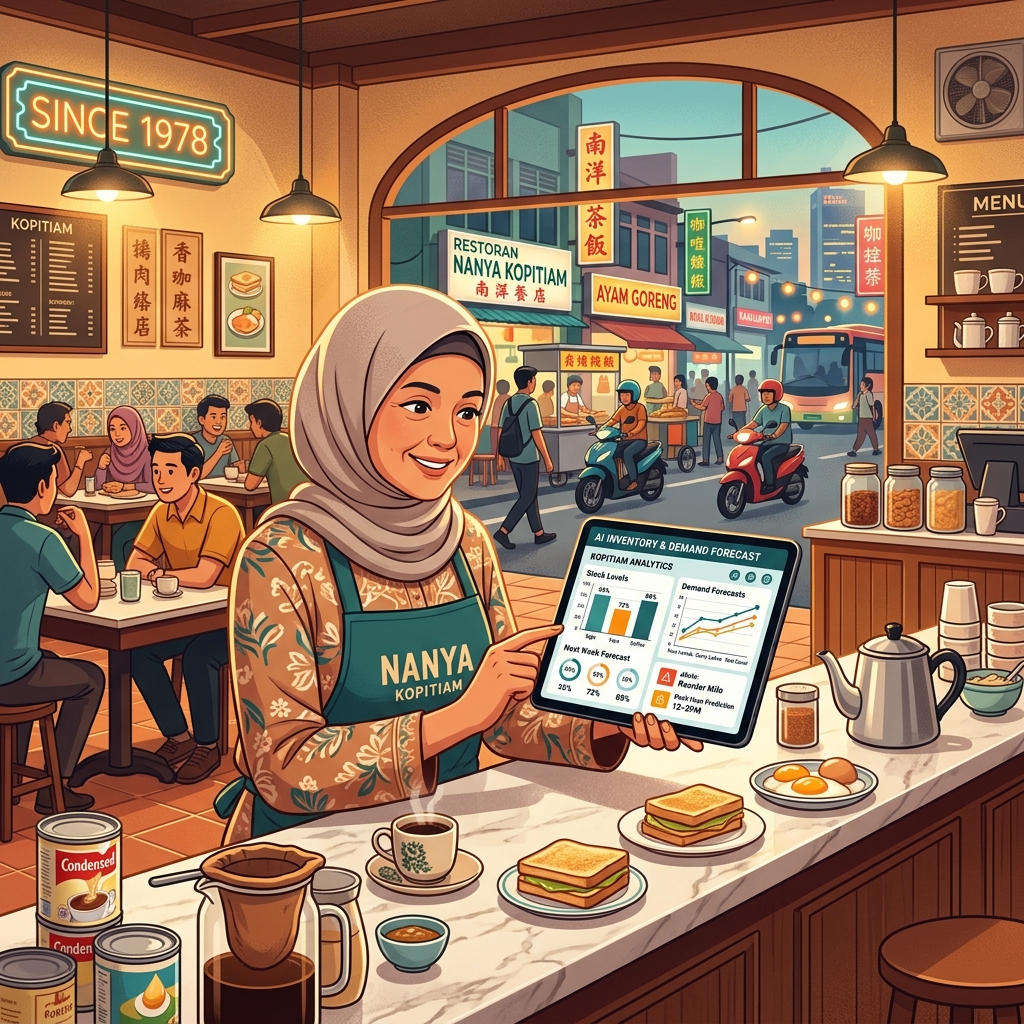
Featured image concept: A Malaysian restaurant owner reviewing an AI dashboard on a tablet at a warmly lit kopitiam counter — the screen shows inventory levels and demand forecasts overlaid on a busy street scene outside, blending the familiar textures of Malaysian F&B culture with modern technology.
Schema markup: Article, HowTo (for the 5-step action plan), LocalBusiness, FAQPage