AI Accounting for Small Business: How to Automate Your Bookkeeping and Save Hours Every Week
Most small business owners did not start their company to spend evenings reconciling bank statements. Yet bookkeeping, invoicing, and financial reporting eat up five to ten hours every week for the average SMB founder. AI accounting tools now automate 80 to 90 percent of that work — and the technology has finally become affordable enough for businesses of any size.
Here is what AI accounting actually looks like in practice, which tasks you should automate first, and how to pick the right tools without adding to your AI tool overload.
Why AI Accounting Matters for Small Businesses Right Now
The numbers tell a clear story. AI adoption among accountants jumped from 9 percent to 41 percent daily usage in just one year, according to Accounting Today's 2026 survey. Firms using AI report a 7x return on investment within the first year and 30 percent margin increases. For small businesses specifically, AI-powered bookkeeping platforms can automate up to 90 percent of routine tasks while achieving 96 to 99 percent accuracy on reconciliations.
This is not a future trend. It is happening now and accelerating fast. The global AI accounting market is projected to reach $10.87 billion in 2026, growing at a 44.6 percent compound annual rate. Small and medium enterprises are the fastest-growing segment driving that growth.
Three forces are converging to make 2026 the tipping point for AI accounting adoption among SMBs.
Mandatory E-Invoicing Is Expanding
Governments across Asia are mandating electronic invoicing. In Malaysia, LHDN's Phase 4 went live on January 1, 2026, requiring businesses with annual revenue between RM1 million and RM5 million to submit e-invoices through the MyInvois system. This directly affects tens of thousands of Malaysian SMEs who must now digitise their invoicing workflows or face compliance issues.
Manual invoice submission cannot keep up with daily transaction volumes at scale. AI-powered accounting tools handle this automatically — extracting data from receipts and invoices using OCR, categorising transactions, and submitting compliant e-invoices to tax authorities without manual data entry.
AI Tools Are Finally Affordable
Until recently, AI accounting was enterprise-only technology. That has changed. Platforms like Booke AI, Bukku, and QNE now offer AI-powered bookkeeping starting at prices accessible to solo entrepreneurs. Many integrate directly with QuickBooks and Xero, so you do not need to switch your existing accounting stack.
The Talent Gap Is Real
Finding affordable, qualified bookkeepers is harder than ever. The AI skills gap extends to accounting — there simply are not enough skilled professionals to serve every small business that needs them. AI fills this gap by handling the repetitive 80 percent of bookkeeping work, letting your existing team (or your accountant) focus on the strategic 20 percent.
What AI Can Actually Automate in Your Accounting
Not all accounting tasks are equally suited to automation. Here is a practical breakdown of what works well, what needs human oversight, and what still requires a qualified accountant.
Fully Automatable Tasks
These are the tasks where AI delivers immediate ROI with minimal setup:
- Bank reconciliation — AI matches transactions across bank feeds, credit cards, and payment platforms automatically. Modern tools achieve 96 to 99 percent accuracy, flagging only exceptions for human review.
- Invoice data extraction — AI reads invoices, receipts, and bills using optical character recognition (OCR), then categorises and records them. Accuracy rates hit 92 to 99 percent on structured documents.
- Expense categorisation — Machine learning models learn your chart of accounts and categorise transactions automatically. After one to three months of training data, most tools handle this without intervention.
- Recurring invoice generation — AI identifies patterns in your billing and generates recurring invoices on schedule, reducing missed payments and late billing.
- E-invoice submission — For Malaysian businesses using the MyInvois system, AI tools auto-format and submit invoices to LHDN, validate them in real time, and store the confirmation.
Partially Automatable (AI + Human)
These tasks benefit from AI assistance but still need a human in the loop:
- Cash flow forecasting — AI analyses historical patterns and predicts future cash positions. Useful for planning, but major decisions still need human judgement about business context.
- Anomaly and fraud detection — AI flags unusual transactions with less than 1 percent false positive rates. A human still decides what action to take on flagged items.
- Tax categorisation — AI handles standard categories well, but edge cases around deductibility and tax treatment require professional review.
- Financial reporting — AI can generate standard reports automatically, but interpreting them for business decisions remains a human skill.
Still Requires a Professional
Do not expect AI to replace your accountant entirely. These tasks need qualified professionals:
- Tax planning and strategy — Understanding your business goals, entity structure, and optimisation opportunities.
- Audit preparation — Complex compliance work that requires professional judgement and sign-off.
- Advisory services — Turning financial data into business strategy is where human accountants add their highest value.
The goal is not to eliminate your accountant. It is to stop paying professional rates for data entry work. As covered in our guide on how to implement AI automation in your business, the best approach is automating high-volume, low-complexity tasks first.
How to Choose the Right AI Accounting Tool
The market is flooded with options. Here is a framework for choosing the right tool based on your business needs.
For Solo Entrepreneurs and Micro-Businesses
If you are a one-person operation or have fewer than five employees, look for:
- Low setup complexity — You need something that works within days, not months.
- Direct bank feed integration — The tool should pull transactions automatically from your bank accounts.
- Receipt scanning — Mobile-friendly OCR for capturing expenses on the go.
- Affordable pricing — Under $50 per month for core features.
Tools in this category include Booke AI (integrates with QuickBooks and Xero), Puzzle (designed for startups), and for Malaysian businesses, Bukku and InvoisPls offer LHDN-compliant e-invoicing with AI-powered OCR.
For Growing SMBs (5 to 50 Employees)
At this stage, you need more sophistication:
- Multi-entity support — If you run multiple business units or locations.
- Accounts payable and receivable automation — End-to-end invoice processing, not just categorisation.
- Integration with your existing stack — CRM, payroll, inventory, and AI chatbots for your website should all connect to your financial data.
- Customisable approval workflows — Set rules for who approves what spending.
For Malaysian SMEs Specifically
If you operate in Malaysia, prioritise:
- LHDN MyInvois compliance — The tool must support the e-invoice format required by LHDN and handle validation through the MyInvois portal or API.
- SST handling — Proper Sales and Service Tax computation and reporting.
- Ringgit and multi-currency support — If you deal with international suppliers or customers.
- BM and English interface — Useful if your team operates in both languages.
QNE AI Cloud Accounting, Bukku, and InvoisPls are built specifically for the Malaysian market with LHDN compliance baked in.
A Step-by-Step Plan to Automate Your Accounting This Month
You do not need to overhaul everything at once. Having a clear AI strategy before jumping into tools prevents wasted effort and subscription bloat. Here is a practical four-week plan.
Week 1 — Audit Your Current Process
- List every accounting task you or your team performs weekly. Include time spent on each.
- Identify the biggest time sinks — Usually bank reconciliation, expense categorisation, and invoice processing.
- Calculate your current cost — Hours spent multiplied by your hourly rate (or your bookkeeper's rate). Use the AI ROI framework to build a business case if needed.
Week 2 — Select and Set Up Your Tool
- Pick one tool that covers your top two or three pain points. Do not try to automate everything simultaneously.
- Connect your bank feeds — This is the single highest-impact integration. Most tools start delivering value within hours of connecting your bank.
- Import your chart of accounts — If you are migrating from existing software, export and import your account structure.
Week 3 — Train and Validate
- Review AI categorisations daily for the first week. Correct any mistakes — the AI learns from your corrections.
- Set up rules for recurring transactions the AI consistently miscategorises.
- Test invoice processing — Upload ten historical invoices and verify the extracted data matches your records.
Week 4 — Expand and Optimise
- Enable automated reconciliation once you trust the categorisation accuracy.
- Set up automated reports — Weekly cash flow summaries, monthly P&L, and any compliance reports you need.
- Review time saved — Compare hours spent this week versus your Week 1 baseline.
Most businesses see a 40 to 60 percent reduction in bookkeeping time within the first month. After three months of AI learning, that often reaches 70 to 80 percent.
Key Considerations Before You Start
Data Security and Privacy
Your financial data is sensitive. Before choosing any tool, verify:
- Where your data is stored (cloud region matters for compliance)
- Encryption standards (AES-256 at minimum)
- Access controls and audit trails
- Whether the tool uses your data to train its models (some do, some do not)
For Malaysian businesses, ensure the provider complies with the Personal Data Protection Act (PDPA) 2010.
The Training Period Is Real
AI bookkeeping tools need one to three months of transaction data to learn your business patterns. During this ramp-up period, expect to spend more time reviewing and correcting than you will once the system is trained. This is normal and temporary.
Integration Matters More Than Features
A tool with 50 features that does not connect to your bank, payment processor, or existing accounting software is less useful than a simpler tool that integrates with everything you already use. Prioritise integrations over feature lists.
Human Oversight Is Non-Negotiable
AI accounting achieves impressive accuracy, but it is not infallible. Maintain these safeguards:
- Monthly review of all AI-categorised transactions by a qualified person
- Quarterly reconciliation check by your accountant
- Clear escalation rules for transactions above a certain amount
As the AI adoption gap research shows, businesses that combine AI with proper human oversight consistently outperform those that either avoid AI entirely or rely on it blindly.
What This Means for Malaysian SMEs
Malaysia's e-invoicing mandate is not just a compliance exercise — it is a forcing function for digital transformation. Businesses with annual revenue above RM1 million are now required to submit e-invoices through LHDN's MyInvois system. The government is offering up to RM50,000 in annual tax deductions for e-invoicing implementation consultancy fees through 2027, and MDEC's RM53 million AI adoption grant is available to help SMEs integrate AI tools.
If you have been putting off digitising your accounting, the compliance deadline removes the option of waiting. The smart move is to treat e-invoicing as the trigger to modernise your entire financial workflow — not just the invoicing part.
Building your first AI-powered digital workforce starts with the processes that cost you the most time. For most businesses, accounting is at the top of that list.
The Bottom Line
AI accounting is no longer experimental or expensive. The tools are mature, the ROI is proven — 7x returns within a year, 30 percent margin improvements, and hours of manual work eliminated every week. Whether you are a Malaysian SME navigating e-invoicing compliance or a growing business anywhere in the world drowning in bookkeeping, the path forward is clear.
Start with bank reconciliation and expense categorisation. Pick one tool. Give it a month. The first digital employee most businesses should hire is not a customer service bot — it is an AI bookkeeper that works 24 hours a day, makes fewer errors than a human, and costs a fraction of a full-time hire.
Your accountant should be advising you on strategy, not entering receipts. AI makes that possible right now.
Internal links used:
- AI tool overload — "AI tool overload"
- The AI skills gap — "AI skills gap"
- How to implement AI automation in your business — "how to implement AI automation in your business"
- AI chatbots for your website — "AI chatbots for your website"
- Having a clear AI strategy — "AI strategy"
- AI ROI framework — "AI ROI framework"
- AI adoption gap research — "AI adoption gap"
- Building your first AI-powered digital workforce — "AI-powered digital workforce"
- First digital employee — "first digital employee"
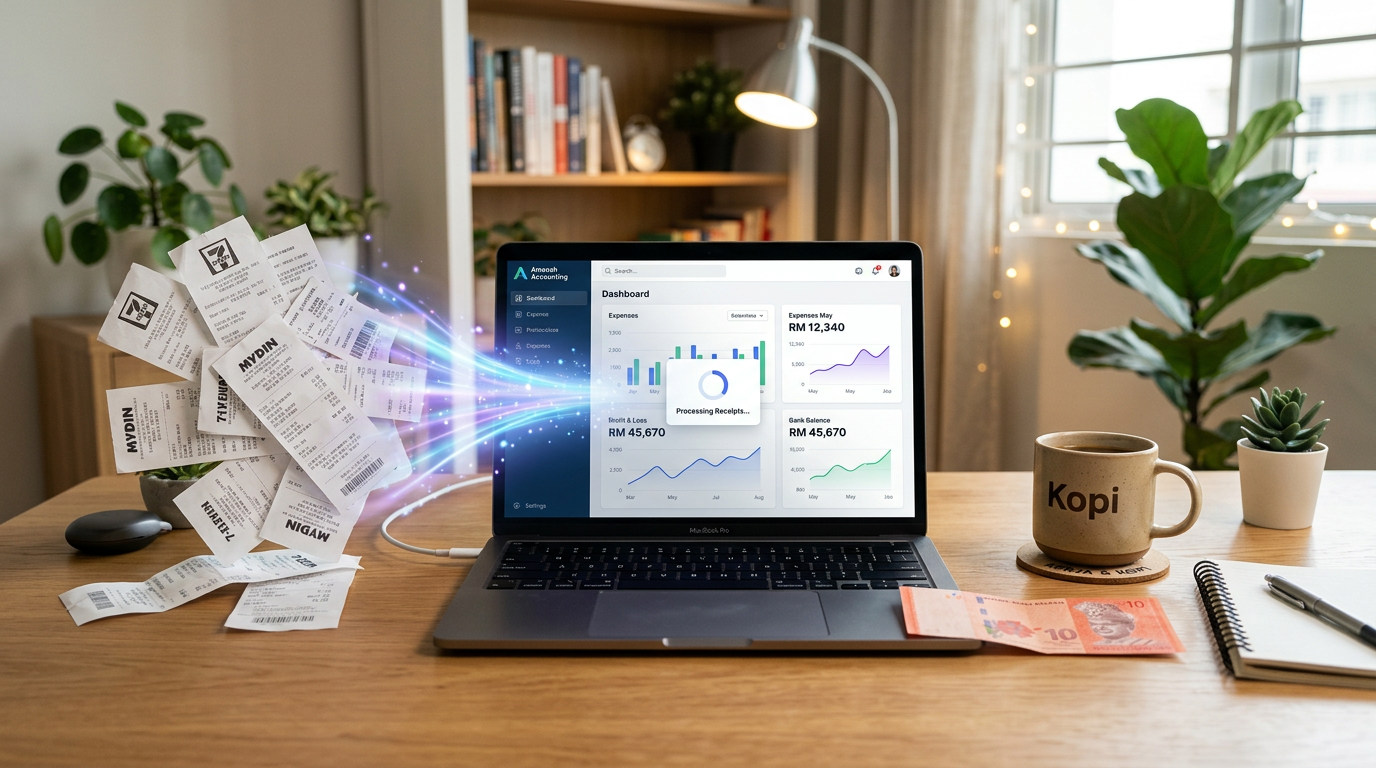
Featured image concept: A warm, modern workspace desk with a laptop showing a clean accounting dashboard, a small stack of receipts being "absorbed" into the screen by a soft blue AI glow, with a Malaysian ringgit note and a coffee cup in the background.
Schema markup: Article, HowTo, FAQPage