AI Agents for Malaysian SME Logistics: How to Cut Supply Chain Costs and Build Resilience in 2026
Supply chain disruptions are costing Malaysia's economy RM8.7 billion every year — and that figure was calculated before the latest wave of trade volatility hit. For Malaysian SMEs managing logistics, the pressure is compounding. AI for supply chain Malaysia is no longer an enterprise-only capability. The tools are accessible, the costs have come down sharply, and the businesses that automate the right parts of their logistics operations now will carry a structural cost advantage into whatever comes next.
The Double Pressure on Malaysian SME Supply Chains
Malaysian businesses are caught between two forces right now.
The first is global trade disruption. The ongoing effects of US tariffs have reshaped sourcing decisions, extended lead times, and introduced overnight cost swings that no manual planning system can absorb fast enough. When landed costs can change week-to-week, you need systems that can model scenarios and flag risks in real time — not a procurement manager who finds out three days later.
The second pressure is structural. Most Malaysian SMEs are still running supply chains on outdated manual systems. Research shows only 21% of Malaysian businesses have fully scaled digital solutions across their operations. Stock counts happen in spreadsheets. Supplier coordination happens over WhatsApp. Delivery delays are typically discovered when a customer complains, not when the shipment misses its window.
According to TRADLINX's analysis, these disruptions collectively cost Malaysia's economy 0.47% of GDP annually — a figure that falls disproportionately on SMEs who lack the buffer capital that large enterprises can absorb. The combination of external volatility and internal manual processes creates a gap that AI agents are specifically designed to close.
What AI Supply Chain Agents Do for Malaysian SMEs
Before getting into specific use cases, it helps to be precise about what an AI agent actually does in a logistics context — because this is different from using AI to draft emails or generate reports.
An AI agent is a system that perceives information from multiple sources, reasons about what that information means, makes decisions based on defined goals, and takes action — without waiting for a human to direct it at each step.
In supply chain operations, this might look like: an agent that monitors your supplier's shipment tracking feed, detects that a container is 48 hours behind schedule, cross-references your current inventory levels against upcoming customer orders, calculates the stockout risk, and automatically contacts your backup supplier to expedite a partial order — all before you have opened your laptop.
That is not a chatbot. That is an autonomous system taking real action on your business's behalf. For a deeper understanding of how multiple agents can hand off tasks to each other in complex logistics workflows, the guide on multi-agent AI explains how coordinated agent systems work together.
Four Core AI Agent Use Cases for Malaysian Logistics SMEs
1. Demand Forecasting and Inventory Optimisation
The most immediately valuable AI logistics use case is also the least glamorous: predicting how much stock you need, when you need it, and where it needs to be.
Manual demand planning typically relies on last year's sales figures adjusted by instinct. AI-driven forecasting pulls in historical sales data, seasonal patterns, promotional calendars, supplier lead times, and external signals — market trends, weather, regional events — to generate forward projections that are continuously updated as new data arrives.
The results are measurable. Malaysian businesses implementing AI-driven demand forecasting report a 12–19% improvement in inventory turnover, according to MDEC research. Across the broader logistics industry, agentic AI systems have demonstrated a 14.2% reduction in stockouts and an 8.7% drop in excess inventory compared to traditional planning methods. For a Malaysian distributor carrying RM500,000 in inventory, even a 10% efficiency improvement frees up RM50,000 in working capital.
The principles covered in the AI inventory management guide for Malaysian retailers apply directly to broader distribution and logistics operations — the mechanics of demand signal, reorder logic, and safety stock calculation work the same way across industries.
2. Shipment Tracking and Proactive Delay Management
Reactive logistics — learning about problems after they have already hurt you — is the operational baseline for most Malaysian SMEs. A shipment misses its arrival window; you find out when the customer is already calling.
AI agents flip this to proactive management. By connecting to carrier APIs, port authority systems, and route data feeds, an agent can flag shipments at risk of delay 48 to 72 hours before the expected arrival, calculate the downstream impact on pending orders, trigger automated customer notifications with revised ETAs, and escalate exceptions that require human judgment directly to the right person.
Recent industry benchmarks from 2026 supply chain pilots show up to a 30% reduction in delivery times and a 22% cut in lead times for organisations deploying agentic logistics management. For a Malaysian SME processing 200 or more shipments per month, that reduction in delay-related costs and customer service hours compounds quickly into meaningful bottom-line savings.
3. Supplier Risk Monitoring and Alternative Sourcing
The volatility of the past two years has exposed a critical vulnerability in many Malaysian SME supply chains: single-source supplier dependency. When your main supplier goes offline — due to geopolitical disruption, factory shutdowns, port closures, or exchange rate moves — you need to know fast and have alternatives ready to act.
AI agents can run continuous background monitoring across your supplier base, tracking news feeds, shipping route status, foreign exchange movements, and port congestion metrics. When a risk threshold is crossed, the agent surfaces an alert, pre-populates an alternative sourcing request from your approved backup supplier list, and queues it for human approval.
Microsoft's agentic supply chain initiative, deployed in early 2026, reported that organisations using AI agents for supplier risk management were able to onboard alternative suppliers three times faster during disruption events than businesses relying on manual processes. In a trade environment where overnight cost changes are now routine, that speed matters enormously.
4. Automated Documentation and Compliance
This is the use case Malaysian SMEs most consistently underestimate — and it may carry the highest per-hour ROI of any logistics automation.
Import and export documentation — customs declarations, certificates of origin, invoice matching, duty calculation, and compliance verification — is time-intensive, error-prone, and increasingly regulated. With Malaysia's e-invoicing system MyInvois now expanding its mandatory scope, the documentation burden on SMEs will only grow through 2026 and 2027.
AI agents trained on your documentation templates, customs classification rules, Harmonised System codes, and compliance requirements can draft, validate, and flag discrepancies in trade documents in seconds. Businesses that have deployed documentation automation in logistics report 60–80% reductions in processing time and near-elimination of rekeying errors — the kind of mistakes that delay customs clearance and trigger penalties.
What Results Are Malaysian Businesses Actually Seeing?
The data from 2026 deployments is becoming harder to dismiss:
- Demand forecasting with AI: 12–19% improvement in inventory turnover (MDEC)
- Agentic shipment management: up to 30% reduction in delivery times
- AI-driven lead time forecasting: 22% reduction, 35–42% improvement in supplier-level accuracy
- Inventory optimisation: 35% reduction in excess stock levels possible
- Documentation automation: 60–80% reduction in processing time
- Fuel and logistics cost savings: 12–15% reported in pilot deployments
According to agentic AI adoption research published in 2026, 67% of companies that deployed agentic AI in supply chain and inventory management saw a measurable revenue increase. At scale, these numbers compound. A mid-sized Malaysian distributor processing RM10 million in annual throughput that achieves even half of these gains across three use cases is looking at a material shift in profitability.
Calculating the actual ROI of a logistics AI deployment is more tractable than most AI projects because the inputs are directly quantifiable — invoice values, delay penalty costs, headcount hours spent on documentation, and stockout losses all have numbers attached to them.
Key Considerations Before You Start
Your Data Quality Determines Everything
AI agents operate on the data they can access. If your inventory records are inconsistent, supplier lead times are not captured digitally, or your order management runs in disconnected spreadsheets, an AI agent will fail — not because the technology is inadequate, but because the inputs are unreliable.
Before deploying any logistics AI, audit your data infrastructure. You need clean, consistent records of: purchase orders and their actual vs. predicted lead times, supplier performance history, inventory movement by SKU, and shipment tracking data. This is not a blocker to starting — it is a prerequisite that smart teams address in the first 30 days.
Start With One Use Case, Not Five
The most common failure mode for Malaysian SMEs adopting AI for logistics is trying to automate everything simultaneously. The AI implementation guide is consistent on this point: identify the use case with the clearest pain and the most accessible data, prove ROI there, then expand.
For most Malaysian logistics SMEs, that starting point is demand forecasting and inventory optimisation. Your order history already exists somewhere. The ROI is directly measurable. The stakes of a contained pilot are manageable.
Grants Can Fund Most of This
The upfront investment in a mid-complexity AI logistics agent in Malaysia typically ranges from RM20,000 to RM250,000, depending on scope and integration complexity. That figure changes significantly when you factor in that Malaysia's SME Digitalisation Grant and MDEC programmes can cover 50–80% of qualifying technology spend. Several AI logistics automation projects qualify under the Digital Productivity and Technology Grant categories — your technology vendor should be able to advise on eligibility.
Data Security and Sovereignty Matter
Logistics data is commercially sensitive. Supplier contracts, pricing structures, route details, inventory levels, and customer order patterns are all competitive intelligence. Before deploying any third-party AI agent for logistics, review where your data is stored and processed — particularly for SMEs with cross-border supply chains subject to multiple jurisdictions. The AI agent security guide covers the full due diligence checklist, including data residency questions to ask every vendor before signing.
A 4-Step Action Plan for This Quarter
-
Map your three biggest logistics pain points — Where do you lose the most money, time, or customers? Stockouts? Late deliveries? Supplier failures? Documentation errors? Rank them by quantified cost impact, not by frustration level.
-
Audit your data — Identify what logistics data you have, where it lives, and how clean it is for each pain point. Most businesses have more usable historical data than they think — it is just sitting in disconnected systems.
-
Build a 60-day pilot on your highest-priority use case — Choose the pain point with the clearest data trail and the most direct cost attached to it. Commission or build an agent for that specific workflow. Give it 60 days of live data before evaluating results.
-
Measure before you expand — Before adding more AI use cases, calculate the actual ROI from your pilot. Use the documented cost savings and efficiency gains as the internal business case for the next stage of investment.
The Bottom Line
Malaysia's supply chain pressures are not temporary. The tariff environment remains volatile, supplier base risk has not abated, and customer expectations for delivery reliability only move in one direction. Logistics has always been a margin business — and the companies that automate the right parts of it earliest will have pricing power when their competitors are still absorbing disruption costs by hand.
AI supply chain agents for Malaysian SMEs are deployed, proven, and increasingly within budget for businesses serious about operational resilience. The question is not whether to adopt them — it is which part of your logistics operation needs them most urgently, and how fast you can build the data foundation to make them perform.
If you want to think through the right automation priorities before committing budget, the DLYC AI strategy guide covers how to map your operations against the highest-ROI AI use cases before you spend a single ringgit.
Internal links used:
- "The ongoing effects of US tariffs" →
/blog/2026/malaysia-us-tariff-impact-small-business-2026 - "AI agent" →
/blog/2026/ai-agents-for-small-business - "multi-agent AI" →
/blog/2026/what-is-multi-agent-ai - "AI inventory management guide for Malaysian retailers" →
/blog/2026/ai-inventory-management-malaysia-retail - "Malaysia's e-invoicing system MyInvois" →
/blog/2026/malaysia-e-invoicing-automation-myinvois - "Calculating the actual ROI" →
/blog/2026/how-to-calculate-ai-roi - "AI implementation guide" →
/blog/2026/how-to-implement-ai-automation-in-your-business - "SME Digitalisation Grant and MDEC programmes" →
/blog/2026/malaysia-sme-digitalisation-grant-2026-ai - "AI agent security guide" →
/blog/2026/ai-agent-security - "DLYC AI strategy guide" →
/blog/2026/small-business-ai-strategy
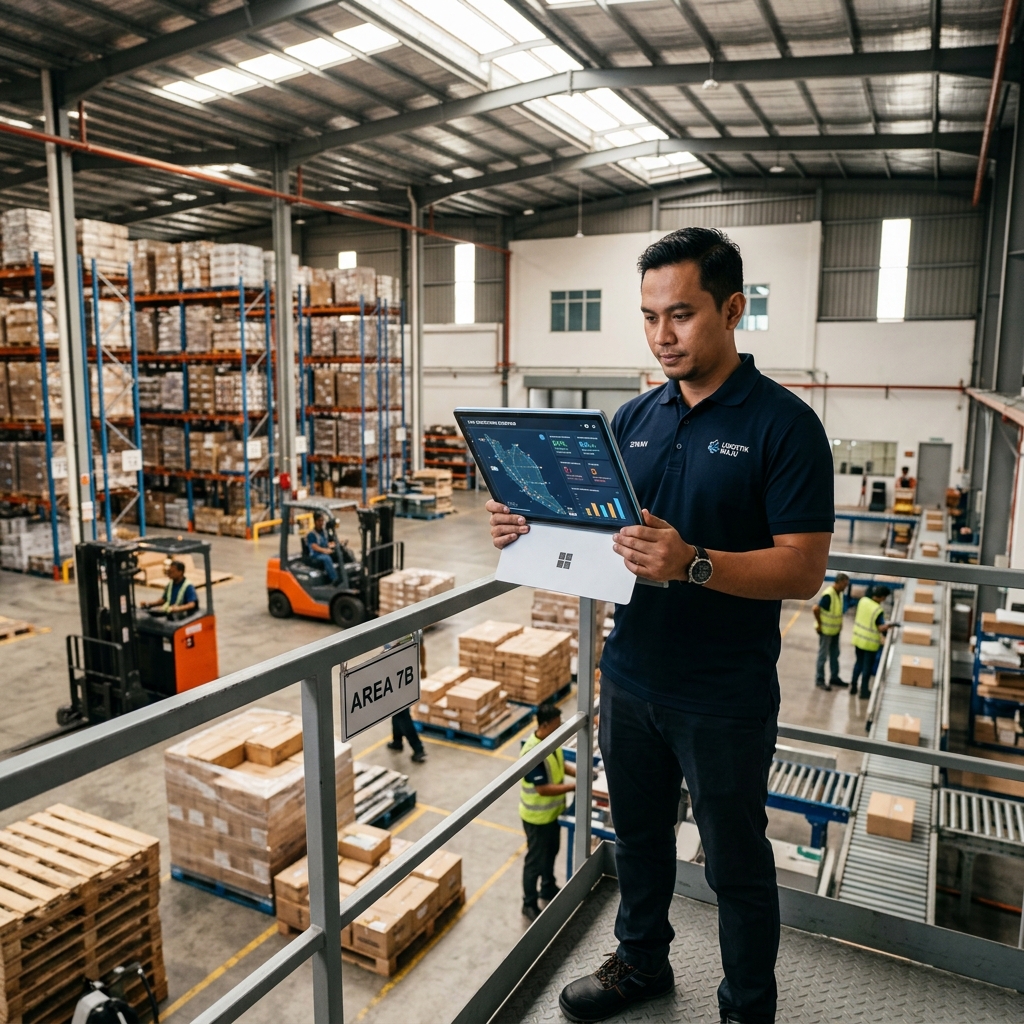
Featured image concept: A Malaysian warehouse operations manager reviewing a live AI logistics dashboard on a tablet, with shipment tracking overlays, inventory alerts, and supplier risk indicators visible on the screen. Modern facility, warm natural lighting from skylights, realistic and professional — conveys control and visibility rather than chaos.
Schema markup: Article, HowTo (for the 4-step action plan), FAQPage (addressing the key consideration questions)