What Is Model Context Protocol (MCP) and Why It Matters for AI Agents
An AI model can write code, draft emails, and analyze data — but it can't check your calendar, query your CRM, or pull the latest sales numbers from your database. Not without custom integrations built from scratch. Model Context Protocol (MCP) eliminates that problem. It's the open standard that gives AI agents a universal way to connect to the tools, data sources, and systems they need to actually be useful. And in 2026, it's becoming the backbone of how enterprise AI gets built.
Understanding the Model Context Protocol
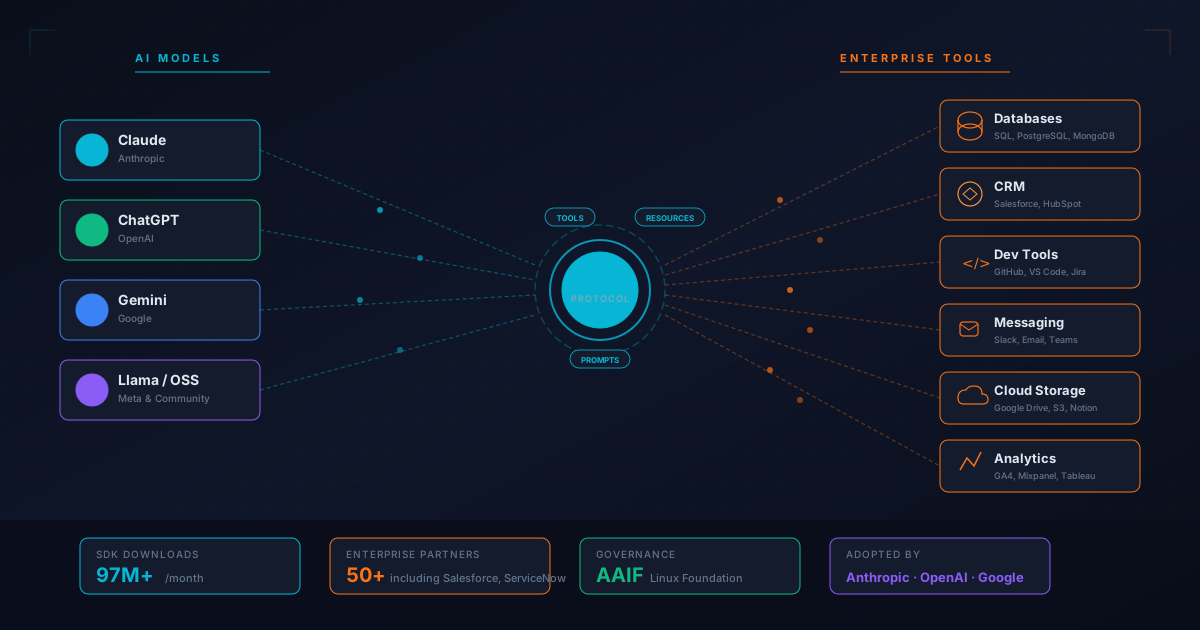
Model Context Protocol is an open-source framework introduced by Anthropic in November 2024 that standardizes how AI systems integrate with external tools, data sources, and applications. Think of it as USB-C for AI — a universal adapter that lets any AI model connect to any tool through a single, consistent interface.
Before MCP, connecting an AI agent to a business tool like Salesforce, Slack, or a company database required custom engineering for every single integration. Each data source needed its own connector, its own authentication flow, its own error handling. If you had 10 tools and 5 AI models, you needed 50 custom integrations. This is what developers call the N×M problem, and it made scaling AI agents painfully slow and expensive.
MCP solves this by creating one standardized protocol that works across models and ecosystems. Build a connector once, and it works everywhere — across Claude, ChatGPT, Gemini, open-source models, and any future AI system that adopts the standard.
Why MCP Exploded in 2025
MCP launched quietly. Few people noticed the initial November 2024 announcement. But the protocol's trajectory over the following 12 months was extraordinary.
The timeline tells the story:
- March 2025: OpenAI adopted MCP across its Agents SDK, Responses API, and ChatGPT desktop app. Sam Altman posted simply: "People love MCP and we are excited to add support across our products."
- April 2025: Google DeepMind confirmed MCP support in upcoming Gemini models.
- November 2025: The spec received major updates — asynchronous operations, statelessness, server identity, and an official community-driven registry for discovering MCP servers.
- December 2025: Anthropic donated MCP to the newly formed Agentic AI Foundation (AAIF) under the Linux Foundation. OpenAI and Block joined as co-founders, with AWS, Google, Microsoft, Cloudflare, and Bloomberg as supporting members.
The adoption numbers are staggering. MCP now has 97 million monthly SDK downloads across Python and TypeScript. Over 50 enterprise partners — including Salesforce, ServiceNow, Workday, Accenture, and Deloitte — are actively implementing the protocol. Tens of thousands of community-built MCP servers exist for everything from database queries to Slack messaging to GitHub operations.
When Anthropic, OpenAI, and Google all adopt the same protocol within a single year, that's not a trend. That's a standard.
How MCP Works
MCP uses a client-server architecture with three core components:
Hosts are the AI-powered applications that users interact with directly — tools like Claude Desktop, ChatGPT, Cursor, or any custom AI application. The host manages the user experience and coordinates communication.
Clients live inside the host and maintain dedicated connections to individual MCP servers. Each client handles one server connection, managing the protocol-level communication.
Servers are programs that expose specific capabilities to AI models. A server might provide access to a database, a file system, a web API, or any external tool. Each server defines what "tools" (actions), "resources" (data), and "prompts" (templates) it offers.
When a user asks an AI agent to "pull last quarter's revenue from our database," here's what happens: the host passes the request to the AI model, the model recognizes it needs database access, the client connects to the database MCP server, the server executes the query, and the results flow back through the same chain. The user never sees the plumbing.
This architecture draws direct inspiration from the Language Server Protocol (LSP), which standardized how code editors communicate with programming language tools. LSP gave us consistent code completion, error checking, and refactoring across every editor. MCP aims to do the same for AI agent integrations.
What You Can Build with MCP
1. AI-Powered Development Environments
MCP's earliest and deepest adoption happened in software development. IDEs like Cursor, Replit, Zed, and Visual Studio Code use MCP to give AI coding assistants real-time access to project context — not just the file you're editing, but your entire codebase, dependencies, documentation, and deployment configuration.
One standout example is Context7, an MCP server that feeds AI models up-to-date, version-specific documentation instead of relying on potentially outdated training data. This directly reduces hallucination in code suggestions.
2. Enterprise Workflow Automation
This is where MCP's business impact gets serious. AI agents connected via MCP can orchestrate multi-step workflows across tools that previously required manual bridging.
A marketing agent could pull campaign data from Google Analytics, cross-reference it with CRM records in Salesforce, draft a performance report, and schedule a Slack summary — all through standardized MCP connections. No custom API wrappers. No brittle integrations that break when one tool updates its interface.
3. Multi-Agent Coordination
As organizations deploy multiple specialized AI agents, MCP provides the common communication layer. Agents can discover each other's capabilities, share context, and coordinate complex processes without centralized control.
This connects directly to the six-layer AI agent infrastructure stack — MCP operates at the tool and orchestration layers, providing the connective tissue that ties the other layers together.
4. Natural Language Data Access
MCP enables users to query structured databases using plain language. Instead of writing SQL or navigating a dashboard, a sales manager can ask "what were our top 10 accounts by revenue last quarter" and get an accurate answer pulled directly from the production database through a governed MCP connection.
Key Considerations Before Adopting MCP
Security Is Still Maturing
MCP's rapid adoption has outpaced its security tooling. The protocol itself provides mechanisms for authentication and permission management, but enterprise-grade implementations require careful attention.
The biggest risks include tool poisoning attacks (malicious MCP servers that manipulate AI behavior), prompt injection through server responses, and unauthorized data access when agents connect to sensitive systems. Security researchers have flagged the potential for "Shadow Agents" — unvetted AI agents running on developer laptops accessing critical data systems without proper governance.
The November 2025 spec update added server identity verification and improved authentication, but organizations deploying MCP in production should implement strict authorization rules, monitor activity logs, and maintain an approved registry of vetted MCP servers.
Context Window Limitations
Every tool definition loaded into an AI model's context window consumes tokens. With hundreds or thousands of available MCP servers, tool overexposure becomes a real performance issue.
Emerging solutions include Cloudflare's "Code Mode," which lets agents discover and call tools on demand rather than loading all definitions upfront — delivering 98%+ token savings in some deployments. Anthropic's recent Tool Search and Programmatic Tool Calling capabilities address the same problem for production-scale deployments.
The Protocol Is Still Evolving
MCP is powerful, but it's young. The ecosystem is roughly where REST APIs were in their early days — functional and growing fast, but with gaps in security tooling, governance frameworks, and enterprise-grade infrastructure. The donation to the Linux Foundation signals long-term stability, but organizations should plan for spec changes and evolving best practices.
How MCP Connects to the Bigger Picture
MCP doesn't exist in isolation. It's one piece of a rapidly consolidating AI infrastructure ecosystem:
- MCP (Anthropic/AAIF) standardizes how agents connect to tools and data
- A2A (Google) standardizes how agents communicate with each other
- ACP (IBM) focuses on agent collaboration patterns
Together, these protocols are building what IBM calls the "agentic mesh" — a standardized network where AI agents can discover capabilities, share context, and collaborate across organizational boundaries. If RAG is how you give AI agents knowledge, MCP is how you give them hands.
Getting Started with MCP
- Explore the official registry. Visit modelcontextprotocol.io and browse the community-driven registry of available MCP servers. Identify which ones connect to tools your team already uses.
- Start with a development use case. If your team uses AI-assisted coding tools like Claude Code or Cursor, MCP servers are likely already available. Install one and observe how it changes the AI's capability.
- Evaluate your integration landscape. Map the tools and data sources your AI agents need access to. Check which ones have existing MCP servers and which would require custom server development.
- Set governance early. Define which MCP servers are approved, who can install new ones, and what data sources agents are permitted to access. Don't let Shadow Agents proliferate.
- Build one custom MCP server. Pick an internal tool or database that would benefit from AI access. Build a simple MCP server using the official SDKs (available in Python, TypeScript, Java, Kotlin, and C#) to understand the development process firsthand.
- Monitor and iterate. Track agent performance, token usage, and security logs. Adjust permissions and tool configurations based on real-world usage patterns.
The Bottom Line
Model Context Protocol transforms AI agents from impressive demos into operational tools. Without standardized connectivity, every AI integration is a custom project. With MCP, it's a configuration step. The protocol's adoption by Anthropic, OpenAI, Google, Microsoft, and 50+ enterprise partners in a single year signals that the fragmentation era of AI integration is ending. Organizations that build on MCP now will have a structural advantage as agentic AI moves from pilots to production throughout 2026.
The hardest part of building useful AI was never the model. It was connecting the model to everything it needs. MCP is the solution.
Suggested Internal Links:
- AI Agent Infrastructure: The 6 Layers Powering Autonomous AI — the stack MCP fits into
- What Is Agentic AI and How Can It Help Your Business — foundational context on AI agents
- AI Agents vs Chatbots — explains why agents need tools that chatbots don't
- What Is RAG (Retrieval-Augmented Generation) — the knowledge layer MCP complements
- How to Implement AI Automation in Your Business — practical next steps for readers ready to act
Suggested External Links:
- Model Context Protocol Specification — official protocol documentation
- Agentic AI Foundation (AAIF) — Linux Foundation governance details
Suggested Schema Markup: Article, FAQ
Suggested Featured Image: An isometric visualization of MCP as a central hub connecting AI models (left) to multiple enterprise tools (right) through standardized connectors. Dark background with blue connection lines radiating from a central protocol node, with tool icons (database, CRM, calendar, code editor, messaging) on the periphery. Style consistent with the AI Agent Infrastructure post.