Local SEO Malaysia: How to Get Your Small Business Found on Google Maps in 2026
Over 1.5 billion "near me" searches happen every month on Google. Seventy-six percent of those searches lead to a store visit within 24 hours. If your Malaysian small business isn't showing up in local search results, you're handing customers to your competitors — every single day.
Local SEO is not the same as general SEO. You don't need to outrank a multinational conglomerate. You need to outrank the salon two streets away. This guide covers exactly how to do that in Malaysia's unique multilingual search environment, with the practical steps that move the needle.
What Local SEO Actually Means for Malaysian Businesses
When someone types "kedai roti near me" or "plumber Shah Alam" into Google, what they see first is the Google Local Pack — a map and three business listings that appear before any website results. Getting into that pack means dramatically more calls, foot traffic, and revenue.
Businesses in the Google 3-pack receive 126% more traffic and 93% more actions — calls, direction requests, website clicks — compared to those ranked 4 through 10. If you're not in those three spots, most people never see you.
Local SEO is the process of optimising your online presence to rank well for these location-based searches. It's different from general SEO for beginners, which focuses on ranking for broader, non-location-specific keywords.
Why Local SEO Matters More in Malaysia Than Elsewhere
Malaysia's search landscape has a layer of complexity that most local SEO guides ignore entirely: your customers search in multiple languages.
Search queries in Bahasa Malaysia grew 43% year-over-year, while English remains dominant for commercial-intent searches. Chinese-language searches cluster heavily in specific sectors — property, education, and food & beverage. The same customer might search "kedai makan near me" on Monday and "restaurant Petaling Jaya" on Wednesday.
This means your local SEO strategy needs to cover all three languages — not through clunky machine translation, but through genuinely useful multilingual content that matches how real Malaysians actually search.
Add to that Google's AI Overviews, which now appear for local searches and pull directly from Google Business Profile data. Businesses that relied on a static listing and passive word-of-mouth are getting left behind. If you want to understand how AI search is changing visibility more broadly, our guide on generative engine optimization covers the full picture.
The Google Business Profile: Your Most Important Asset
If you do only one thing from this guide, claim and fully optimise your Google Business Profile (GBP). Research shows that customers are 70% more likely to visit a business with a complete, optimised profile. Incomplete listings — unclaimed, photo-less, review-free — miss those visits every single day.
Here's what a fully optimised GBP looks like in practice.
Complete Every Single Field
Don't leave anything blank. Business name, address, phone number, website, operating hours, business category, service areas, and business description — fill in all of them. Google's algorithm weighs completeness heavily, and AI Overviews pull from this data directly.
Use your exact business name consistently across every online platform. Name, Address, and Phone number (NAP) consistency is a foundational local ranking factor. One inconsistency in an old directory listing can quietly undermine your entire strategy.
Choose the Right Primary Category
Your primary business category is one of the strongest local ranking signals. "Restaurant" is different from "Malay Restaurant," which is different from "Nasi Lemak Restaurant." The more specific and accurate your category, the better your chances of ranking for the exact searches your customers are running.
Add Photos — and Keep Adding Them
Profiles with photos receive 42% more direction requests and 35% more website click-throughs than those without. Upload high-quality images of your premises, your products, your team, and your completed work. Don't upload ten photos once and forget the profile exists.
Google now uses AI to analyse uploaded images and extract contextual information. A clear photo of your menu, your storefront signage, or a finished service job helps Google understand what your business actually does and who it serves.
Post to Your Profile Weekly
GBP has a built-in posting feature most businesses ignore. These are short updates — promotions, new products, events, announcements — that appear directly on your profile in search results. Weekly posts signal to Google that your business is active, which the 2026 algorithm now weighs as a ranking factor.
Reviews: The Signal You Cannot Fake or Skip
Eighty-nine percent of consumers say they're more likely to choose a business that responds to all of its reviews. For local SEO, reviews serve double duty: they build trust with potential customers and send credibility signals to Google.
Your goal is a consistent, ongoing stream of genuine reviews — not a sudden burst of fifty in a single week, which looks like manipulation and may trigger penalties.
How to Build a Steady Review Stream
Ask every satisfied customer for a review. Train your staff to mention it at the end of every positive interaction. Make it effortless by sending a direct link to your GBP review form via WhatsApp. If you're already using a system to automate WhatsApp customer communications, adding a post-service review request message is a natural extension.
Respond to every review — positive and negative. Thank customers who leave good reviews, ideally mentioning their name or their specific visit. For negative reviews, acknowledge the concern and offer to resolve it. This signals professionalism to both Google and the customers reading through your profile.
Never buy fake reviews. Google's detection systems have become significantly better at identifying unnatural patterns, and the consequence — removal from Google Maps — is catastrophic for any local business.
On-Page Signals: What Your Website Contributes to Local Rankings
Your GBP doesn't work in isolation. Google cross-references your listing against your website to verify your business exists where you say it does. Weak on-page local SEO can undermine even the most polished GBP.
Create Location Pages for Each Area You Serve
If your business covers multiple areas — say, Kuala Lumpur, Petaling Jaya, and Subang Jaya — create dedicated service-area pages for each location. Each page should include the location name in the title, H1, and URL; content specific to that area rather than copy-pasted from other pages; local testimonials where possible; and a Google Maps embed showing your location.
This approach directly targets location-specific searches and signals to Google that you have a genuine connection to those areas.
If you're still building or improving your website, our guide on how to use AI to improve your small business website covers the technical and content foundations that support strong local rankings.
Put Your NAP in Your Website Footer
Your business name, address, and phone number should appear consistently in the footer of every page. This is a basic trust signal for both Google and your visitors, and it reinforces the NAP consistency across all your online presence.
Write Content That Uses Local Context
Blog posts, service descriptions, and FAQs that reference local landmarks, neighbourhoods, and Malaysian context rank better for local searches. A post about "bookkeeping services for SMEs in Johor Bahru" will rank for JB-specific searches in a way that a generic accounting services page simply will not.
AI content creation tools can help you produce initial drafts of location-specific content at scale, which you then review and refine for accuracy and local nuance.
Citations: Building Your Local Credibility Footprint
A citation is any mention of your business name, address, and phone number on another website. Local directories, industry listings, and regional platforms all count toward your local authority.
For Malaysian businesses, the key citation sources are Google Business Profile, Bing Places, your Facebook Business Page, Foursquare, Yelp Malaysia, OpenRice (for F&B), iProperty (for real estate), and the SME Corporation Malaysia business directory.
Consistency matters more than quantity. Twenty accurate, consistent citations outperform a hundred that have varying phone numbers or old addresses. Use a tool like Moz Local or BrightLocal to audit your existing citations and fix discrepancies — both are covered in our roundup of the best SEO tools for small business in 2026.
The Multilingual Advantage: Why Most Competitors Are Leaving Searches Uncovered
Most of your local competitors aren't doing multilingual SEO. That's your opportunity.
Malay-language searches have grown 43% year-on-year. Chinese-language searches dominate in specific sectors. A business that ranks only in English is missing a substantial share of its addressable market.
At the practical level, multilingual local SEO means writing your GBP business description in both English and Bahasa Malaysia, creating location pages that include local Malay search terms alongside English equivalents (e.g., "kedai baiki kereta Shah Alam" alongside "car repair Shah Alam"), and writing FAQs in the way your customers actually ask questions — which in Malaysia often means switching between languages naturally.
This isn't just a linguistic exercise. It's capturing demand that your competitors are leaving behind because they haven't bothered. Malaysian SMEs that have access to government digitalisation funding can use those resources to invest in proper multilingual content as part of a broader digital presence upgrade.
The 2026 Factor: AI Overviews and Local Search Visibility
Google's AI Overviews — the AI-generated summaries now appearing at the top of search results — are pulling heavily from GBP data, review content, and website information for local queries. To appear in these results, your business needs a complete, accurate GBP; genuine, detailed customer reviews that mention specific services and locations; website content that directly answers common local questions; and consistent NAP signals everywhere your business is listed.
This is why the fundamentals matter more than ever. AI systems reward structured, accurate, credible data. Businesses that treat their GBP as a one-time setup task are getting outranked by competitors who actively maintain theirs.
For Malaysian businesses thinking about how AI fits into their overall digital strategy — not just local search — our guide to building an AI strategy before adding more tools is a useful starting point.
Your 7-Day Local SEO Action Plan
- Claim and verify your Google Business Profile — Go to business.google.com, search for your business name, and follow the verification process. If it's already listed but unclaimed, claim it today.
- Complete every field in your GBP — Business category, hours, services, description, and attributes. Add at least 10 photos before the week is out.
- Audit your NAP consistency — Google your business name and check that your address and phone number are identical everywhere you appear online. Fix any discrepancies.
- Ask five existing customers for a review — Send them a direct GBP review link via WhatsApp. Target customers who've recently had a good experience.
- Update your website's contact page — Include your full address, an embedded Google Map, and all the local service areas you cover.
- Submit to key Malaysian directories — Spend 30 minutes this week creating or updating listings on Bing Places, Foursquare, Yelp Malaysia, and any industry-specific directories relevant to your business.
- Write one piece of location-specific content — A blog post or service page that mentions a specific area you serve and the services you provide there. Include both English and Bahasa Malaysia terms where relevant.
For Malaysian businesses looking to grow their digital presence more broadly, our guide on building a digital workforce with AI agents covers how automation can support the consistent content and engagement work that local SEO requires.
The Bottom Line
Most Malaysian small businesses appear on Google as unclaimed, photo-less, review-less stubs. That's your competition. It's not particularly formidable.
Claim your GBP, fill it out completely, build a steady stream of genuine reviews, create location-specific content in the languages your customers actually use, and build citations across the key Malaysian directories. Do all of that consistently, and you will outrank most of your local competitors within 90 days.
Local SEO is not a one-time project. It's an ongoing discipline. But it's one of the few marketing channels where small businesses can genuinely compete against much larger operations — because the algorithm rewards relevance, consistency, and credibility, not budget size.
The Malaysian businesses winning local search in 2026 are not the ones with the biggest marketing spend. They're the ones who show up completely, consistently, in all three languages their customers use.
Internal links used:
- general SEO for beginners — "SEO for Beginners: How to Get Your Website Ranking on Google"
- generative engine optimization — "What Is Generative Engine Optimization (GEO) and How to Rank in AI Search"
- automate WhatsApp customer communications — "WhatsApp AI Chatbots for Small Business: How Malaysian SMEs Can Automate Sales and Support"
- how to use AI to improve your small business website — "How to Use AI to Improve Your Small Business Website (Step-by-Step)"
- AI content creation tools — "AI Content Creation for Malaysian SMBs: How to Produce a Month of Social Media Posts in One Day"
- best SEO tools for small business in 2026 — "Best SEO Tools for Small Business in 2026 (Free & Paid)"
- government digitalisation funding — "Malaysia SME Digitalisation Grants in 2026: How to Fund Your AI Transformation"
- building an AI strategy before adding more tools — "Why Your Small Business Needs an AI Strategy Before Another AI Tool"
- building a digital workforce with AI agents — "AI Agents for Small Business: How to Build Your First Digital Workforce in 2026"
Total internal links: 9 ✓
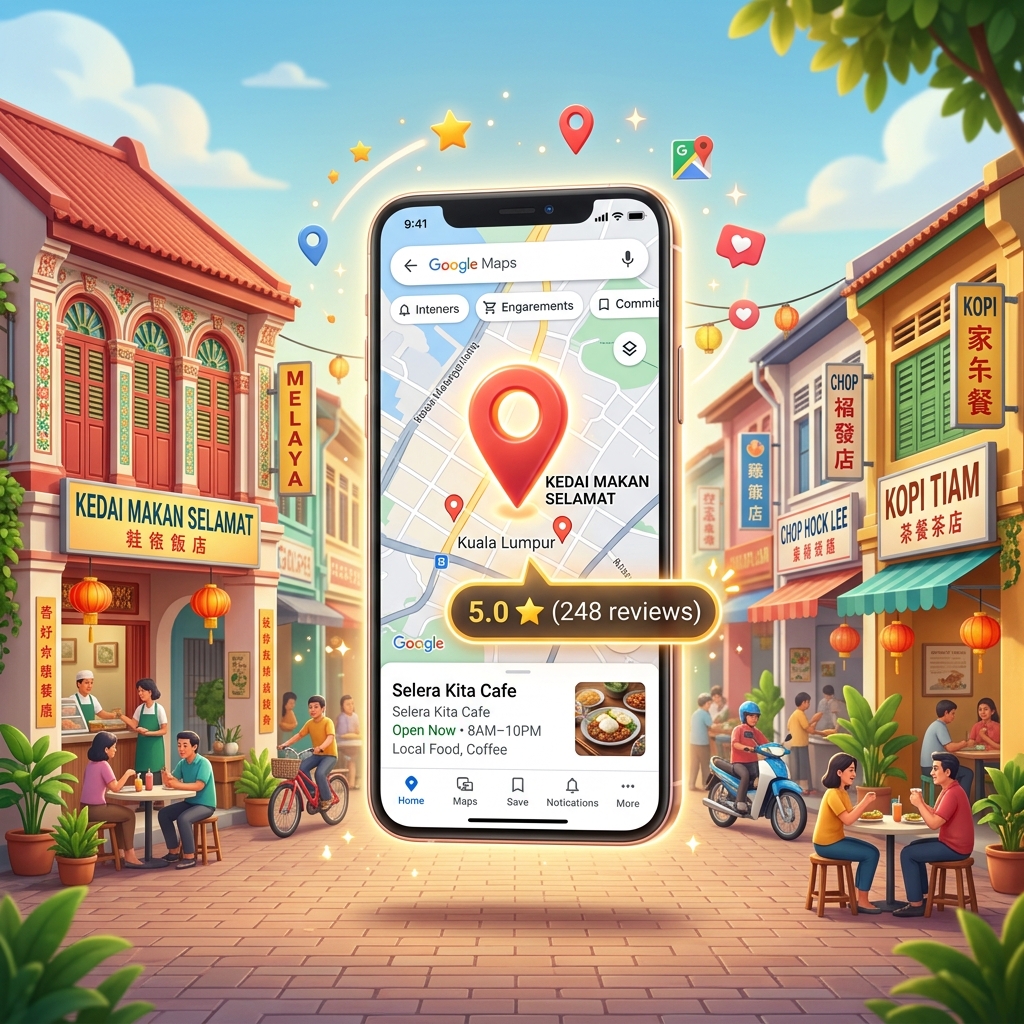
Featured image concept: A Malaysian small business owner — perhaps a café or hardware shop proprietor — looking at their phone showing a Google Maps result with their business highlighted in the Local Pack. Warm, natural light, a recognisable Malaysian street shopfront visible in the background. The screen shows a 4.8-star Google Business Profile with many reviews.
Schema markup: LocalBusiness schema (to reinforce DLYC's own local presence), HowTo schema for the 7-day action plan section, FAQPage schema for any FAQ content added on-page.