What Is Generative Engine Optimization (GEO) and How to Rank in AI Search
Your next customer might never click a search result. They'll ask ChatGPT a question, get a synthesized answer pulled from five different sources, and make a decision — all without visiting a single website. If your content isn't one of those five sources, you're invisible. This is the reality of generative engine optimization (GEO), and it's reshaping how businesses think about online visibility in 2026.
Understanding Generative Engine Optimization
Generative Engine Optimization is the practice of structuring digital content so AI-powered search engines — ChatGPT, Perplexity, Google AI Overviews, Claude, Gemini, and Microsoft Copilot — can discover, understand, and cite it when generating responses.
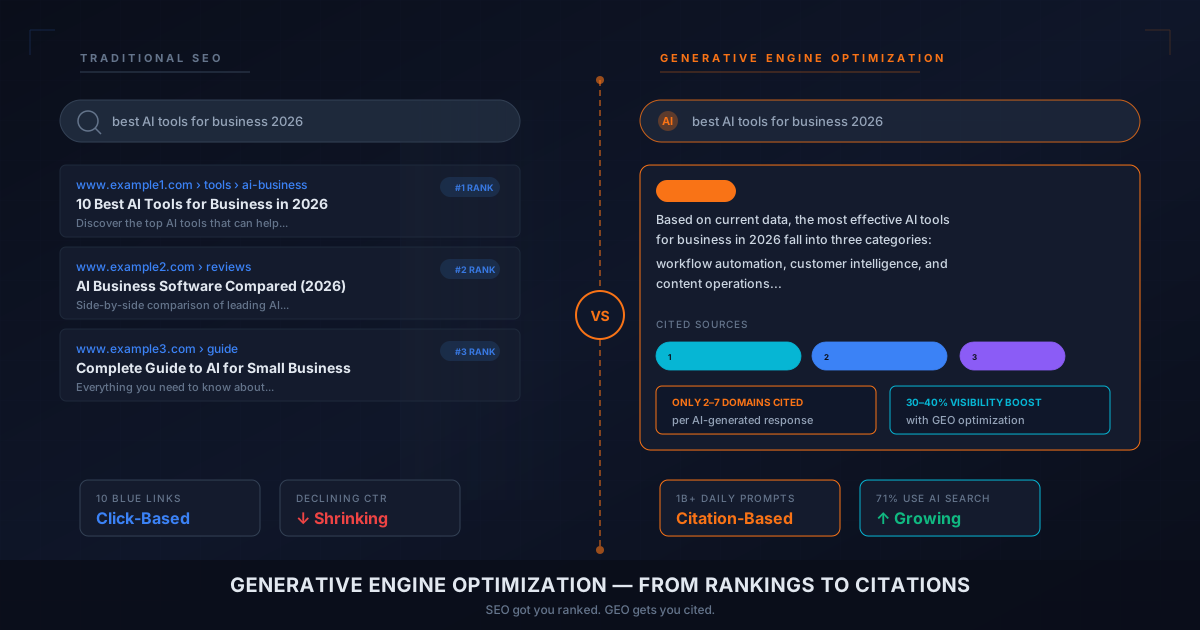
Traditional SEO optimizes for ranked lists of blue links. GEO optimizes for something fundamentally different: being selected as a trusted source inside an AI-generated answer.
The term was first coined by Princeton researchers in 2023, but it remained academic until 2025 when AI search usage crossed critical thresholds. By early 2026, GEO has shifted from experimental concept to operational necessity.
Here's the core difference: SEO asks "how do I rank higher?" GEO asks "how do I get cited?"
Why GEO Matters Right Now
The numbers tell a clear story. Over 1 billion prompts are sent to ChatGPT daily. More than 71% of Americans now use AI search tools to research purchases or evaluate brands, according to Adobe research. Forrester reports that 89% of B2B buyers have adopted generative AI as a key source of self-guided information throughout their purchasing journey.
Meanwhile, the overlap between top Google results and AI-cited sources has dropped from 70% to below 20%, according to research from GEO firm Brandlight. This gap is widening, meaning that ranking first on Google no longer guarantees visibility in AI-generated answers.
The shift creates two distinct problems for businesses:
- Zero-click resolution. Generative engines often answer questions completely, so the user never needs to visit your site. If you're not part of that answer, you lose the touchpoint entirely.
- Winner-take-most citation. LLMs typically cite only 2–7 domains per response, compared to Google's 10 blue links. Fewer slots mean fiercer competition for visibility.
The first GEO Conference launched in Austin in July 2025 and has already expanded to multiple cities, with 200+ marketing leaders from companies like OpenAI, Google, Anthropic, Adobe, and Etsy attending each event. The discipline has arrived.
How GEO Differs from Traditional SEO
GEO doesn't replace SEO — it layers on top of it. Strong traditional SEO remains the foundation. AI engines frequently use search rankings as a credibility signal when deciding which sources to cite. But GEO requires additional techniques that traditional SEO doesn't cover.
Source of answers. Search engines list URLs. Generative engines synthesize information from multiple sources into a single response.
Ranking factors. Backlinks and domain authority still matter, but citation authority, structured data, and content verifiability carry more weight in AI contexts.
User intent. Conversational, multi-part queries replace rigid keyword phrases. When someone asks an AI about the "best email marketing platform for a small e-commerce business with fewer than 10,000 subscribers," the AI breaks that into multiple sub-queries and searches for each one separately.
Measurement. Organic ranking position becomes less meaningful. AI citation frequency, generative referral traffic, and visibility share across LLM responses become the new KPIs.
Princeton research found that the top GEO optimization methods — citing sources, adding statistics, and including expert quotations — can improve AI visibility by 30–40% compared to unoptimized content.
How to Optimize Your Content for AI Search
1. Make Sure AI Crawlers Can Access Your Content
Before optimizing anything, verify that AI systems can actually read your pages. This is the most common failure point.
Check your robots.txt file. Many sites inadvertently block AI crawlers. Cloudflare recently changed its default configuration to block AI bots automatically. If you use Cloudflare, your AI bot traffic may have been shut off without you knowing.
Check your server logs for user agents like "ChatGPT-User," "ClaudeBot," and "PerplexityBot." If they're not showing up, something is blocking them.
Ensure important content is server-side rendered, not hidden behind JavaScript frameworks, login walls, or interactive elements that bots can't parse.
Consider creating an llms.txt file — a machine-readable site map designed specifically to help AI systems understand your site structure.
2. Structure Content for Extraction
Generative engines don't read your content the way humans do. They extract specific passages that answer specific sub-queries. Structure matters enormously.
- Lead every section with a direct, concise answer before providing context and supporting detail
- Use clear heading hierarchies (H1 → H2 → H3) with one distinct topic per section
- Write in scannable formats with bullet points, numbered lists, and comparison tables where appropriate
- Include FAQ sections using proper schema markup — these are heavily favored by both Google AI Overviews and conversational AI tools
Think of each section as a self-contained answer that an AI can extract independently.
3. Shift from Keyword Targeting to Topic Targeting
Traditional SEO optimizes for specific search phrases. GEO requires broader topical coverage because of how AI engines process queries.
When someone asks a complex question, the AI breaks it into smaller fan-out queries and searches for each one separately. Your content needs to address not just the main topic, but every sub-question the AI might generate from it.
For example, a query like "how can small businesses use AI for customer service" might trigger sub-queries for "AI customer service tools 2026," "chatbot vs live agent comparison," and "AI customer service implementation cost." Your content should address all of these within a single comprehensive resource.
4. Build Citation Authority
AI engines evaluate source credibility when choosing which pages to cite. Several signals increase your citation worthiness:
- Include specific data and statistics with clear source attribution. Unsourced claims get deprioritized.
- Add expert quotes and credentials. Content with transparent author bios, professional credentials, and expert commentary outperforms anonymous content.
- Reference and link to authoritative sources. Academic papers, government data, and industry reports signal trustworthiness.
- Update content regularly. Generative engines favor current, recently-verified information. Stale content gets passed over.
This aligns directly with Google's E-E-A-T framework (Experience, Expertise, Authoritativeness, Trustworthiness), which remains critical in GEO contexts.
5. Optimize for Brand Mentions, Not Just Rankings
Since generative engines don't operate on a ranking system, there aren't positions to compete for. Instead, the focus shifts to getting your brand cited or mentioned in the response.
Build brand presence across the web through guest posts, PR coverage, industry publications, and community participation. The more AI training data includes your brand name associated with your expertise area, the more likely you are to be cited.
Monitor your brand's AI visibility using emerging tools like OmniSEO, Otterly.ai, Rankscale, or Ahrefs Brand Radar to track how often and where generative engines reference your content.
What to Know Before You Start
GEO is a long game. Expect a 3–6 month timeline before seeing meaningful changes in AI citation frequency. Quick wins are rare.
Don't abandon SEO. GEO supplements traditional search optimization. Sites that perform well in organic search often get prioritized by AI systems as credibility signals.
Track new metrics. Traditional analytics won't capture GEO performance. You need to measure AI citation frequency, generative referral traffic, and visibility share across platforms like ChatGPT, Perplexity, and Google AI Overviews.
Optimize for multiple platforms. Just as people have preferences between Google and Bing, AI search users gravitate toward specific platforms. Focus on where your audience is most active, but don't ignore the others entirely.
Avoid keyword stuffing. It's counterproductive in GEO contexts. AI engines penalize content that feels manipulative or artificially optimized, just as Google does.
Getting Started with GEO
- Audit your AI crawl access. Check robots.txt and server logs for AI bot activity. Unblock any crawlers you've inadvertently restricted.
- Review your top 10 pages. Do they lead with clear answers? Are statistics sourced? Do they have structured data and FAQ schema? Fix the gaps.
- Install AI visibility tracking. Set up tools to monitor how your brand appears in generative engine responses across ChatGPT, Perplexity, and Google AI Overviews.
- Restructure one pillar page. Pick your highest-traffic informational page and rebuild it following GEO principles: direct answers first, comprehensive topic coverage, sourced data, expert attribution.
- Create content for fan-out queries. Map the sub-questions an AI might generate from your primary topics and ensure you have content addressing each one.
- Build your citation footprint. Publish on authoritative platforms, earn brand mentions, and produce original research that AI systems will want to reference.
The Bottom Line
Generative Engine Optimization isn't about gaming AI systems. It's about earning relevance in a world where machines increasingly mediate how people discover information. The brands that adapt early — structuring content for extraction, building citation authority, and tracking AI visibility — will own the conversation. The ones that wait will find themselves answering to an audience that already made their decision inside a chatbot window.
Your SEO fundamentals still matter. Your AI strategy still matters. GEO is the bridge between them. Start building it now.
Suggested Internal Links:
- SEO for Beginners — foundational context for readers new to search optimization
- What Is RAG (Retrieval-Augmented Generation) — explains the underlying technology powering AI search
- AI Agent Infrastructure — connects to the infrastructure layer driving AI search tools
- What Is Agentic AI — broader AI context for readers exploring the ecosystem
Suggested External Links:
- Princeton GEO Research Paper — original academic research on GEO
- Google Search Central Documentation — structured data and schema markup guides
Suggested Schema Markup: Article, FAQ
Suggested Featured Image: A split-screen visualization comparing traditional search (blue links in a ranked list) with AI-generated search (a conversational answer with cited sources highlighted). Dark, modern aesthetic with blue and orange accents. The left side fades or cracks to show the transition from old to new.