AI Inventory Management for Malaysian Retail Shops: Stop Losing Money on Overstock and Stockouts
Walk into most independent retail shops in Malaysia and you'll find the same story: shelves of slow-moving stock gathering dust in one corner, popular items perpetually out of stock in another, and a shop owner running between a spreadsheet, a WhatsApp group, and a supplier on the phone trying to keep it all together. AI inventory management is changing this — and it's now within reach for Malaysian SMEs, not just large chains.
The stakes are real. Companies that embed AI in their inventory operations reduce stock holdings by 20% to 30% on average, according to McKinsey research. For a retail shop carrying RM150,000 in stock, that's RM30,000–RM45,000 freed up. That's cash that could fund a renovation, hire a staff member, or expand to a second outlet.
The Hidden Cost of Getting Inventory Wrong
Most retail shop owners know they have an inventory problem. Few know exactly how much it's costing them.
Overstock ties up working capital in goods that sit on shelves for months. It creates storage pressure, increases the risk of expiry or obsolescence, and eventually leads to markdowns that eat into margins. Stockouts, on the other hand, are often more damaging — a customer who can't find what they want doesn't wait; they walk across the street or order online. You lose the sale and, frequently, the customer.
The research on Malaysian retailers specifically is sobering. A 2025 study on AI adoption in Malaysian retail supply chains found that most local SMEs still rely on manual or historical trend-based forecasting — spreadsheets, gut feel, and last year's numbers. Stock discrepancies from data entry errors and system mismatches are common, and retailers in smaller towns face additional digital infrastructure barriers that make automated tracking harder to implement.
Less than 20% of Malaysian businesses are fully equipped to deploy AI technologies right now, according to industry assessments. But that gap is closing quickly, and the retailers who move first will have a significant operational advantage over those who wait.
What AI Inventory Management Actually Does
Before we get into tools and tactics, it's worth being clear about what "AI inventory management" means in practice — because the term gets used loosely.
At its core, an AI inventory system does three things that spreadsheets and manual methods cannot:
It forecasts demand with real data. Instead of guessing based on last year's numbers, AI systems analyse your actual sales history, seasonal patterns, promotions, and even external signals like local events or public holidays to predict what you'll sell and when. For a Malaysian clothing retailer, this means stocking the right styles before Hari Raya instead of scrambling after.
It automates reordering. When stock drops below a dynamically calculated threshold — not just a fixed number, but one that accounts for lead times and supplier reliability — the system triggers a purchase order. You set the rules once; the system handles execution. This is what AI agents for small business look like in a retail context.
It provides real-time visibility across your whole business. Whether you have one shop or three, AI inventory management gives you a live dashboard of stock levels, movement rates, and cash tied up in inventory — updated automatically as sales happen. No more end-of-day stock counts or surprise out-of-stocks on your bestsellers.
The result: 87% of retailers globally report that AI has had a positive impact on revenue, and 94% report reduced operating costs. The return on investment typically becomes visible within three to six months of implementation.
The Best AI Inventory Tools for Malaysian Retail Shops
The good news is you don't need to build anything custom. Several tools work well for Malaysian retail SMEs today.
POS-Integrated Solutions: Start Here First
If you're running a physical shop, start with your point-of-sale system. The best modern POS platforms include intelligent inventory management built in — meaning every sale automatically updates your stock, triggers reorder alerts, and feeds your sales data into forecasting reports.
StoreHub is the standout local option. Built specifically for Southeast Asian retail and F&B businesses, it combines sales, inventory, customer loyalty, and promotions in one platform. Stock levels update as items are sold, you get low-stock alerts, and it integrates with Malaysian e-commerce channels. For a retail shop already using a basic POS, upgrading to StoreHub or a comparable platform is often the highest-ROI first step.
Other POS platforms with strong inventory AI include Shopify POS (ideal if you sell both online and offline), EMERGE App (built for product-based businesses with multi-location support), and Cin7 (for shops with more complex supply chains).
Standalone AI Inventory Platforms
For shops with more complex inventory needs — multiple warehouses, own-brand manufacturing, or high SKU counts — dedicated inventory AI platforms offer deeper functionality.
Prediko connects to your existing sales data and generates AI-driven demand forecasts and replenishment recommendations. It's particularly strong for product-based businesses that need granular SKU-level forecasting without enterprise-level complexity or pricing.
LEAFIO focuses specifically on retail inventory optimisation, with AI that continuously recalibrates replenishment parameters based on real sales velocity. It's used by retailers across Southeast Asia.
For fashion and apparel retailers — a significant category in Malaysian retail — Toolio provides merchandise planning and inventory optimisation tools built specifically for the clothing buying cycle.
Workflow Automation: Connect Your Systems
Even if your POS handles the basics, you'll likely need automation to connect your inventory system to your suppliers, your finance tools, and your e-commerce channels. This is where AI workflow automation tools like n8n, Make, and Zapier come in.
A simple automation might: detect when a SKU drops below reorder point → generate a purchase order → send it to your supplier via WhatsApp or email → update your accounts → notify your staff. What used to take thirty minutes of manual work becomes a two-minute review of what the system already prepared.
Key Considerations Before You Start
AI inventory management delivers results — but only if you go in with realistic expectations and the right groundwork.
Your Data Quality Matters More Than the Tool
Every AI system is only as good as the data it runs on. If your current stock records are unreliable — items that show as "in stock" on the system but are physically missing, or sales that were recorded against the wrong SKU — the AI will make bad predictions confidently.
Before implementing any AI inventory system, run a full stock audit. Count everything physically, reconcile against your records, and fix the discrepancies. This is boring work, but skipping it is one of the main reasons over 60% of AI implementation projects fail to deliver expected ROI. Getting this right from the start is the core message of building a proper AI strategy for your business — foundations first.
Start With One Location, One Category
If you're running multiple outlets or a broad product range, resist the temptation to roll out AI inventory across everything at once. Pick one location and one product category — ideally your fastest-moving, most profitable line — and run the AI system there for 90 days. Track the results. Then expand.
This mirrors the step-by-step implementation approach that consistently produces better outcomes than big-bang rollouts.
Integration With Your E-Commerce Channel Is Essential
If you sell on Shopee, Lazada, or your own website in addition to your physical shop, your inventory system must sync across all channels. There are few things more damaging to a retail business than selling an item online that's already out of stock in the shop — or vice versa. This is the inventory challenge at the heart of scaling Malaysian e-commerce operations. Your AI inventory system needs to be the single source of truth for all channels simultaneously.
How to Get Funding for AI Inventory Tools
Implementation costs for AI inventory management vary widely — a StoreHub subscription runs a few hundred ringgit a month, while a more comprehensive enterprise platform may cost several thousand. The good news is that Malaysian SMEs can access significant government support to offset these costs.
The Malaysia SME Digitalisation Grants available in 2026 include co-funding mechanisms that can cover 50% to 80% of qualifying digital tool expenses. The Business Digitalisation Initiative (BDI) under MDEC specifically targets productivity tools for MSMEs, and inventory management software typically qualifies.
Budget 2026 also introduced an additional 50% tax deduction for SMEs on AI and cybersecurity training expenses certified by NAICI and NAIO — so if you invest in training your team to use an AI inventory platform, that cost is partly tax-deductible.
Separately, the Strategic Co-Investment Fund (CoSIF) provides RM200 million in co-funding for digital and AI adoption. If your inventory project is more ambitious — say, a multi-location deployment or a custom integration with your ERP — this fund may be relevant.
The Malaysian digital transformation market is growing at 18.62% annually, with SMEs recording the fastest growth rate of all segments. The funding infrastructure exists specifically to help businesses like yours make this transition.
A Getting-Started Action Plan
If you're ready to move from spreadsheets to AI inventory management, here's a concrete sequence:
- Audit your current data — Spend one week doing a full physical stock count and reconciling it against your system. Fix every discrepancy before touching any new software.
- Map your inventory pain points — Write down the three biggest inventory problems your shop faces right now: most common out-of-stocks, biggest dead stock items, most time-consuming manual tasks.
- Evaluate your POS first — Check whether your current POS system has AI inventory features you're not using. Many shops are paying for capabilities they've never activated.
- Shortlist two to three tools — Based on your shop size and complexity, request demos from StoreHub, Prediko, or Cin7. Most offer free trials.
- Calculate your baseline ROI — Use the AI ROI framework to estimate what a 20% reduction in overstock and a 50% reduction in stockouts would be worth to your business in ringgit terms. This number will make the investment decision straightforward.
- Check grant eligibility — Before purchasing anything, verify which government schemes apply to your planned investment. A 50% co-grant changes the economics significantly.
- Pilot on one category for 90 days — Implement on your fastest-moving product line. Measure stock turns, out-of-stock incidents, and working capital. Use the data to justify a full rollout.
For a step-by-step walkthrough of how to deploy AI agents across your business operations broadly, the guide on building your first digital workforce covers the full picture — inventory is one piece of a larger AI strategy that can transform how your shop runs day-to-day.
The Bottom Line
Inventory management is the operational heartbeat of any retail business. Get it wrong and you're constantly firefighting — chasing suppliers, marking down dead stock, apologising to customers for items that are out of stock. Get it right with AI and the business runs more smoothly, your cash is deployed more efficiently, and you can focus on growth instead of damage control.
Malaysian retail SMEs have access to the tools, the funding, and the implementation support to make this shift today. The AI in retail market is already worth $15.3 billion globally and growing fast. The question isn't whether AI inventory management will become standard — it's whether your shop will be running it before or after your competitors.
Start with a stock audit. Pick one tool. Run a 90-day pilot. The data will tell you everything you need to know.
Internal links used:
- "AI agents for small business" →
/blog/2026/ai-agents-for-small-business-first-digital-employee - "AI workflow automation tools like n8n, Make, and Zapier" →
/blog/2026/ai-workflow-automation-tools-smb - "building a proper AI strategy for your business" →
/blog/2026/small-business-ai-strategy - "step-by-step implementation approach" →
/blog/2026/how-to-implement-ai-automation-in-your-business - "scaling Malaysian e-commerce operations" →
/blog/2026/ai-ecommerce-automation-malaysia-online-sellers - "Malaysia SME Digitalisation Grants available in 2026" →
/blog/2026/malaysia-sme-digitalisation-grant-2026-ai - "AI ROI framework" →
/blog/2026/how-to-calculate-ai-roi - "building your first digital workforce" →
/blog/2026/ai-for-small-business-malaysia
Total internal links: 8
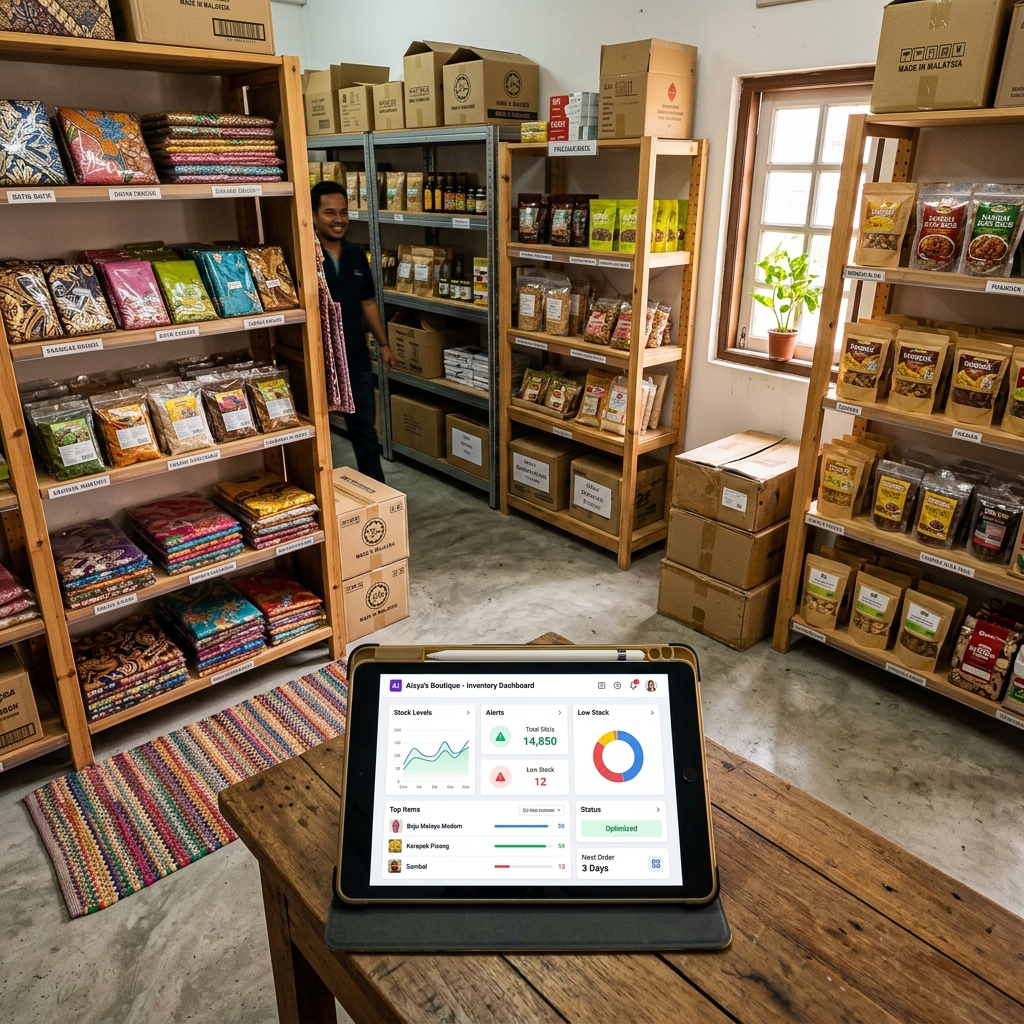
Featured image concept: A warm, overhead shot of a tidy Malaysian retail shop stockroom — shelves of neatly organised products with a tablet showing a clean inventory dashboard in the foreground, natural light coming through a small window. Feels practical and optimistic, not corporate.
Schema markup: HowTo schema (for the action plan section), Article schema, FAQPage schema for questions like "What is AI inventory management?" and "How much does AI inventory software cost for Malaysian SMEs?"