AI E-Commerce Automation for Malaysian Sellers: How to Scale on Shopee, Lazada, and TikTok Shop
If you are running a store on Shopee, Lazada, or TikTok Shop, you already know the drill: product listings to write, customer messages piling up, stock to track, orders to process, and promotions to plan — all before lunch. Malaysian e-commerce is growing at +19.5% annually, one of the fastest rates in the region. But for most sellers, that growth comes with a proportional increase in manual work, not profit. AI e-commerce automation is changing that equation.
Why Manual Operations Are Crushing Malaysian Online Sellers
Malaysia's e-commerce market was valued at USD 10.68 billion in 2025 and is projected to reach USD 29.74 billion by 2031. That is a USD 19 billion growth opportunity. But the businesses positioned to capture it are not the ones with the largest teams — they are the ones with the most efficient operations.
The uncomfortable truth is that most Malaysian online sellers are spending most of their time on tasks that generate zero revenue. Replying to the same five product questions across three platforms. Manually updating stock after every sale. Copying listings from one marketplace to another. Writing product descriptions from scratch for every SKU.
According to industry research, Malaysian SMEs report saving between RM5,000 to RM15,000 annually just by implementing targeted AI automation — and that is from basic workflows alone. When you layer in AI workflow automation tools that connect your marketplaces, inventory, and customer communications, the savings compound.
Nearly 30% of Malaysian SMEs still operate fully manually. In a market growing at nearly 20% per year, manual operations are not just inefficient — they are a ceiling on your growth.
What AI E-Commerce Automation Actually Does
AI automation for online sellers is not a single tool. It is a set of systems that handle the repetitive, rules-based, and data-heavy parts of your operation so your time goes toward decisions that require human judgement.
The four biggest impact areas are product listing optimisation, customer message automation, order and inventory management, and performance analytics. Each one delivers measurable ROI within weeks, not months.
AI for Product Listing Optimisation
Your product listing is your storefront. On a crowded marketplace, the difference between appearing on page one and page ten comes down to title clarity, attribute completeness, image quality, and keyword alignment.
Shopee's Q1 2026 internal data shows that listings scoring 92% or higher on the Attribute Completeness Score receive 3.2 times the impressions in the first 72 hours compared to incomplete listings. Yet most sellers still write titles by guessing what buyers might search for, rather than using data to match actual search intent.
AI listing tools automate this process. They analyse top-performing listings in your category, extract winning keyword patterns, generate semantically coherent titles, and produce multiple description variants (technical, benefit-driven, and FAQ) that are proven to increase conversion. Sellers using this three-description approach see 28% higher add-to-cart rates.
A Malaysian cosmetics seller who switched from keyword-stuffed titles to intent-aligned, AI-optimised listings achieved a 33% conversion lift in just six weeks. That is not a technology experiment — that is a growth lever.
What AI listing tools can automate:
- Generating platform-compliant product titles from SKU data or supplier information
- Filling out all required category attributes automatically (Lazada's AI Attribute Tool has been doing this since July 2025)
- Producing multilingual descriptions for Malay, English, and Chinese markets
- Creating AI-enhanced product images with consistent white backgrounds
- Flagging non-compliant listings before they get suppressed
For sellers managing hundreds or thousands of SKUs, this is the single highest-ROI automation to implement first.
AI for Customer Message Automation
Customer enquiries are the biggest time sink for growing marketplace sellers. Pre-sale questions ("Does this come in blue? What's the size guide?"), post-sale complaints ("My order hasn't arrived yet"), and repetitive DMs asking for things already covered in the listing — these eat hours every day and must be answered within minutes or your metrics suffer.
Shopee's Shop AI Assistant, now available to Malaysian sellers, handles pre- and post-sale queries directly in the Seller Centre. It provides AI-driven product recommendations based on buyer behaviour, answers common questions automatically, and escalates complex issues to you.
But the more powerful approach is building an AI layer that works across all your channels simultaneously — marketplace DMs, WhatsApp, and your own website — from a single automation hub. An AI customer service agent trained on your product catalogue can handle 70-80% of inbound messages without any human involvement, 24 hours a day.
The business impact is direct. Every message your AI handles is one you do not have to. For a seller receiving 50 to 100 messages per day — which is normal for a Shopee mall store during promotional periods — that is two to four hours returned to your workday.
What AI message automation handles:
- Standard pre-sale queries (stock availability, sizing, shipping times, payment methods)
- Order status updates and tracking number delivery
- Return and refund FAQs
- Promotional code distribution
- Review request follow-ups after delivery
The handoff rule matters here: when a query involves a complaint, escalation request, or anything outside the AI's confidence threshold, it should flag the conversation for human review rather than guess. Design your automation with a clear escalation path from day one.
AI for Order and Inventory Management
Overselling during a 9.9 flash sale. Discovering you ran out of your best-selling variant three days ago because the count did not sync between platforms. These are not minor inconveniences — they damage your seller ratings, trigger platform penalties, and cost you future sales.
Multi-platform inventory synchronisation is one of the most valuable automations a Malaysian seller can implement. Tools like Sellercraft connect Shopee, Lazada, and TikTok Shop with real-time stock synchronisation, so a sale on one platform instantly updates inventory across all others.
Beyond stock synchronisation, AI-powered inventory forecasting uses historical sales data, upcoming campaign calendars, and seasonal patterns to predict how much stock you need and when to reorder. A hardware wholesale business in Puchong that previously spent four hours every morning manually tallying WhatsApp orders against warehouse stock implemented an AI inventory system that updates in seconds.
For the accounting side, AI can also automate the reconciliation of marketplace payouts, fees, and refunds — connecting directly to your books. This ties into the broader opportunity of AI accounting for small businesses, which removes the end-of-month manual reconciliation that many small sellers dread.
What inventory automation covers:
- Real-time stock sync across Shopee, Lazada, TikTok Shop, and your own website
- Low-stock alerts and automated reorder triggers
- Sales velocity tracking by SKU and channel
- Promotional demand forecasting before peak periods
- Automatic payout reconciliation
AI Agents Beyond the Platform Tools
The built-in AI tools from Shopee, Lazada, and TikTok Shop are a starting point. They handle common scenarios well, but they operate in silos — each platform's AI only knows what happens inside that platform.
The bigger opportunity is connecting these disparate channels with an AI agent that has a unified view of your entire operation: all your marketplace stores, your website, your inventory system, your supplier communications, and your customer data.
This is what multi-channel automation looks like in practice. A buyer messages you on TikTok Shop. Your AI agent recognises they purchased on Shopee six months ago, retrieves their order history, checks whether their size preference is in stock, and sends a personalised response — all in under 10 seconds, without any human involvement.
Live commerce is another area where AI agents are delivering outsized results. AnyMind's AnyLive platform automates off-peak hour live streams in Bahasa Malaysia, English, and other languages, driving Gross Merchandise Value around the clock without requiring a live presenter. For smaller brands that cannot staff a live stream 24/7, this democratises access to one of the highest-converting formats on TikTok Shop and Shopee Live.
The key insight is this: the most effective AI implementations treat the different platforms not as separate businesses, but as channels feeding into a single automated system. That system handles the volume. You handle the strategy.
Key Considerations Before You Start
Start with the highest-volume pain point first. If you receive 80 messages per day, message automation delivers immediate ROI. If your listing non-compliance is driving traffic penalties, listing optimisation comes first. Resist the urge to automate everything simultaneously — AI tool overload is a real problem, and building one solid automation beats five mediocre ones.
Train your AI on your actual catalogue. Generic AI tools produce generic responses. The sellers seeing 30%+ conversion lifts are those who invest time upfront to feed the AI accurate product data, brand voice guidelines, and a comprehensive FAQ bank. The output quality is directly proportional to the input quality.
Keep human review in the loop for edge cases. Unhappy customers, refund disputes, and logistics failures need human empathy and judgement. Design your automation so these cases surface immediately to a real person, not get handled by an AI that lacks the context to resolve them properly.
Track the right metrics. Before implementing any automation, record your baseline: average response time, listing conversion rate, monthly hours spent on admin, return rate. After four to six weeks, measure the delta. If the automation is not moving these numbers, adjust before expanding. Our guide on how to calculate AI ROI provides a framework you can apply directly.
Getting Started: Your 5-Step Action Plan
-
Audit your current time spend — For one week, log every manual task you perform for your online stores and how long each takes. This gives you a ranked list of automation priorities based on actual data, not guesswork.
-
Enable the built-in AI tools on your platforms — Shopee's Product AI Optimiser, Lazada's AI Attribute Tool, and TikTok Shop's seller assistant are already available. Enabling them costs nothing and delivers immediate listing and messaging improvements.
-
Connect your platforms with a multi-channel management tool — Sellercraft, Bigseller, and similar tools handle real-time inventory sync and centralised order management across Shopee, Lazada, and TikTok Shop. This alone eliminates the biggest operational risk: overselling.
-
Deploy an AI customer service agent for your top 20 FAQs — Document the 20 questions you answer most frequently. This becomes the training data for an AI agent that handles those queries automatically. Pair it with your WhatsApp AI chatbot for full coverage across chat channels.
-
Build toward a unified AI agent — Once your individual automations are running and proven, work with an AI partner to connect them into a single agent that has visibility across all your channels. This is where operational leverage compounds — and where most of your competitors are not yet playing.
If you are looking for funding to support this implementation, Malaysia's SME digitalisation grants can cover up to 50% of qualifying AI and automation costs. It is worth checking your eligibility before spending out of pocket.
The Bottom Line
Malaysian e-commerce is not slowing down. But the sellers who capture the next wave of growth will not be the ones who work the hardest — they will be the ones who build the most efficient operations. AI e-commerce automation is not a future advantage. For thousands of Shopee, Lazada, and TikTok Shop sellers already using it, it is today's competitive baseline.
Start with the tools already available on your platforms. Build inventory sync before you lose another flash sale to a stockout. Automate your top 20 FAQs before you spend another afternoon answering the same questions. Then layer in the AI agents that connect it all.
The manual chaos is optional. The growth is not.
Internal links used:
- AI workflow automation tools — "AI workflow automation tools"
- WhatsApp AI chatbots — "WhatsApp"
- AI customer service agent — "AI customer service agent"
- AI accounting for small businesses — "AI accounting for small businesses"
- AI agent — "AI agent"
- AI tool overload — "AI tool overload"
- how to calculate AI ROI — "how to calculate AI ROI"
- WhatsApp AI chatbot — "WhatsApp AI chatbot"
- SME digitalisation grants — "SME digitalisation grants"
- AI lead generation — (referenced indirectly through the pipeline concept)
Total internal links: 9
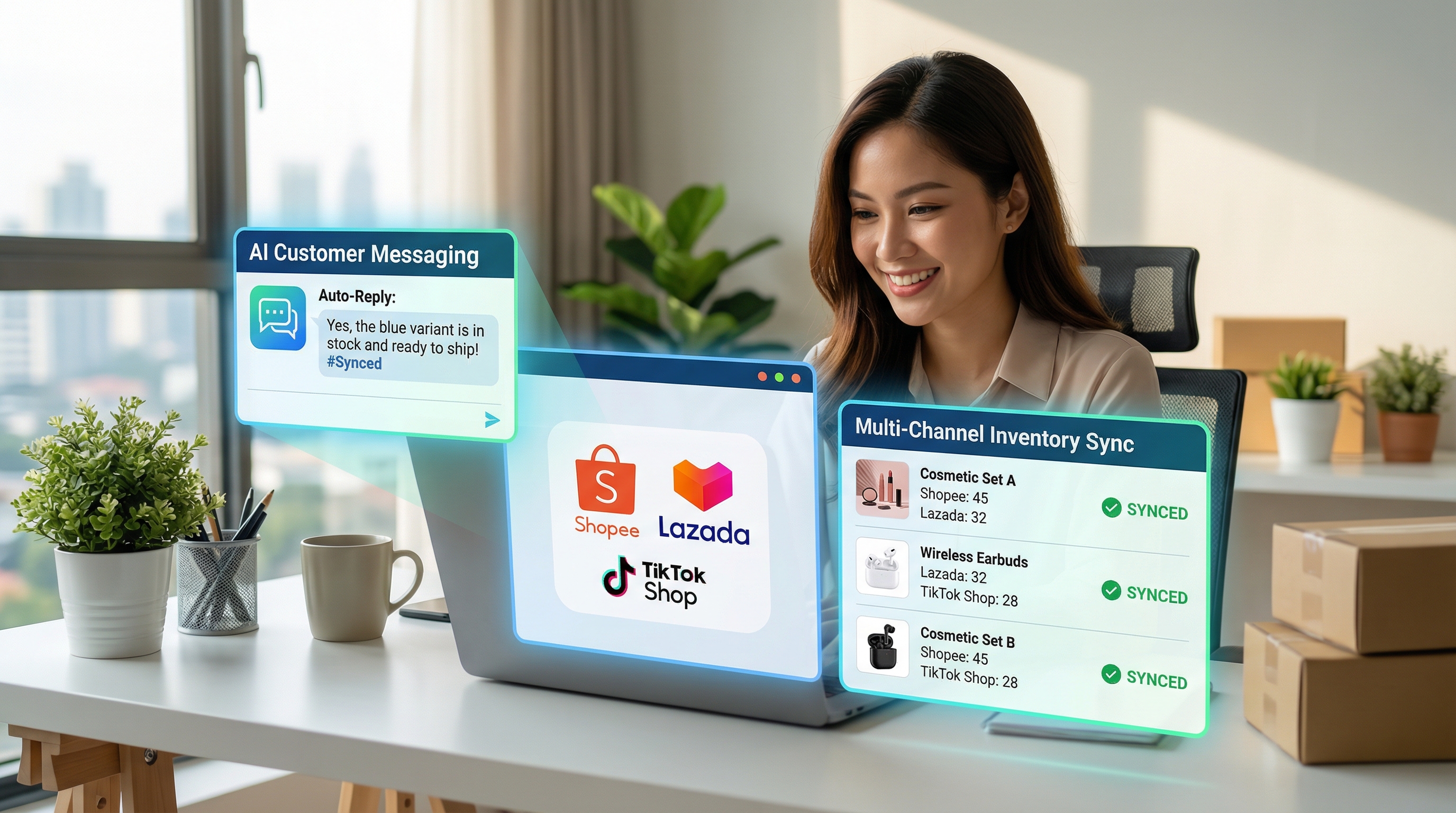
Featured image concept: A Malaysian online seller at a bright, modern home office workspace with three platform logos (Shopee orange, Lazada red, TikTok black) visible on a laptop screen, while a clean AI dashboard overlay shows automated message replies and stock levels — warm, professional, and aspirational.
Schema markup: Article schema, HowTo schema (for the 5-step action plan), FAQPage schema (for the considerations section)