What Is Multi-Agent AI? How Coordinated AI Systems Work Together
If 2025 was the year businesses deployed individual AI agents, 2026 is the year they're learning those agents need to work together. Gartner reported a 1,445% surge in enterprise inquiries about multi-agent systems from Q1 2024 to Q2 2025. By 2027, one-third of all agentic AI implementations will combine agents with different skills to manage complex tasks across application and data environments.
The pattern is familiar to anyone who's managed a team: one generalist can handle simple tasks, but complex projects require specialists who coordinate. Multi-agent AI applies that same principle to autonomous software — and the businesses that get the orchestration right are seeing results that single-agent deployments can't match.
What Multi-Agent AI Actually Means
Multi-agent AI is an architecture where multiple specialized AI agents collaborate, share context, and coordinate actions to accomplish complex tasks that no single agent could handle alone. This distincts them from simple chatbots which typically handle single-turn interactions.
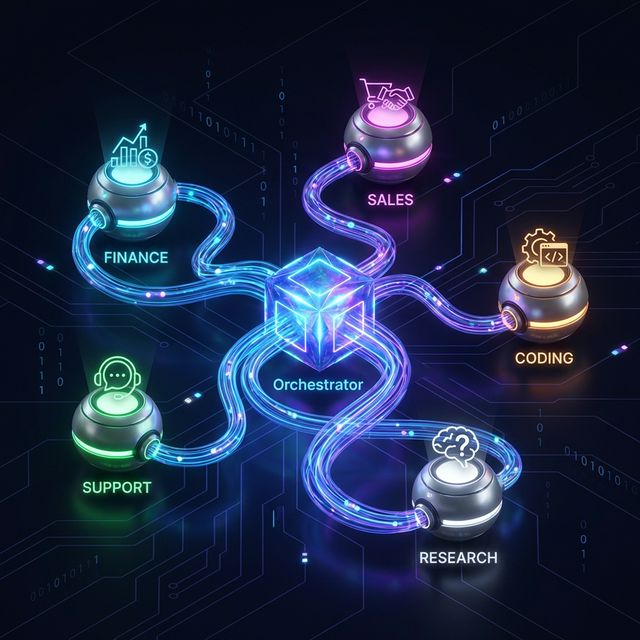
Instead of building one large, general-purpose agent and asking it to do everything — manage customer service, process invoices, qualify leads, monitor IT infrastructure — a multi-agent system assigns each function to a purpose-built agent. A central orchestrator coordinates the team, routing tasks to the right specialist, passing context between agents, and aggregating results.
Think of it like a hospital. You don't have one doctor who handles surgery, radiology, prescriptions, and billing. You have specialists who each excel in their domain, coordinated by systems and protocols that ensure patient care flows smoothly between them. Multi-agent AI works the same way — except the specialists are software and the coordination happens in milliseconds.
This represents the most significant architectural shift in enterprise AI since the move from monolithic applications to microservices. And it's happening for the same reason: as complexity grows, distributed specialization outperforms centralized generalization.
Why Single-Agent Systems Hit a Wall
The move toward multi-agent architecture isn't theoretical — it's a direct response to real limitations that organizations encountered when scaling individual AI agents.
Context window limits. Every AI agent is powered by a language model with a finite context window — the amount of information it can process at once. A single agent trying to handle customer service, inventory management, and financial reporting simultaneously runs out of cognitive bandwidth. Its responses degrade as the task scope grows.
Jack-of-all-trades problem. An agent optimized for drafting sales emails performs differently than one optimized for analyzing financial data. Forcing a single agent to do both means it does neither as well as a specialist would. Multi-agent systems let each agent be configured, prompted, and fine-tuned for its specific domain.
Failure isolation. When a single agent fails, everything stops. In a multi-agent system, if the email-drafting agent encounters an error, the lead-scoring agent and the CRM-updating agent continue operating. Failures are contained rather than cascading.
Scalability. Single agents can't easily scale different capabilities independently. If your customer service volume spikes but your invoice processing stays flat, a multi-agent system lets you scale the customer service agents without touching the rest. Each component scales based on its own demand.
Organizations discovered these limitations firsthand in 2025. As KPMG's Q4 AI Pulse Survey found, leading enterprises haven't pulled back from agents — they've professionalized them, investing in infrastructure, governance, and orchestration to run multi-agent systems reliably.
How Multi-Agent Systems Are Structured
Multi-agent architectures follow a few dominant patterns. The right choice depends on your workflow complexity and coordination requirements.
Orchestrator-Specialist (Most Common)
A central orchestrator agent receives incoming tasks, breaks them into subtasks, and delegates each to a specialized agent. The orchestrator manages sequencing, handles dependencies, and aggregates results into a final output.
Example: A customer submits a complex support request involving a billing dispute and a product return. The orchestrator routes the billing component to a finance agent and the return request to a logistics agent. Each specialist resolves its piece, and the orchestrator combines the results into a unified response.
This is the most widely adopted enterprise pattern because it provides clear control, predictable routing, and straightforward governance. Gartner and industry frameworks consistently recommend starting here.
Hub-and-Spoke
Similar to orchestrator-specialist, but the central hub manages shared resources — memory, data access, tool permissions — that all spoke agents draw from. This pattern works well when agents need consistent access to the same knowledge base or customer data.
Example: An HR operations system where a benefits agent, a payroll agent, and an onboarding agent all draw from a shared employee database managed by the hub. The hub ensures data consistency and handles access controls.
Hierarchical
Agents are arranged in tiers. Higher-level agents make strategic decisions and set priorities. Lower-level agents execute specific tasks. This mirrors how management structures work in large organizations.
Example: A supply chain system where a strategic planning agent sets inventory targets based on demand forecasts, and operational agents handle individual purchase orders, shipment tracking, and warehouse allocation within those parameters.
Peer-to-Peer
Agents communicate directly with each other without a central coordinator. Each agent has defined responsibilities and negotiates with peers when tasks overlap or require handoffs. This pattern is more complex to govern but can be faster for highly parallel workflows.
Example: A software development pipeline where a coding agent, testing agent, and deployment agent pass work between them directly as code moves through the pipeline.
The Orchestration Layer: Why It Matters
The agents themselves are only half the equation. The orchestration layer — the system that coordinates how agents interact — is what determines whether a multi-agent system produces coherent business outcomes or chaotic, conflicting results.
As Zapier's Director of Product Management put it directly: "If 2025 was the year of AI agents, 2026 will be the year of multi-agent systems." The reasoning is practical. Many organizations deployed specialized agents across departments in 2025, but few planned for how those agents would collaborate or how their outputs would integrate. The result was disconnected systems, duplicate logic, and a new kind of digital busywork between humans and AIs.
Effective orchestration solves three problems:
Task routing. The orchestrator determines which agent handles which task based on the request type, complexity, and current agent availability. Misrouting a financial compliance question to a marketing agent wastes time and produces unreliable output.
Context sharing. Agents need shared context to coordinate effectively. If a customer service agent resolves a complaint, the sales agent working that same account needs to know about it. The orchestration layer manages this shared memory so agents aren't operating in information silos.
Conflict resolution. When two agents produce contradictory recommendations — one suggests offering a discount, another flags the account for payment risk — the orchestrator applies business rules to resolve the conflict or escalates to a human.
Where Multi-Agent AI Is Being Deployed
Customer Experience
Multi-agent customer service systems deploy specialized agents for different interaction types: billing questions, technical support, returns, product recommendations. An orchestrator classifies incoming requests and routes them to the right specialist. Complex requests that span multiple categories get decomposed and handled by multiple agents in parallel, with results combined into a single customer-facing response.
The impact is measurable. Instead of one generalist agent that handles everything adequately, customers get specialist-level responses regardless of their issue type — with faster resolution times since agents work in parallel rather than sequentially.
Sales and Go-to-Market
Multi-agent GTM systems coordinate research agents (gathering prospect data), outreach agents (drafting and sending personalized messages), qualification agents (scoring responses), and CRM agents (updating deal stages and logging interactions). Each agent is optimized for its specific function, and the orchestrator ensures the full sales workflow executes seamlessly.
Companies using multi-agent architectures for sales report 4–7x conversion rate improvements and 70% cost reductions compared to manual processes.
Software Development
This is where multi-agent systems most visibly mirror human team structures. Frameworks like MetaGPT assign specialized roles — product manager, developer, QA tester, code reviewer — to different agents. The system receives a natural-language task description and orchestrates a full development workflow: planning, coding, testing, and review.
Amazon used coordinated AI agents to modernize thousands of legacy Java applications, completing upgrades in a fraction of the expected time. Genentech built multi-agent ecosystems on AWS to automate complex research workflows, freeing scientists to focus on drug discovery rather than data processing.
Finance and Risk Management
Finance departments deploy multi-agent systems where separate agents handle transaction monitoring, anomaly detection, compliance checking, and reporting. The orchestrator ensures that when a suspicious transaction is flagged, it flows through the right sequence of analysis, verification, and escalation — with a complete audit trail at every step.
The audit trail is particularly important in regulated industries. Multi-agent frameworks designed for finance (like AgentFlow) include built-in compliance features that record every AI-driven action in chronological order, supporting external audits and regulatory requirements.
The Standards Making It Work
A critical development in 2026 is the maturation of open standards that allow agents from different vendors and platforms to communicate with each other.
Model Context Protocol (MCP), originally developed by Anthropic and now under open governance through the Linux Foundation, standardizes how agents connect to external tools and data sources. Agent-to-Agent Protocol (A2A), introduced by Google, defines how agents communicate and delegate tasks between each other. IBM's Agent Communication Protocol (ACP) addresses similar challenges from an enterprise infrastructure perspective.
These protocols matter because they prevent vendor lock-in and enable interoperability. An agent built on one platform can collaborate with agents built on another — the same way web standards let different browsers access the same websites.
As IBM's Kate Blair noted, "2026 is when these patterns are going to come out of the lab and into real life." The convergence of open standards is a key enabler of that transition.
Key Challenges and Considerations
Governance Gets More Complex
Governing one autonomous agent is manageable. Governing a network of agents that make decisions, share data, and take actions across multiple systems requires a fundamentally different approach. You need clear policies defining what each agent can and cannot do, escalation rules for when agents disagree or encounter edge cases, audit trails that track every action across every agent in the system, and data access controls that limit each agent to the information it needs.
Gartner warns that without governance, over 40% of agentic AI projects may be canceled by 2027. Organizations that embed governance from the start — rather than retrofitting it later — move to production faster and with more organizational trust.
Security Surface Expands
Each agent that connects to an external system creates a potential attack surface. Multi-agent systems multiply this risk. Implement scoped permissions (each agent gets access only to the tools and data it needs), end-to-end encryption for inter-agent communication, and continuous monitoring for anomalous agent behavior.
Debugging Gets Harder
When something goes wrong in a multi-agent system, tracing the issue across multiple agents, their interactions, and their tool calls is significantly more complex than debugging a single agent. Invest in observability tools that provide full visibility into the orchestration flow — which agent handled which step, what data was passed, and where the failure occurred.
Start Simple
The strongest recommendation from practitioners is consistent: don't start with a complex multi-agent architecture. Begin with a single well-defined workflow where two to three agents collaborate. Prove the coordination works. Then expand incrementally. The orchestrator-specialist pattern is the safest starting point because it provides centralized control and clear accountability.
How to Get Started with Multi-Agent AI
- Identify a workflow that naturally involves multiple functions — such as customer support that spans billing, logistics, and technical troubleshooting.
- Design specialist agents for each function — each with a clear, narrow scope and defined capabilities.
- Choose an orchestration approach — start with the orchestrator-specialist pattern for maximum control.
- Select a framework — LangGraph, CrewAI, AutoGen, or purpose-built enterprise platforms like AgentFlow offer different tradeoffs between flexibility and production-readiness.
- Implement governance from day one — define boundaries, escalation rules, and audit logging before agents go live.
- Measure coordination quality — track not just individual agent performance, but how well the system works as a whole: end-to-end resolution time, handoff accuracy, and conflict rate.
The Bottom Line
Multi-agent AI is the natural evolution of the single-agent deployments that defined 2025. As business workflows grow more complex and span more systems, coordinated teams of specialized agents outperform generalist alternatives — just as specialized human teams outperform individual generalists on complex projects. The architecture is maturing, the standards are converging, and the enterprises leading the shift are moving from experimentation to orchestrated, production-grade systems. The competitive advantage in 2026 isn't having more agents. It's having agents that work together.