Malaysia E-Invoicing 2026: How to Automate Your MyInvois Compliance Before the Deadline
If your business turns over between RM1 million and RM5 million a year, Malaysia's e-invoicing mandate is already live — and the grace period ends December 31, 2026. Every invoice you send must now be validated through LHDN's MyInvois system. Here's what that actually means, why manual compliance is a problem waiting to happen, and how AI automation can handle most of the work for you.
What Is Malaysia E-Invoicing and Why LHDN Built MyInvois
Malaysia e-invoicing (also called MyInvois) is a government-mandated digital invoicing system run by the Inland Revenue Board of Malaysia (LHDN). Instead of sending a PDF or paper invoice directly to your client, every commercial transaction must first be submitted to LHDN's MyInvois platform for real-time validation. Once validated, the system returns a unique identification number (UIN) and QR code that must be embedded in the final invoice.
The purpose is twofold: reduce tax leakage and create a digital audit trail across the Malaysian economy. For businesses, it means your old invoicing workflow — generate PDF, email client, move on — no longer meets the legal standard.
Each e-invoice must contain 55 mandatory data fields, covering seller and buyer details, line items, quantities, prices, applicable taxes, totals, and payment information. Miss a field, and the system rejects the submission entirely.
Who Needs to Comply — and When
Malaysia's rollout has followed a phased approach:
- Phases 1–3 (large companies with revenue above RM5 million) are already fully mandatory.
- Phase 4 covers businesses with annual revenue between RM1 million and RM5 million. Mandatory as of January 1, 2026, with a grace period (no penalties enforced) extended to December 31, 2026.
- Full enforcement begins January 1, 2027. At that point, non-compliance can result in fines of up to RM20,000 or six months' imprisonment under the Income Tax Act.
- Businesses below RM1 million in annual revenue are currently exempt following a threshold increase from RM500,000 effective January 2026.
The extended grace period is frequently misread. It does not mean you can wait until 2027 to start. It means LHDN will not issue penalties while you prepare — but you are already legally required to issue compliant e-invoices. Auditors will look at your records from January 2026 onward.
One more important detail: transactions above RM10,000 now require individual e-invoices — consolidated invoices for these amounts are no longer accepted.
Why Manual MyInvois Compliance Breaks Down Fast
For a business issuing five or ten invoices a month, the free MyInvois portal works. You log in, fill in the fields manually, submit, wait for validation, and download the approved invoice. It is slow, but manageable.
The problem scales quickly. Consider a trading company or professional services firm generating 100 to 300 invoices a month. Manual entry of 55 fields per invoice, checking for validation errors, correcting and resubmitting rejected invoices — this becomes a part-time job. One missed field causes a rejection. A rejected invoice delays payment. Delayed payments compound into cash flow problems.
The data is stark: organizations without automation average 17.4 days to process a single invoice. Businesses with AI-powered automation average 3.1 days. The manual cost per invoice runs between RM45 and RM120 when you factor in staff time. Automated systems bring that down to RM4 to RM18 per invoice — a reduction of 60 to 80 percent.
Relying on staff to manually enter 55 fields into a government portal, every single invoice, every working day, is also how you create compliance errors under pressure. A single transposition in a tax identification number will reject the submission. Do that across hundreds of invoices during a busy month and you have a meaningful operational risk.
Your Three Options for MyInvois Compliance
| Option | Best For | Cost (Annual) | Setup Time | Error Risk |
|---|---|---|---|---|
| MyInvois Portal (Manual) | < 30 invoices/month | Free | 1–2 hours | High |
| Accounting Software + API | 30–200 invoices/month | RM1,200–RM60,000 | 1–2 days | Low |
| AI Agent Middleware | 200+ invoices/month | RM6,000–RM24,000 | 1–2 weeks | Very Low |
The Manual Portal (For Very Low Volume)
The MyInvois portal is LHDN's free, browser-based interface. You enter invoice data directly into the portal, or upload a spreadsheet batch. It is the right choice for businesses issuing fewer than 30 invoices per month and with staff who can dedicate time to data entry.
The portal is zero-cost and requires no software integration, but it does not connect to your existing accounting system. Every invoice is a manual step. Errors in the template format will cause batch rejections. For growing businesses, this option has a ceiling.
Accounting Software with Built-In MyInvois Integration
Several LHDN-compliant accounting platforms have added native MyInvois API support, including SQL Accounting, AutoCount, QuickBooks Malaysia, and Xero Malaysia. You raise an invoice in the software as usual, and the system handles the format conversion (to XML or JSON), submission to MyInvois, and retrieval of the UIN and QR code automatically.
Licensing costs for these platforms typically run between RM1,200 and RM60,000 per year, depending on the tier and number of users. This is also a claimable business expense, and MSMEs can deduct up to RM50,000 annually in consultancy fees related to e-invoicing implementation under a government incentive running from 2024 to 2027.
For most Phase 4 businesses, this is the recommended baseline. It removes manual data entry, reduces rejection risk, and integrates invoicing into your existing financial workflow. If you're already running an accounting system, check whether your vendor has already released a MyInvois integration — many have done so without a price increase.
AI Agent Automation (For Higher Volume and Custom Workflows)
If your business generates complex invoices, has high transaction volumes, or operates across multiple entities, middleware and AI agent solutions go further than off-the-shelf accounting software.
An AI agent middleware solution connects to your existing system — ERP, billing platform, CRM, or custom-built database — and monitors for new invoice triggers. When a transaction is created, the agent:
- Pulls the relevant data from your system
- Maps it to MyInvois's 55-field requirement
- Converts it to the required XML or JSON format
- Submits it to the MyInvois API
- Receives the validation response
- If approved: attaches the UIN and QR code to the invoice in your system
- If rejected: flags the error, attempts auto-correction, or escalates to a human reviewer
AI-powered systems can pre-fill approximately 80% of fields automatically based on your transaction history and supplier/client database. The remaining 20% is either auto-populated from master data or surfaced for quick human review.
This approach brings processing costs down to the RM4–18 per invoice range and achieves payback within six to nine months for most SMBs at moderate invoice volumes. Beyond cost, the real value is reliability — the system runs 24/7, doesn't make transcription errors, and maintains a clean audit trail that satisfies both LHDN and your own finance team.
This connects directly to how AI automation works in practice. The invoicing workflow is one of the cleaner use cases because the rules are structured, the inputs are defined, and the output format is mandated — precisely the conditions where AI agents perform best.
Key Considerations Before You Automate
Start With Your Invoice Volume
The right solution depends almost entirely on volume. Under 30 invoices a month: the free portal is fine. Between 30 and 200: accounting software with MyInvois integration is the cost-effective path. Above 200, or if you're running multiple business entities: middleware automation pays for itself quickly. If you're unsure where you fall, pull your last three months of invoice data and count.
Assess Your Current Accounting Stack
Before buying a new tool, check whether your existing accounting software already supports MyInvois. Many vendors released updates in late 2025 and early 2026 that are included in your current license. Switching accounting platforms purely for e-invoicing compliance is usually unnecessary and expensive.
Claim the Tax Deduction
MSMEs can claim up to RM50,000 per year in consultancy fees for e-invoicing implementation as a tax deduction, for years of assessment 2024 through 2027. If you are engaging a service provider to set up your integration, keep all invoices and documentation for this deduction. It is a material offset against implementation costs that many businesses are leaving on the table.
Don't Conflate the Grace Period With Permission to Wait
The grace period means LHDN won't penalise you for compliance failures while you are actively transitioning. It does not give you a clean slate. Businesses that wait until Q4 2026 to start implementation will face compressed timelines, rushed testing, and a high probability of operational disruption right before full enforcement begins.
A Practical Getting-Started Plan for Phase 4 Businesses
-
Confirm your compliance phase — Verify your revenue bracket and confirm you fall under Phase 4 (RM1M–RM5M). Check the LHDN e-invoice implementation timeline for the latest deadlines.
-
Audit your monthly invoice volume — Pull three months of data. Count the number of invoices issued. This determines which implementation path makes financial sense.
-
Check your existing accounting software — Log into your current platform and look for a MyInvois or e-invoice integration module. Call your vendor's support line if you're unsure.
-
Register on the MyInvois portal — Even if you plan to use API integration, registering your business and your software provider on the MyInvois portal is required before API access can be granted.
-
Run parallel submissions during testing — Issue invoices through both your old system and MyInvois simultaneously during a testing window. This surfaces data mismatches before you go fully live.
-
Calculate your ROI for full automation — Use your current invoice volume, average time per invoice, and staff hourly rate to estimate manual processing costs. Compare against software or middleware pricing. Our guide on how to calculate AI ROI walks through this framework.
-
Explore the RM50,000 consultancy deduction — If you're engaging a vendor or consultant for implementation, confirm the fees qualify for the MSME deduction and retain documentation. Also review what Malaysia SME digitalisation grants may apply to your technology costs.
How This Fits a Broader AI Strategy for Your Business
E-invoicing compliance is, in many ways, a forced introduction to workflow automation for businesses that have not yet taken that step. The same AI agent that automates your invoice submission can be extended to handle payment follow-ups, reconciliation, purchase order matching, and supplier communication. If you're thinking about AI for your business more broadly, this is a concrete, compliance-driven entry point with a clear ROI.
We've written about building an AI strategy for your small business — the principle is the same here. Start with a workflow that is painful, rule-based, and time-consuming. Automate it. Measure the result. Then expand.
Malaysian SMBs are at a specific inflection point. MDEC secured RM87.4 billion in digital investments in 2025, largely in AI and data centre infrastructure. The ecosystem for building and deploying AI tools in Malaysia has never been more developed. The e-invoicing mandate is the government's way of pulling businesses into that ecosystem whether they planned to be there or not.
The businesses that treat this as a forcing function — rather than just a compliance checkbox — will end up with leaner finance operations and a better foundation for AI adoption across the rest of their business.
Frequently Asked Questions About Malaysia E-Invoicing
Who needs to comply with MyInvois in 2026? Businesses with annual revenue between RM1 million and RM5 million (Phase 4) are required to implement MyInvois e-invoicing from January 1, 2026. Businesses below RM1 million are currently exempt following a threshold increase effective January 2026. Larger businesses above RM5 million were already covered under Phases 1–3 and are fully mandatory.
What happens if my business doesn't comply with MyInvois? During the grace period (until December 31, 2026), LHDN will not impose penalties if your business is actively working toward compliance. From January 1, 2027, full enforcement begins. Non-compliance penalties under the Income Tax Act include fines of up to RM20,000 or six months' imprisonment.
Can I still use the free MyInvois portal instead of buying software? Yes. The MyInvois portal is free and remains a valid compliance method. It works well for businesses issuing fewer than 30 invoices per month. For higher volumes, the manual entry burden — 55 required fields per invoice — makes software integration more cost-effective than staff time spent on data entry.
How long does it take to set up MyInvois integration with accounting software? For accounting software with built-in MyInvois integration (SQL Accounting, AutoCount, Xero Malaysia, QuickBooks Malaysia), setup typically takes one to two business days including testing. Custom AI middleware solutions require one to two weeks for configuration and parallel testing before going fully live.
Is there any financial support available for e-invoicing implementation costs? Yes. Malaysian MSMEs can claim up to RM50,000 per year in consultancy fees related to e-invoicing implementation as a tax deduction, for years of assessment 2024 to 2027. This covers implementation services, software setup, and staff training fees. Confirm eligibility with your accountant and keep all invoices and documentation.
The Bottom Line
Malaysia e-invoicing 2026 is not optional, and the grace period will not last forever. If your business turns over more than RM1 million a year and you have not yet implemented a compliant invoicing workflow, you have roughly nine months before full enforcement begins.
The businesses that act now will have time to test properly, claim the available tax deductions, and turn compliance into an operational improvement. The ones that wait will be scrambling in Q4 — and facing the enforcement regime without the buffer they have today.
Manual compliance via the MyInvois portal is manageable at low volumes. Accounting software with MyInvois integration covers most Phase 4 businesses cleanly. For higher-volume or complex operations, AI agent middleware pays for itself quickly and removes human error from a high-stakes process.
Start with your invoice volume. Pick the right tool for that volume. Register on the portal this week. The work of getting compliant is not complicated — but it takes time to do properly, and that time is not unlimited.
Internal links used:
- what is agentic AI — "AI agent" anchor on first introduction
- how AI automation works in practice — connected to AI agent middleware section
- how to calculate AI ROI — in getting-started step 6
- Malaysia SME digitalisation grants — in getting-started step 7
- building an AI strategy for your small business — in broader AI strategy section
- AI adoption across the rest of their business — in closing section
Total internal links: 6
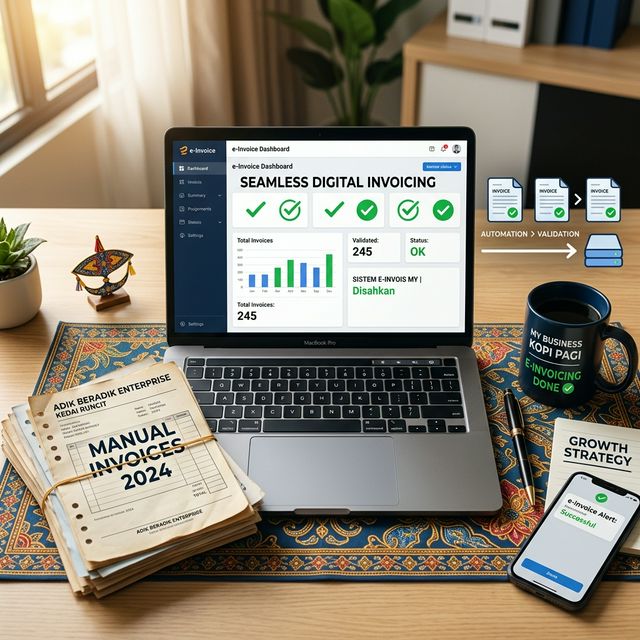
Featured image concept: A clean, warm-toned flat-lay showing a Malaysian business owner's desk — a laptop open to a dashboard showing green invoice validation ticks, a stack of traditional paper invoices to the left being replaced by a digital flow to the right, with subtle Malaysian motifs (batik-pattern desk mat) and soft morning light. Professional but approachable.
Schema markup: Article schema (primary), HowTo schema for the 7-step getting-started plan, FAQPage schema for the key considerations section.