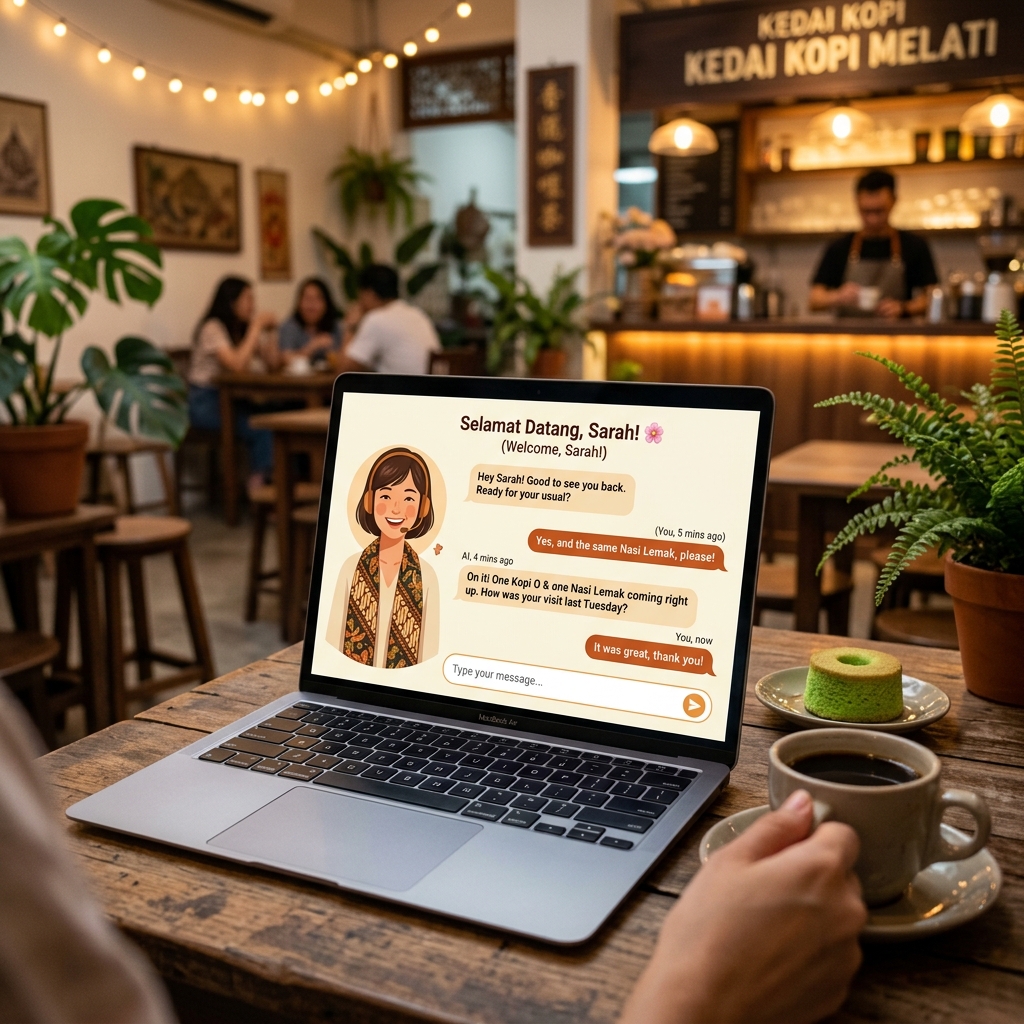
AI Agent Memory: Why Your AI Needs to Stop Forgetting Your Customers
Every time a customer opens a new chat with your AI agent, it has no idea who they are. No history. No context. No memory of the last three conversations where they explained their problem in detail. That is not a chatbot quirk — it is a business problem, and AI agent memory is how you solve it.
This is one of the most underrated gaps in how Malaysian SMBs currently deploy AI. Most businesses install a chatbot and call it a day. The smarter businesses are building agents that learn, retain context, and get better at serving each customer over time. The difference in customer experience — and business results — is significant.
What Is AI Agent Memory?
AI agent memory is the capability that allows an AI agent to retain and recall information across multiple conversations and sessions. Without it, every interaction starts from zero. The agent has no idea whether the person messaging is a first-time visitor or a loyal customer of five years.
Think of it this way: a new staff member with no training versus an experienced team member who remembers that Mr. Lim always orders the same product, prefers delivery on weekdays, and had a billing dispute three months ago that was resolved. The experienced staff member closes more deals, handles complaints faster, and earns more repeat business — not because they are smarter, but because they remember.
An AI agent with memory works the same way.
There are three core types of AI agent memory to understand:
Short-Term Memory (In-Session Context)
This is what most basic chatbots already do. The agent remembers what was said earlier in the same conversation. It knows you just asked about pricing before you asked about delivery. When the chat ends, everything disappears.
Long-Term Memory (Cross-Session Persistence)
This is where real business value lives. The agent stores information from past interactions — customer preferences, previous complaints, purchase history, communication style — and retrieves it the next time that customer gets in touch. The conversation picks up where it left off, not from scratch.
Semantic Memory (Domain Knowledge)
This is the agent's "what it knows" layer — product catalogues, company policies, FAQ databases, pricing structures. It is the institutional knowledge your AI draws from to give accurate, relevant answers. Retrieval-Augmented Generation (RAG) is the most common way to power this layer, pulling from your actual business documents in real time.
Why This Matters More for Malaysian SMBs Than You Think
Malaysia's business culture is built on relationships. Your regular customers at a kopitiam know the uncle by name. He knows their order. In professional services, clients expect their lawyer, accountant, or consultant to remember the context from the last meeting without them having to repeat everything.
AI agents are now embedded in the customer journey for thousands of Malaysian small businesses — through WhatsApp chatbots, website assistants, and automated sales follow-ups. But most of these agents behave like strangers every time they interact. That frictions the relationship. It signals to customers that the automation is cheap and impersonal.
There is also a performance dimension. According to a 2025 MIT report, despite enterprises spending $30–40 billion on generative AI, 95% of organisations saw no measurable ROI. The primary culprit was AI systems that could recall facts but failed to maintain meaningful context across interactions. The same problem is playing out at the SMB level — businesses add AI tools but see minimal return because the tools are stateless and impersonal.
The SMB AI adoption data backs this up: 93% of small businesses report some positive impact from AI, but only 14% have fully integrated it into core operations. The gap between "tried AI" and "got real ROI from AI" is largely a memory and context problem.
Three Business Cases Where AI Memory Changes Everything
1. Customer Service That Feels Human
AI customer service agents deployed without memory are fast but frustrating. They answer basic queries, but every follow-up becomes a new interrogation: "May I have your name? Your order number? Your issue?" Customers who have already provided this information — sometimes multiple times — lose patience quickly.
With persistent memory, the agent already has the customer's profile loaded before the conversation begins. It knows their last order, their preferred contact method, whether their last complaint was resolved. It can open with context: "Hi Sarah, I can see your last delivery was on March 15 — is this related to that order?" That is the experience that builds loyalty.
A randomised field experiment with an e-commerce delivery company found that AI-assisted support agents with access to customer context responded faster and achieved measurably higher customer satisfaction scores than agents operating without history. The technology was the same — the memory was the differentiator.
2. Sales Agents That Actually Close
AI lead generation and follow-up systems are common in Malaysian SMBs. But most operate on fixed drip sequences — the same templated messages sent to everyone on a schedule, regardless of what that lead has already said or done.
A memory-enabled sales agent changes the dynamic entirely. It remembers that the prospect mentioned budget constraints in the first conversation and came back three weeks later. It knows they downloaded your pricing guide but did not book a call. It recalls that they mentioned comparing you to a competitor. The follow-up it sends is not the generic template — it is a message that speaks directly to where that person is in their decision.
Agents with this capability remember buyer objections, successful pitches, timelines, and preferences. They personalise outreach not because someone manually updated a CRM field, but because the agent learned from every prior interaction.
3. Operations That Retain Institutional Knowledge
One of the most underappreciated use cases for AI agent memory is internal. When a team member leaves, they take institutional knowledge with them — how to handle the difficult client, what workarounds exist for the old accounting system, which suppliers are reliable and which are not.
A memory-enabled internal AI agent accumulates this knowledge over time. Every resolved support ticket, every successful negotiation, every workflow exception becomes part of its retrievable memory. New staff get the benefit of everything that came before them without needing weeks of handover.
How AI Agent Memory Actually Works
You do not need to understand the engineering in detail, but knowing the architecture helps you make better decisions when building or buying an AI agent.
The core components are:
- A memory store — This is where information is saved after each interaction. It can be a structured database, a vector database, or a hybrid. Vector databases are particularly well-suited for AI memory because they store information in a way that allows semantic search — the agent can retrieve not just exact matches but conceptually similar context.
- A retrieval mechanism — Before each response, the agent queries its memory store for relevant context. This is often powered by RAG, which pulls the most relevant past interactions and domain knowledge into the agent's working context.
- Model Context Protocol (MCP) — An emerging standard that defines how AI agents share and access context across tools, databases, and sessions. MCP is becoming an important layer for businesses that want their agents to work with existing tools — CRMs, helpdesk software, inventory systems — rather than in isolation.
The practical effect: when a customer messages your agent, the system retrieves the last three interactions, their product preferences, and any open issues — then feeds all of that context to the AI before it formulates a response. The customer experiences a seamless conversation. The agent appears to actually know them.
Getting Started: An Action Plan for Malaysian SMBs
Building an AI agent with memory does not require an enterprise budget. Here is a realistic path for a small business starting from scratch:
-
Map your highest-value interaction — Identify the one customer conversation that, if your AI remembered it perfectly, would most improve your business outcomes. For most SMBs, this is either customer support or sales follow-up.
-
Audit your current data — What customer information do you already have? Order history in Shopify? Enquiries in a spreadsheet? WhatsApp chat logs? The quality of your memory layer depends directly on the quality of your existing data.
-
Choose a memory architecture — For most SMBs, starting with a simple long-term memory store (a structured database linked to your agent) is sufficient. More sophisticated semantic search comes later. Work with an AI agent specialist if the architecture decisions feel overwhelming.
-
Build or configure your agent — Platforms like n8n, Make, or purpose-built agent frameworks can handle the plumbing. The critical decision is which memory framework to use. Mem0, Zep, and Redis are three popular options at different price and complexity points.
-
Start narrow and expand — Launch your memory-enabled agent on one channel first — WhatsApp or your website chat. Measure the impact on resolution time, customer satisfaction, and repeat interactions. Then expand to additional use cases once you have a working model.
-
Set data governance rules — Decide upfront what your agent stores, how long it retains information, and how customers can request deletion. Malaysia's Personal Data Protection Act (PDPA) applies here. Your AI agent is collecting customer data, and you are responsible for how it is handled.
Key Considerations Before You Build
Memory Without Accuracy Is Worse Than No Memory
An agent that confidently retrieves the wrong information — pulling a record from a different customer with a similar name, or surfacing an outdated policy — does more damage than an agent that simply starts fresh. Invest in data quality and retrieval testing before deploying to real customers.
Transparency Builds Trust
Malaysian customers, like most customers globally, are becoming aware that AI is involved in their service experience. Agents that pretend to be human and claim to "remember" a conversation they technically retrieved from a database can erode trust when discovered. Being transparent about how your AI works — that it stores past interactions to serve customers better — is not a weakness. It is a selling point.
Start With a Single Use Case
The fastest way to fail with AI agent memory is to try to build an all-knowing, all-remembering system on day one. The AI tool overload problem is real — and it applies to AI architecture decisions as much as it does to software purchases. Pick one high-value interaction, build memory around it well, and expand methodically.
The Bottom Line
Most Malaysian businesses are deploying AI agents that forget everything the moment a conversation ends. That is the difference between automation that feels convenient and automation that actually builds relationships.
AI agent memory is what transforms an AI tool into an AI teammate — one that knows your customers, learns from every interaction, and gets better over time. The businesses that build this capability now are accumulating a compounding advantage that will be very hard for late movers to close.
The tools exist. The frameworks are maturing. The only thing standing between most Malaysian SMBs and a properly memory-enabled AI agent is knowing where to start.
Start with one conversation. Make your AI remember it.
Frequently Asked Questions About AI Agent Memory
What is AI agent memory in simple terms? AI agent memory is the capability that allows an AI agent to remember information from past conversations and interactions. Instead of starting each conversation from scratch, a memory-enabled agent can recall customer preferences, past purchases, previous complaints, and interaction history — making every conversation feel more personal and contextually aware.
Why don't most AI chatbots remember my customers? Most basic chatbots and AI tools are stateless — they process each conversation in isolation without storing anything once the session ends. This is a design choice that simplifies the architecture but sacrifices relationship continuity. Building persistent memory requires additional infrastructure: a memory store, a retrieval mechanism, and a framework to manage what gets saved and recalled.
How does AI agent memory differ from a CRM? A CRM stores structured data that humans enter — contact details, deal stages, notes added manually. AI agent memory stores unstructured context from actual conversations — tone preferences, objections raised, questions asked, resolutions achieved — and retrieves it automatically when needed. The two work best together: CRM provides the structured record, memory provides the conversational context.
Is AI agent memory compliant with Malaysia's PDPA? Yes, but only if implemented correctly. Malaysia's Personal Data Protection Act (PDPA) requires that businesses collect only necessary data, inform customers about data collection, and honour data deletion requests. An AI agent that stores customer conversation history is collecting personal data. Businesses must have a clear retention policy, a method for customers to request deletion, and appropriate data security measures in place.
What are the best tools to add memory to an AI agent? Three popular options at different price and complexity levels: Mem0 (open-source, API-based, easy to integrate), Zep (purpose-built agent memory platform with vector search), and Redis (high-performance in-memory database, more technical to configure). For Malaysian SMBs without a developer, working with an AI agent specialist to select and configure the right memory layer is recommended.
How long does it take to build a memory-enabled AI agent? For a basic implementation on one channel (e.g., WhatsApp), a competent AI agent developer can build a functional memory layer in 2–4 weeks. A more sophisticated system spanning multiple touchpoints — website chat, WhatsApp, email follow-ups — typically takes 6–10 weeks. Starting with a single high-value interaction reduces complexity and accelerates time to value.
Internal links used:
- "Retrieval-Augmented Generation (RAG)" →
/blog/2026/what-is-rag - "WhatsApp chatbots" →
/blog/2026/whatsapp-ai-chatbot-small-business-malaysia - "SMB AI adoption data" →
/blog/2026/smb-ai-adoption-gap - "AI customer service agents" →
/blog/2026/ai-customer-service-agent-malaysia-smb - "AI lead generation" →
/blog/2026/ai-lead-generation-small-business - "Vector databases" →
/blog/2026/vector-database - "Model Context Protocol (MCP)" →
/blog/2026/model-context-protocol-mcp - "AI agent specialist" →
/blog/2026/ai-for-small-business-malaysia - "n8n, Make, or purpose-built agent frameworks" →
/blog/2026/ai-workflow-automation-tools-smb - "AI tool overload problem" →
/blog/2026/ai-tool-overload-small-business
Featured image concept: A warm, close-up illustration of a friendly AI interface on a laptop screen displaying a returning customer's name and conversation history — set in a Malaysian café or small retail shop environment, with soft ambient lighting. The image should feel like personalised service, not cold technology.
Schema markup: Article schema (primary), FAQPage schema (for "What Is AI Agent Memory?" and subtypes), HowTo schema (for the 6-step action plan section).