Fine-Tuning vs RAG: How to Choose the Right AI Strategy for Your Business
Every business hitting a wall with their LLM comes to the same fork in the road: fine-tune the model, or plug in RAG? Pick the wrong one and you'll waste months of engineering time and tens of thousands in compute costs. Pick the right one and your AI suddenly starts performing like it actually understands your business.
What Are We Actually Comparing?
Before picking sides, it's worth being precise about what each approach does — because the terminology gets muddy fast.
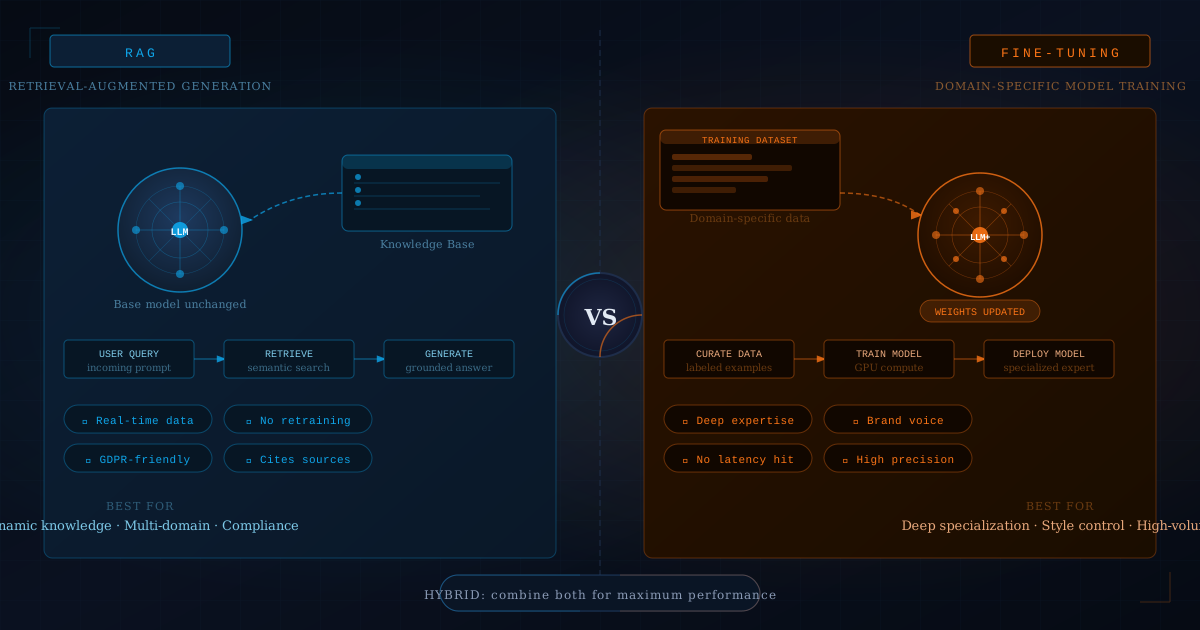
Retrieval-Augmented Generation (RAG) leaves the base LLM completely untouched. Instead, at the moment a user submits a query, a separate retrieval system searches your external knowledge base, pulls the most relevant document chunks, and injects them into the prompt as added context. The model then generates a response grounded in both its pre-trained knowledge and that freshly retrieved data. Your company's product manuals, compliance docs, support tickets — all of it stays in your database and gets pulled in on demand.
Fine-tuning works at a fundamentally different level. You take a pre-trained foundation model and continue training it on a smaller, curated, domain-specific dataset. This process adjusts the model's internal weights — the model doesn't just read your data, it learns from it. Afterwards, that specialized knowledge is baked directly into the model itself.
The core distinction: RAG gives the model access to your knowledge at runtime. Fine-tuning embeds that knowledge into the model permanently.
Why This Decision Actually Matters
This isn't a technical detail. It's a strategic choice that determines your cost structure, your maintenance burden, your data security posture, and how fast you can iterate.
A Wipro FinOps analysis published this month made the point clearly: for high-traffic applications handling millions of monthly queries, RAG's recurring token costs from context injection can actually exceed the upfront investment of fine-tuning over the long term. The math flips depending on your use case. Meanwhile, fine-tuning a model on sensitive healthcare or legal data raises compliance exposure that a RAG architecture largely sidesteps — your data stays in secured storage and only surfaces at query time.
The choice compounds over time, too. Fine-tuned models go stale as your domain evolves and require expensive retraining cycles. RAG knowledge bases can be updated by simply editing a document.
When RAG Is the Right Call
RAG wins in most enterprise scenarios, especially when you're dealing with information that changes frequently or spans multiple domains.
1. Your Data Changes Often
Customer-facing support bots, legal research tools, internal knowledge bases — these need to reflect reality right now, not reality from six months ago when you last retrained a model. With RAG, updating your knowledge base means updating a document. No retraining. No downtime. No engineering sprint.
2. You're Serving Multiple Domains from One Model
Fine-tuning a separate model per department or client quickly becomes unmanageable. RAG handles this elegantly: the same base model can serve HR, Finance, and Legal simultaneously by routing queries to different data sources. It scales without multiplying your infrastructure costs.
3. Data Privacy and Compliance Are Non-Negotiable
RAG keeps sensitive information in secured repositories. The LLM only sees it at query time and doesn't store it in its weights. This makes GDPR and HIPAA compliance dramatically simpler to enforce — you maintain access controls at the data layer, and nothing gets permanently baked into the model.
4. You Want Transparent, Auditable Answers
Because RAG can be engineered to cite its sources, you get a traceable chain from answer back to document. For regulated industries, this is the difference between a tool your legal team approves and one they ban.
When Fine-Tuning Is the Right Call
Fine-tuning earns its complexity in specific, well-defined situations where depth of expertise beats breadth and flexibility.
1. You Need Deep Domain Specialization
A radiology report generator needs to know the precise formatting conventions, standard terminology, and systematic documentation approach that radiologists use — nuances that go far beyond what a RAG retrieval system can inject through context alone. A fine-tuned legal model will consistently outperform a RAG approach on legal question-answering benchmarks because it has internalized the domain, not just retrieved from it.
2. You Need to Change How the Model Behaves
RAG can make a model more knowledgeable. Fine-tuning is the only method that can fundamentally change how a model responds — its tone, format, style, and reasoning patterns. If you need a chatbot that consistently sounds like your brand, not like a generic AI assistant, fine-tuning is the lever to pull.
3. Your Knowledge Is Stable and Traffic Is High
At scale, RAG's token economics work against you. Every query forces the model to process an extended prompt containing retrieved chunks, which adds latency and cost per query. A fine-tuned model carries its knowledge internally and returns precise, compact responses without a retrieval step. For stable, high-volume applications, that efficiency compounds into real savings.
4. You're Working in a Regulated, Compliance-Heavy Environment
When consistency and predictability are legally required — clinical decision support, contract analysis, financial compliance — fine-tuning delivers more controlled, reproducible outputs than a retrieval pipeline that depends on search quality.
The Decision Matrix
Use this to cut through the noise quickly:
| Factor | Choose RAG | Choose Fine-Tuning |
|---|---|---|
| Knowledge currency | Updates frequently | Stable, slow-changing |
| Domain scope | Multiple domains | Single, deep domain |
| Data sensitivity | Must stay in secured storage | Can be used for training |
| Output requirements | Factual grounding, citations | Consistent style, behavior change |
| Traffic volume | Low-to-medium scale | High volume, cost-sensitive |
| Time to deploy | Faster (no training pipeline) | Slower (training + evaluation) |
| Maintenance burden | Ongoing knowledge base curation | Periodic but expensive retraining |
The Hybrid Approach: When You Need Both
The most sophisticated enterprise AI deployments in 2026 aren't choosing between RAG and fine-tuning — they're combining them in layers.
The pattern works like this: fine-tune the base model for fluency, tone, and task mastery in your domain. Then layer RAG on top to supply real-time, up-to-date, proprietary knowledge. A healthcare AI might be fine-tuned to speak with clinical precision and follow documentation conventions, while RAG surfaces the latest drug interaction data and specific patient history at query time. The fine-tuned layer handles expertise and style. The RAG layer handles freshness and specificity.
This hybrid architecture is becoming the standard for complex enterprise deployments — not because it's the easiest path, but because it's the one that avoids the trade-offs of either approach alone.
How to Make the Call for Your Organization
Start with three questions before touching any code:
- How often does your knowledge change? If the answer is "constantly," RAG is almost certainly the right foundation.
- Do you need to change the model's behavior, or just its knowledge? Behavior change requires fine-tuning. Knowledge augmentation doesn't.
- What are your compliance constraints? If sensitive data can't leave your environment for training, RAG keeps you covered.
From there, model size matters. For large foundation models, RAG typically preserves general capability better than fine-tuning, which can cause "catastrophic forgetting" — where the model loses broader skills as it specializes. For smaller custom models with limited pre-trained knowledge, fine-tuning often outperforms RAG because there's less general capability to preserve.
The Bottom Line
RAG and fine-tuning aren't competing philosophies — they're tools for different jobs. RAG is the default choice for most enterprise use cases: faster to deploy, easier to update, cheaper to maintain at moderate scale, and cleaner from a compliance standpoint. Fine-tuning earns its complexity when you need permanent expertise, behavioral control, or peak efficiency at scale with stable knowledge.
If you're building your first production AI system, start with RAG and a solid agent infrastructure. Add fine-tuning when you've validated the use case, proven the ROI, and hit the ceiling of what retrieval alone can do. That sequencing will save you months of rework — and a painful conversation with your CFO.
Frequently Asked Questions
Can you use RAG and fine-tuning together? Yes, and many enterprise deployments do. The typical pattern is to fine-tune for domain expertise and behavioral alignment, then layer RAG on top for real-time, proprietary knowledge access.
Is RAG cheaper than fine-tuning? Usually — upfront. Fine-tuning has significant training costs. However, at very high query volumes with stable knowledge, the ongoing token costs of RAG context injection can eventually exceed a fine-tuned model's inference costs.
Does fine-tuning prevent hallucinations? It reduces them in its domain of specialization, but doesn't eliminate them. A fine-tuned model can still hallucinate on questions outside its training distribution. RAG grounds responses in actual retrieved documents, which generally improves factual accuracy across a broader range of queries.
How long does fine-tuning take? Depending on dataset size, model size, and hardware availability, production fine-tuning projects typically run from days to several weeks. RAG architectures can often be stood up and tested within days.
Which approach is better for a customer support chatbot? RAG in almost every case. Support knowledge changes frequently — policies update, products change, pricing shifts. RAG lets you update the knowledge base without touching the model.