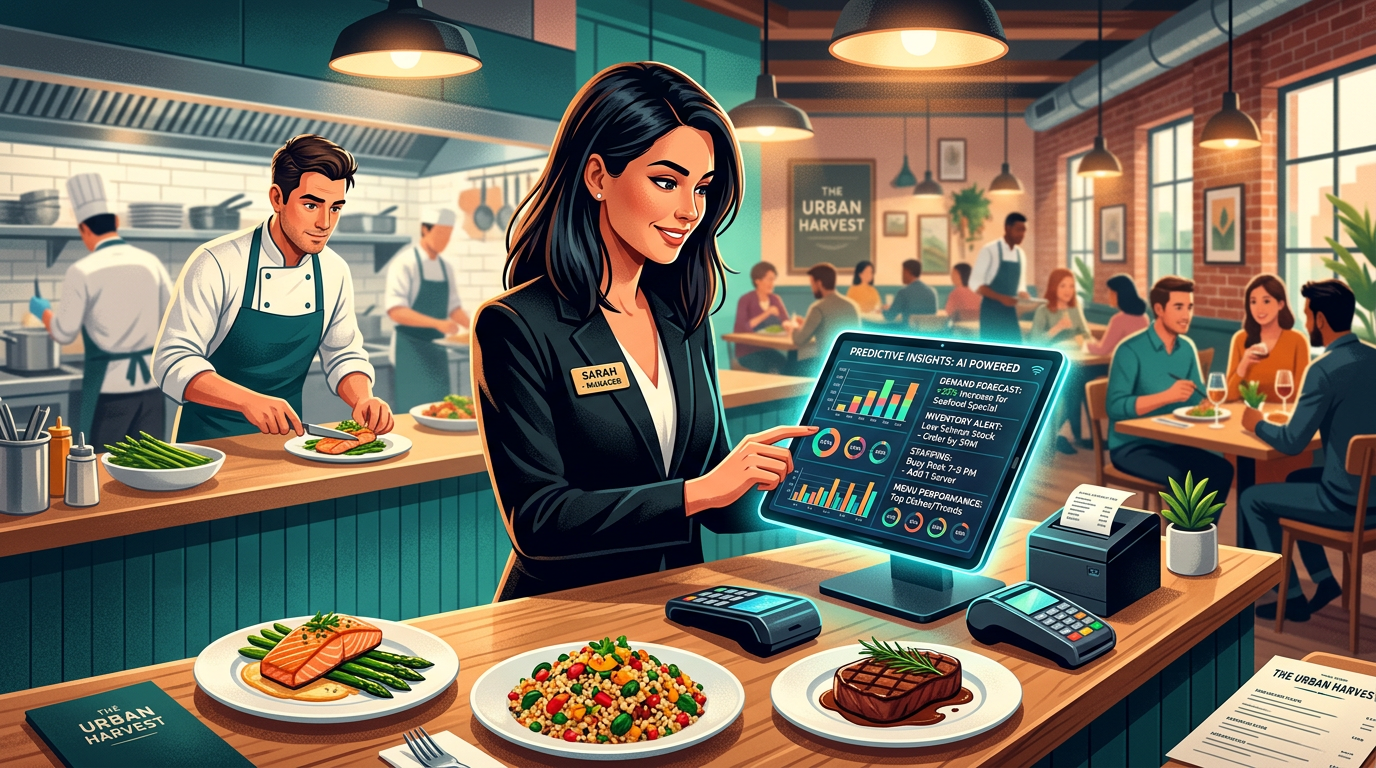
The F&B industry in Malaysia is experiencing unprecedented growth, with the market valued at RM 95.2 billion in 2023 and projected to grow at 7.2% annually through 2030, according to market research from the Malaysian Franchise Association. Yet despite this expansion, most restaurant and F&B businesses still rely on manual processes for order management, inventory tracking, and customer communication. AI agents are transforming how F&B businesses operate, automating repetitive tasks, reducing food waste, and enabling owners to focus on growth and customer experience. For Malaysian F&B owners facing rising operational costs and labour shortages, AI automation isn't a luxury—it's becoming essential to remain competitive.
The Problem: Why F&B Businesses Struggle with Manual Processes
The hospitality sector faces unique operational challenges that directly impact profitability. Restaurant owners in Malaysia report that 60-70% of their operational time is spent on non-revenue-generating tasks such as manual order entry, inventory counting, and responding to customer inquiries. This time drain isn't just inefficient—it's costly.
Labour shortages remain a persistent challenge for the F&B industry. According to the Malaysian Employers Federation, the hospitality sector faces a 15-20% staff vacancy rate, making it increasingly difficult to maintain service quality while managing back-of-house operations. Many establishments hire fewer staff members than needed, pushing existing employees to multitask and work longer hours, which leads to burnout and reduced service quality.
Food waste represents another critical pain point. Studies indicate that Malaysian F&B establishments waste between 15-25% of their purchased inventory due to poor tracking and demand forecasting. A mid-sized restaurant purchasing RM 50,000 in ingredients monthly could waste up to RM 7,500—money that disappears before a single dish reaches a customer.
Customer communication challenges compound these issues. Most restaurants still manage reservations, customer inquiries, and complaints through multiple channels—phone calls, WhatsApp messages, social media, and email—with no unified system. This fragmentation leads to missed bookings, delayed responses, and dissatisfied customers who take their business elsewhere.
Additionally, compliance requirements in Malaysia continue to evolve. The introduction of e-invoicing requirements by the Inland Revenue Board of Malaysia (LHDN) for F&B businesses adds another layer of administrative burden, requiring precise real-time transaction tracking that many establishments struggle to maintain.
How AI Agents Work for F&B: Four Transformative Use Cases
Use Case 1: Automated Order Taking and Processing
AI-powered ordering systems are revolutionising how restaurants capture and process customer orders. Rather than customers waiting on hold or operators manually transcribing orders, intelligent agents handle order intake through multiple channels—WhatsApp, Facebook Messenger, phone, and web interfaces—simultaneously.
For Malaysian F&B businesses, WhatsApp-based ordering bots represent a game-changer. With over 95% of Malaysian internet users active on WhatsApp, a WhatsApp ordering bot eliminates friction from the customer experience. Customers can place orders by simply sending a message, selecting items from a menu displayed in the chat, specifying dietary requirements, and confirming delivery details—all without leaving WhatsApp.
These AI agents reduce order errors by 95% compared to manual entry, as they clarify ambiguous requests in real-time and confirm details before finalising orders. For delivery-focused establishments, this accuracy directly improves customer satisfaction and reduces costly refunds and remakes. Processing time for order-to-confirmation drops from 10-15 minutes to under 2 minutes, allowing kitchen staff to begin preparation faster and reducing meal delivery times.
Beyond order entry, AI agents integrate with POS systems to automatically update inventory levels, flag items that are out of stock or approaching depletion, and even suggest upsells based on customer order history and preferences.
Use Case 2: Inventory Management and Waste Reduction
Inventory management represents one of the most transformative applications of AI in F&B. Traditional inventory methods—manual counts, spreadsheets, and periodic stocktakes—provide only snapshots of inventory status and offer no predictive capability. AI agents change this fundamentally.
Machine learning models trained on historical sales data, seasonal trends, and external factors (weather, local events, holidays) generate accurate demand forecasts at the ingredient level. When a restaurant predicts it will sell 120 portions of a particular dish next Wednesday based on historical data and upcoming events, it can purchase exactly the right quantity of ingredients rather than guessing and buying 150 portions.
For perishable goods—the lifeblood of F&B businesses—this precision matters enormously. AI agents monitor ingredient expiration dates, suggest recipes and specials that use items approaching expiration, and alert staff when items need to be used within a specific timeframe. Some systems can even recommend promotional pricing strategies to move aging inventory before spoilage.
Integration with supplier management systems allows AI agents to automatically generate purchase orders when inventory falls below optimal levels, optimising both stock availability and cash flow. By reducing overstock of perishables by just 20%, a restaurant purchasing RM 50,000 monthly in ingredients can save approximately RM 5,000 annually while simultaneously reducing food waste.
Use Case 3: Customer Service and Reservation Management
AI chatbots handle the majority of routine customer service inquiries without human intervention, resolving common questions about operating hours, menu items, delivery options, and reservation availability instantly, 24/7. This immediate response significantly improves customer satisfaction while reducing the workload on staff.
For reservation management, AI agents maintain real-time availability, accept bookings directly through messaging platforms or web interfaces, send automatic confirmation messages and pre-reservation reminders, and handle cancellations and rebooking requests. This automation reduces no-show rates (typically 15-25% in F&B) by ensuring customers receive multiple reminders and have flexibility in managing their reservations.
More advanced systems collect customer feedback automatically through post-transaction surveys, identify patterns in complaints and compliments, and flag issues that require human intervention. A chatbot might recognise that multiple customers report long wait times on Friday evenings and alert management to adjust staffing or kitchen processes for those periods.
For Malaysian F&B businesses, customer service chatbots can operate in multiple languages—English, Malay, Mandarin, Tamil—removing language barriers and expanding the customer base to diverse communities.
Use Case 4: Marketing Automation and Review Management
AI agents monitor online reviews across Google, Facebook, Trip Advisor, and other platforms, automatically responding to reviews, categorising feedback by theme, and alerting management to urgent issues requiring immediate attention. A restaurant receives 50 online reviews monthly but struggles to respond to them all—an AI agent ensures no review goes unacknowledged and maintains a professional online reputation.
Loyalty program management becomes automated, with AI agents identifying high-value repeat customers, personalising promotional offers, and timing incentives to drive repeat bookings. Rather than sending generic discounts to all customers, AI agents segment customers by behaviour and offer targeted rewards that increase lifetime customer value.
Email and SMS marketing campaigns are optimised through AI, with timing, messaging, and offers personalised based on customer preferences and purchase history. A customer who regularly orders biryani receives personalised promotions for Indian cuisine, while one who orders vegetarian meals receives plant-based options.
For social media presence, AI agents schedule posts, engage with followers, and generate content ideas based on trends, seasonal themes, and restaurant specials. This maintains consistent online visibility without requiring staff to spend hours on social media management.
AI Tools for F&B Compared
| Tool | Pricing Model | Key Features | Best For | Malaysia Support |
|---|---|---|---|---|
| StoreHub | RM 99-499/month | POS integration, inventory, online ordering, WhatsApp integration | All-in-one F&B ops | Native Malaysian support |
| FeedMe | RM 150-600/month | Delivery management, kitchen display, customer analytics | High-volume delivery operations | Strong local presence |
| Mr Yum | RM 250-800/month | Digital menus, ordering kiosks, customer engagement | Dine-in and delivery hybrid | Limited local integration |
| Toast | USD 69-199/month (~RM 300-850) | Comprehensive POS, AI-powered insights, labour management | Growing multi-location chains | International support |
| Zuppler | RM 200-600/month | Online ordering portal, delivery coordination | Restaurants relying on delivery partners | Global support |
| Lunchbox | RM 180-550/month | AI chatbots, SMS campaigns, customer loyalty | Marketing-focused establishments | International platform |
Each platform offers different strengths. StoreHub leads for Malaysian-specific requirements due to native LHDN e-invoicing integration and WhatsApp connectivity. FeedMe excels for delivery-heavy operations. More advanced implementations combine multiple tools—a POS system, dedicated ordering platform, and AI chatbot—to create a comprehensive ecosystem.
ROI Breakdown: Real Numbers for Malaysian F&B Businesses
Implementing AI automation delivers quantifiable returns within 6-12 months for most establishments. Consider a typical mid-sized Malaysian restaurant (50 seats, 300-400 daily covers):
Labour Cost Reduction: An AI ordering and customer service system handles 70% of routine inquiries and order entry tasks. With one staff member dedicated to these functions at RM 2,500/month salary plus benefits, replacing this function with AI (monthly SaaS cost RM 300-400) saves RM 25,000+ annually.
Food Waste Reduction: Implementing AI-powered inventory forecasting reduces waste from 20% to 8% of inventory purchases. A restaurant purchasing RM 40,000 monthly in ingredients saves RM 4,800 annually (20% - 8% = 12% savings on RM 40,000).
Revenue Increase from Improved Customer Experience: AI-powered reservations and WhatsApp ordering reduce no-shows from 20% to 8%, and improve order accuracy, leading to fewer complaints and remakes. Improved customer satisfaction increases repeat visits by 15-20%, translating to an additional RM 2,000-4,000 monthly for a mid-sized restaurant.
Operational Efficiency: Kitchen staff spend less time managing unclear orders or hunting for inventory information. More efficient operations allow the same kitchen staff to handle 20-30% more covers without additional hiring.
Combined Annual ROI: RM 25,000 (labour) + RM 4,800 (waste reduction) + RM 36,000 (revenue growth at RM 3,000 additional monthly) + RM 12,000 (operational efficiency) = RM 77,800 annual benefit against RM 5,000 annual software costs represents a 1,456% return on investment.
These figures are based on data from the Malaysian Retailers Association and implementation case studies from F&B establishments across Klang Valley, Penang, and Johor Bahru.
Malaysia-Specific Considerations for AI Implementation
LHDN E-Invoicing Compliance
Malaysia's e-invoicing mandate, implemented by the Inland Revenue Board of Malaysia (LHDN), requires real-time electronic invoicing for F&B businesses. AI-integrated POS systems automatically generate compliant e-invoices, ensuring your business remains audit-ready and avoids penalties. Choose platforms with native LHDN certification to avoid expensive integration complications.
WhatsApp as a Business Channel
Unlike Western markets where SMS dominates, Malaysian customers prefer WhatsApp for business communication. AI solutions that prioritise WhatsApp Business API integration ensure your business reaches customers on their preferred platform. WhatsApp ordering bots reduce friction in the customer journey—a critical advantage in Malaysia's competitive F&B landscape.
Local POS System Integration
Most established Malaysian F&B businesses operate legacy POS systems (Micros, Square, local systems). Ensure any AI solution you implement integrates seamlessly with your existing POS infrastructure. Data migration and system conflicts represent the primary implementation risks—choose vendors with proven track records integrating with Malaysian F&B POS systems.
Cultural Considerations in Automation
Malaysian F&B customers value personal service and customisation. Implement AI to handle routine functions—ordering, basic inquiries, inventory management—while preserving human touchpoints for upselling, special requests, and complaint resolution. Customers should feel they can escalate to a human representative easily when needed.
Multi-Language Support
With Malaysia's diverse population (Malay, English, Mandarin, Tamil, and other communities), F&B businesses benefit significantly from AI systems supporting multiple languages. This expands your potential customer base and improves service quality for non-English speakers.
Data Privacy and Cloud Infrastructure
Ensure your AI platform complies with Malaysia's Personal Data Protection Act (PDPA) requirements for customer data storage and processing. Understand where customer data is stored—whether on Malaysian servers or international cloud infrastructure—as this affects compliance obligations and data residency requirements.
Getting Started: A 3-Step Implementation Plan
Step 1: Audit Current Operations (Week 1-2)
Conduct a thorough assessment of your current processes. Identify where staff spend the most time on non-revenue-generating tasks, quantify current food waste levels, measure customer wait times and satisfaction scores, and document your current tech stack (POS system, reservation platform, ordering channels).
This audit identifies your biggest pain points and helps you prioritise which AI solutions will deliver the highest ROI. Don't rush this phase—understanding your baseline is critical for measuring success post-implementation.
Step 2: Select and Integrate Your AI Stack (Week 3-6)
Based on your audit, select AI tools addressing your priority pain points. Start with one tool rather than attempting a complete system overhaul. Most successful implementations begin with either an AI ordering system or an AI customer service chatbot—both deliver quick wins and build internal buy-in.
Coordinate closely with your technology partner during integration. Ensure your chosen platform integrates cleanly with your existing POS and other systems. Test thoroughly in a staging environment before going live.
Step 3: Train and Optimise (Week 7 onwards)
Staff training is essential. Your team needs to understand how to manage the new systems, when to escalate issues to human staff, and how to interpret AI-generated insights. Most implementation failures occur due to inadequate training or resistance to change, not technical issues.
After going live, actively monitor system performance. Adjust chatbot responses based on customer interactions, refine inventory forecasts as the AI learns your business patterns, and continuously optimise based on metrics. This is an ongoing process, not a one-time implementation.
FAQ
Q: Will AI ordering systems reduce the personal touch customers expect from our restaurant?
A: AI handles routine, transactional tasks like order entry and basic inquiries, freeing your staff to provide personalised service during customer interactions. Many businesses report improved customer satisfaction because staff spend less time on administrative work and more time engaging with guests. The key is maintaining easy human escalation paths for customers wanting personal interaction.
Q: How long does it typically take to implement an AI system?
A: Basic implementations (AI ordering or chatbot) typically go live in 3-6 weeks. Comprehensive implementations integrating inventory, ordering, POS, and customer service can take 8-12 weeks. The timeline depends on your current technology infrastructure, system integration complexity, and internal capacity to manage the project.
Q: What happens if the AI makes mistakes or upsets customers?
A: AI systems should include human oversight and escalation pathways. Customer complaints or complex inquiries should route to human staff immediately. Most systems log these interactions, allowing you to identify patterns and improve the AI's responses. Start with AI handling straightforward interactions where mistakes are low-cost, then expand as the system proves reliable.
Q: Is AI affordable for small restaurants, or only for large chains?
A: AI solutions range from RM 99-800+ monthly, making them accessible to restaurants of all sizes. Small establishments should start with one focused tool (WhatsApp ordering, for example) rather than attempting comprehensive implementation. As your business grows and you see ROI, you can expand to additional AI systems.
Q: How do I ensure customer data stays secure and complies with Malaysian privacy laws?
A: Verify that your chosen AI platform is PDPA-compliant and understand their data storage and processing practices. Request documentation confirming data privacy practices, encryption standards, and compliance certifications. For Malaysian businesses, platforms with native Malaysia support or certified local integrations typically provide stronger compliance assurance than international platforms without local expertise.
Q: Can AI systems work with my existing POS system, or do I need to replace everything?
A: Most modern AI solutions integrate with existing POS systems through APIs. During vendor selection, explicitly confirm integration capabilities with your specific POS model. StoreHub and FeedMe offer strong integration with popular Malaysian POS systems. Avoid vendors requiring complete POS replacement—this is costly and unnecessary with modern integration approaches.
Ready to transform your F&B business with AI? Learn more about implementing AI automation in how to implement AI automation in your business. For insights on customer service improvements, explore AI chatbots for small business websites and discover how AI voice agents support small business operations. Additionally, read about AI tool overload for small businesses to avoid common implementation mistakes.