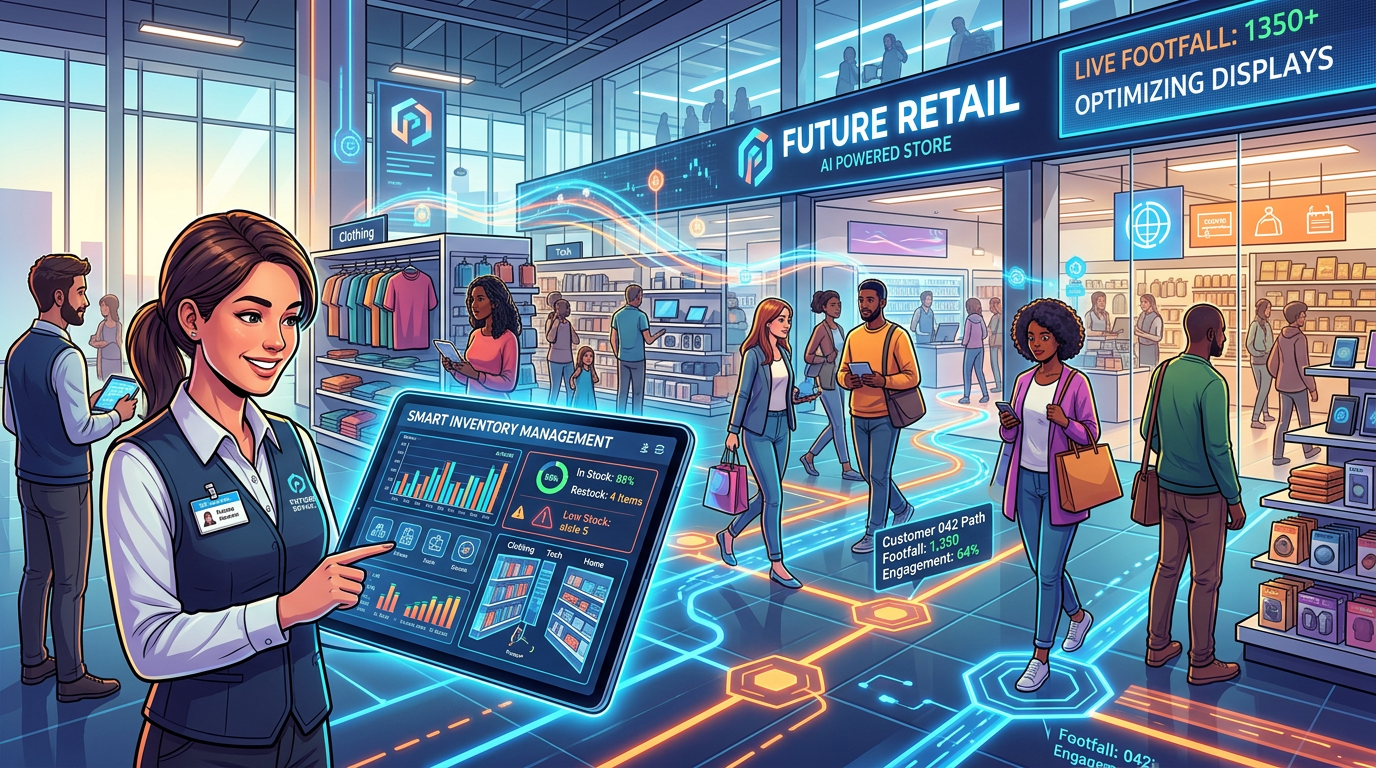
Retail in Transition: Why AI Matters Now
Malaysia's retail sector is undergoing rapid digital transformation. According to the MyDIGITAL initiative, small and medium enterprises (SMEs) that adopt digital tools see revenue increases of up to 45% within the first year. Yet many Malaysian retailers still manage inventory with spreadsheets, lose sales to stockouts, and treat customer service as a cost centre rather than a growth lever.
The challenge isn't technology adoption—it's finding solutions designed for the realities of running a retail business: thin margins, unpredictable demand, and limited staff. This is where AI agents change the game. Unlike traditional software that requires constant manual input, AI agents work continuously to optimise inventory, anticipate customer needs, and personalise experiences at scale.
In this guide, we'll walk you through how modern retail businesses use AI to compete effectively, reduce operational costs by 20-30%, and unlock revenue opportunities that were previously invisible.
The Retail Challenge: Inefficiency at Every Step
Most Malaysian retailers operate under significant constraints:
Inventory Inefficiency: Stockouts cost you lost sales. Overstock ties up capital. Without real-time visibility, you're managing by gut feel—and that rarely works at scale. The average retail SME wastes 15-20% of inventory value through shrinkage, obsolescence, or markdowns.
Reactive Customer Service: Customer inquiries pile up. Response times drag. Your team spends hours answering repetitive questions instead of supporting customers with complex needs or closing high-value deals.
Marketing That Doesn't Convert: You're sending the same promotions to everyone, whether they bought luxury items last month or budget products. Personalisation at scale feels impossible without a data science team.
Pricing Guesswork: Competitors change prices. Demand fluctuates seasonally. You adjust pricing manually—usually too late, missing margin opportunities or pricing yourself out of the market.
These inefficiencies don't just waste money. They create friction for customers and frustration for your team. AI agents eliminate this friction by automating decisions and surfacing insights in real time.
Four Ways AI Transforms Retail Operations
Intelligent Inventory and Demand Forecasting
AI agents analyse historical sales data, seasonal patterns, and external factors (weather, promotions, events) to predict demand accurately. Instead of guessing how many units to stock, you get precise recommendations.
What this looks like in practice: You receive a notification that monsoon season is coming and demand for umbrellas will spike 300% next week. The system recommends increasing orders to your supplier today. Two weeks later, monsoon hits—and you're fully stocked while competitors face stockouts. That's margin protection and satisfied customers.
This capability alone typically reduces stockouts by 25-40% and cuts excess inventory by 15-20%, freeing up working capital for other growth initiatives.
Cost impact: For a typical retail store with RM500,000 in annual inventory, this translates to RM75,000-RM100,000 in cash freed up and RM50,000+ in prevented lost sales.
Personalised Marketing at Scale
AI agents segment your customer base automatically and tailor offers in real time. A customer who spent RM8,000 on fashion last year but hasn't visited in three months gets a different message than a first-time visitor browsing casual wear.
Personalisation goes deeper than this: The system learns what each customer segment responds to. For some, discounts trigger purchase. For others, exclusive early access or loyalty rewards work better. The AI adapts messaging across email, SMS, and in-store promotions.
The result: conversion rates typically increase 15-25%, and customer lifetime value rises as repeat customers feel understood and valued.
Always-On Customer Service
AI chatbots and service agents handle 60-70% of routine inquiries instantly—order tracking, return policies, product questions, store hours. Your team focuses on complex issues, complaints, or upselling opportunities.
Beyond deflection: Modern AI service agents maintain context across interactions. They know this customer bought a dress last month, can recommend complementary items, and escalate smoothly to a human when needed. This turns customer service from a cost into a sales channel.
Impact: First-response resolution rates jump to 75-85%, customer satisfaction increases, and your team's productivity rises 40-50%.
Dynamic Pricing and Margin Optimisation
AI monitors competitor pricing, demand signals, inventory levels, and profit targets to recommend optimal prices in real time. In slow periods, the system suggests strategic discounts to convert browsers into buyers. During high-demand seasons, it protects margins by raising prices where elasticity allows.
Regulatory awareness: For Malaysian retailers, the system integrates with LHDN e-invoicing compliance requirements, ensuring all dynamic pricing and promotional adjustments are properly recorded and auditable.
Impact: Margin improvement typically ranges 3-7%, depending on your product mix and price sensitivity. For a store with 30% gross margin and RM2 million annual revenue, that's RM18,000-RM42,000 in additional profit.
Comparing Retail AI Solutions
| Feature | StoreHub | EasyStore | Shopify AI | Custom AI Agent | RetailCo Analytics |
|---|---|---|---|---|---|
| Inventory Forecasting | Basic | Advanced | Yes | Advanced | Advanced |
| Personalised Campaigns | Limited | Yes | Yes | Full | Yes |
| Chatbot/Service Agent | No | Optional | Yes | Yes | Optional |
| Dynamic Pricing | No | No | Limited | Yes | Advanced |
| Integration with Local Systems | Yes | Yes | No | Yes | Yes |
| LHDN Compliance Support | Yes | Yes | No | Yes | Yes |
| Pricing (Monthly, SGD) | 200-800 | 150-600 | 300-1000+ | 300-1200+ | 250-900 |
| Best For | SME basics | Balanced growth | Ambitious multi-channel | Custom needs | Data-driven retail |
Our recommendation for Malaysian retailers: If you're starting, StoreHub or EasyStore offer solid fundamentals at low cost. As you scale and margins matter more, a custom AI agent tailored to your business model delivers better ROI. Shopify works if you're primarily online; it's less effective for brick-and-mortar or hybrid operations common in Malaysia.
ROI: What Retail Businesses Actually See
Let's run real numbers. Assume you're a Malaysian fashion retailer with:
- RM2 million annual revenue
- 3-4 staff members
- 5,000 annual customer transactions
- 32% gross margin
Year 1 with AI implementation:
- Inventory optimisation: 18% reduction in carrying costs = RM36,000 savings
- Prevented stockouts: 12% additional sales from available inventory = RM240,000 new revenue (RM77,000 gross profit)
- Marketing personalisation: 20% increase in repeat customer rate = RM150,000 additional revenue (RM48,000 gross profit)
- Service automation: 30% reduction in customer service overhead = RM15,000 labour savings
- Dynamic pricing: 5% margin improvement on 60% of inventory = RM60,000 additional profit
Total Year 1 benefit: ~RM236,000 (gross profit and savings combined)
AI investment cost: RM25,000-RM50,000 (setup, training, initial software)
Break-even point: 1.5-2.5 months
Year 2 ROI: 400-500% (now you're just running and optimising; costs plateau)
These numbers are conservative. Retailers in high-margin categories (luxury goods, premium apparel) often see 2-3x these returns.
Malaysia-Specific Advantages of AI Retail
Malaysian retailers benefit from AI adoption in ways specific to the market:
MyDIGITAL Funding: The government's MyDIGITAL initiative provides grants and subsidies for SMEs adopting approved digital solutions. Some AI platforms qualify, reducing your net investment by 30-50%.
LHDN e-Invoicing Compliance: From 1 January 2024, all businesses above a certain revenue threshold must issue e-invoices. AI systems that integrate e-invoicing compliance reduce administrative burden and ensure audit readiness automatically.
Multi-language Support: AI agents serving Malaysian retail often support Malay, English, and Mandarin—essential for reaching diverse customer bases. Most international platforms don't prioritise this; local or Asia-focused solutions do.
Seasonal Demand Patterns: AI trained on Malaysian retail data understands local shopping patterns—Raya season peaks, CNY surges, back-to-school cycles. Generic AI sometimes misses these; localised models predict them accurately.
Cash Management: Malaysia's preference for cash and digital wallets (GCash, TouchnGo) differs from Western markets. AI systems that integrate local payment methods and cash flow forecasting are more useful here.
Getting Started: 3 Steps to Implementation
Step 1: Define Your Priority Problem (Week 1-2)
Don't try to fix everything at once. Identify your biggest pain:
- Is it stockouts costing you sales? Start with inventory forecasting.
- Are customer inquiries overwhelming your team? Start with service automation.
- Is marketing spending inefficient? Start with personalisation.
This focus ensures faster ROI and easier team adoption.
Step 2: Choose and Pilot (Week 3-8)
Select a platform (see comparison table above) and run a 4-week pilot on your priority problem. Define clear success metrics:
- Inventory: measure stockout frequency and excess inventory levels
- Service: track first-response resolution rate
- Marketing: measure repeat customer rate or conversion lift
Most platforms offer free trials or affordable pilot programs.
Step 3: Train, Integrate, and Scale (Week 9+)
Your team needs 2-3 hours of training to use the AI effectively. Integrate it with your existing systems (POS, CRM, email) so data flows automatically—manual data entry defeats the purpose.
After 30 days, review results against your metrics. Adjust settings, expand to secondary use cases, and build momentum.
Timeline to full value: 12-16 weeks from decision to measurable business impact.
Frequently Asked Questions
Q: Will AI replace my staff? A: No. AI automates routine, repetitive work—inventory decisions, basic customer questions, promotional emails. This frees your team to focus on complex problems, relationship-building, and upselling. Most retailers report better job satisfaction after AI adoption because work becomes more strategic.
Q: How much data do I need to start? A: 6-12 months of historical sales data (even from spreadsheets) is enough to train most systems. You don't need big data; you need clean, structured data. Your POS system already has this.
Q: Is AI adoption complicated? Do I need IT expertise? A: Modern retail AI platforms are designed for non-technical users. Integration with your existing POS or eCommerce platform typically takes 1-2 days with vendor support. You shouldn't need an IT specialist.
Q: What about data security and customer privacy? A: Reputable platforms comply with Malaysian data protection laws (PDPA) and international standards (ISO 27001). Ensure your vendor signs a data processing agreement and clarifies how customer data is used and stored. This is non-negotiable.
Q: Can I test this before fully committing? A: Yes. Most vendors offer 2-4 week free trials or low-cost pilot programs. Use this to confirm benefits before rolling out company-wide. There's no reason to commit blind.
The Competitive Edge
AI in retail isn't a luxury—it's becoming table stakes. Your competitors in Singapore and Jakarta are already using it. Malaysian retailers who move now get a 12-24 month advantage before the market catches up.
The good news: implementation is faster and cheaper than ever. The barrier to entry isn't technology or cost—it's deciding to begin.
Start with one problem. Pick a metric. Run a pilot. In 12-16 weeks, you'll have concrete evidence of what AI can do for your business. That evidence drives the rest.
Your next step: Read our guide to calculating AI ROI for small business to understand how to measure success. Then learn how to develop your small business AI strategy to plan your rollout.
Retail is changing. The retailers who adapt—starting now—will thrive.