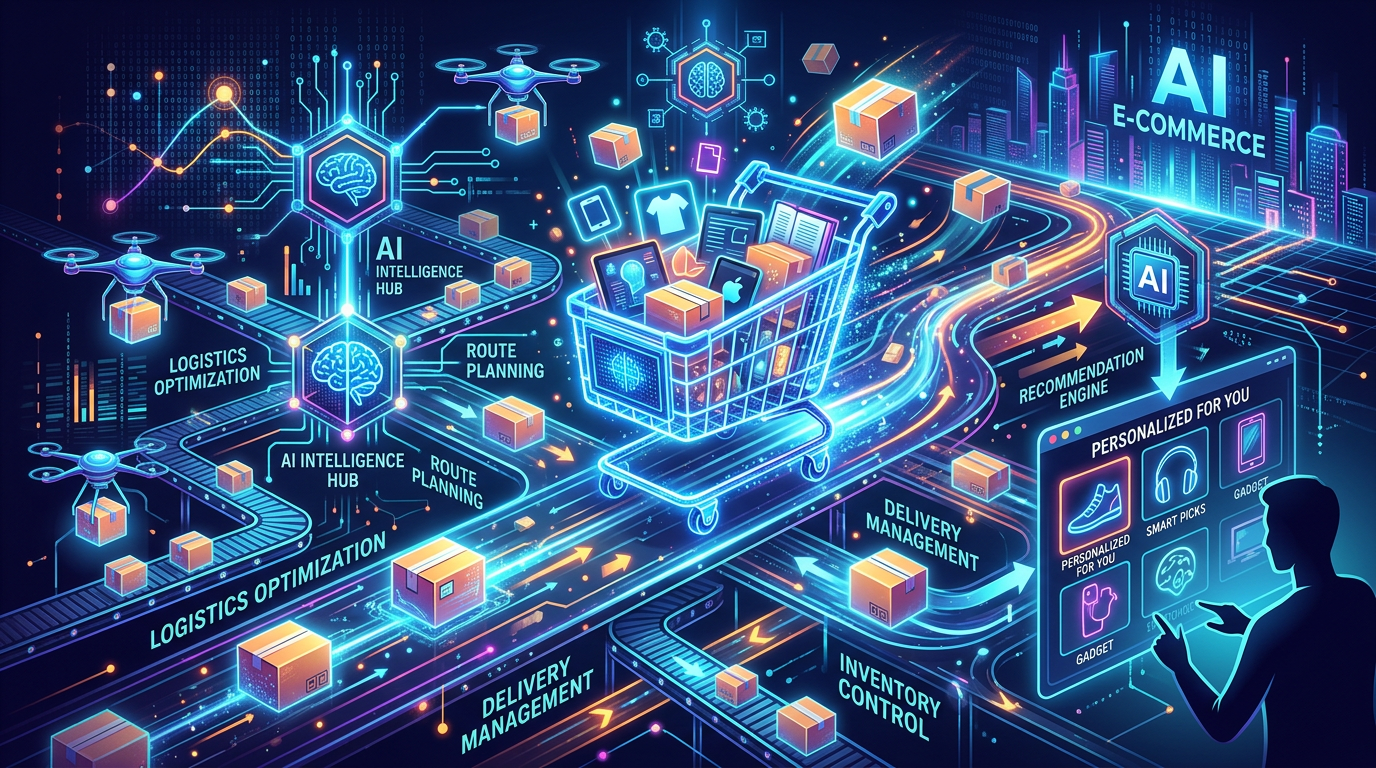
The AI-Powered E-Commerce Revolution
Running an online store demands constant attention to dozens of moving parts: responding to customer queries, writing product descriptions, managing inventory levels, adjusting prices across platforms, and crafting marketing campaigns. For Malaysian sellers operating on Shopee, Lazada, TikTok Shop, or independent storefronts, this operational burden directly erodes profit margins. According to a 2025 Forrester report, e-commerce businesses spend an average of 35% of revenue on operations and customer service. AI agents are fundamentally changing this equation by automating the time-intensive tasks that prevent growth.
This guide explores how online sellers in Malaysia can leverage AI to scale their operations without proportionally increasing headcount or overhead costs.
The Problem: Manual Work Is Killing Your Margins
The challenge facing most Malaysian e-commerce businesses isn't demand—it's capacity. A seller managing 500 daily orders receives 150+ customer inquiries across Shopee, Lazada, WhatsApp, and email. Each question demands a response within hours to maintain ratings. Simultaneously, maintaining fresh product listings with accurate descriptions, competitive pricing, and up-to-date inventory becomes a full-time role.
Data from the Malaysian E-Commerce Association 2025 shows that 68% of SME sellers cite "customer service response time" and "product content management" as their top operational bottlenecks. Many hire virtual assistants at RM2,000–RM4,000 monthly, only to discover that scaling further requires hiring more staff—a cost structure that doesn't improve as business grows.
The economics are unfavourable. A customer support representative handling 200 inquiries daily might reduce response time from 4 hours to 2 hours, but this still requires continuous hiring. AI agents, by contrast, handle 2,000+ simultaneous conversations with millisecond response times, scaling infinitely without additional labour cost.
Four High-Impact AI Use Cases for E-Commerce
Customer Service Chatbots
AI-powered chatbots answer 80% of routine customer inquiries without human intervention. Shopee sellers report that the most common questions involve order status (22%), product specifications (18%), shipping timelines (15%), and return policies (12%).
A trained AI agent learns your store's policies, product catalog, and response tone. When a customer asks "Berapa lama delivery ke Ipoh?"—the bot responds instantly with accurate information, qualifying urgent cases for human escalation. Malaysian sellers using AI chatbots report a 40–60% reduction in support ticket volume and improved customer satisfaction scores (reflected in Shopee Star ratings and Lazada LazScore metrics).
The operational benefit extends beyond response time. By capturing customer questions, AI systems generate insights about the most common product confusions, enabling you to improve listings preemptively.
Product Listing and Description Generation
Writing 200 product descriptions is tedious; writing 2,000 is impossible without hiring. AI generation tools produce SEO-optimised descriptions in seconds—a critical advantage given that Shopee and Lazada's algorithms reward keyword-rich, detailed listings.
For cross-border sellers, this scales further. An AI agent trained on successful product descriptions from your category generates variations for different platforms. A single product listed on Shopee, Lazada, and TikTok Shop requires different emphasis and keywords per platform; AI handles this automatically.
Malaysian sellers benefit especially from multilingual AI. Descriptions generated in both English and Bahasa Malaysia reach broader audiences. Tools supporting code-switching (mixing Malay and English, as Malaysian consumers naturally do) generate more authentic, conversion-optimised copy.
Inventory and Demand Forecasting
Manual inventory tracking is reactive—you reorder when stock runs low. AI systems are predictive. By analyzing historical sales data, seasonal trends, and external factors, AI forecasts demand for each product variant and recommends optimal order quantities.
For sellers managing multiple SKUs across multiple marketplaces, this prevents two costly scenarios: stockouts (lost sales and negative ratings) and overstock (cash tied up and storage costs). A mid-sized Shopee store managing 300 SKUs typically employs one person full-time on inventory alone. AI consolidates this role into a weekly review task.
Demand forecasting is especially valuable during peak seasons. Malaysian e-commerce experiences predictable spikes: Chinese New Year, Ramadan, Hari Raya, and year-end shopping. AI models trained on historical data predict these surges months in advance, enabling smart inventory positioning.
Personalised Marketing and Ad Campaign Optimization
E-commerce margins are compressed by ad costs. Shopee Ads and Lazada Ads operate on a pay-per-click model; a 2% click-to-conversion rate with a RM15 cost-per-click requires RM750 in ad spend per sale. AI optimizes both sides: targeting the customers most likely to buy and adjusting bids in real-time based on performance.
AI agents segment your customer base by purchase history, browsing behaviour, and demographics. They then generate personalized product recommendations and craft targeted ad copy for each segment. A customer who browsed "women's fitness trackers" receives different creative than one who browsed "luxury watches"—automation ensures this personalization scales across thousands of customers.
For Malaysian sellers, this includes currency and timezone optimization. TikTok Shop reaches international audiences; AI adjusts messaging and pricing for different regions and purchasing power.
AI Tools for E-Commerce: A Comparison
| Tool | Primary Strength | Best For | Pricing | Integration |
|---|---|---|---|---|
| Chatbase | Custom chatbot training on your content | Customer support automation | Free tier available; RM99/month for premium | Shopee/Lazada API (custom) |
| Copy.ai | Bulk product description generation | Rapid content creation at scale | RM50/month base tier | Integrates with spreadsheets; manual to platforms |
| Algopix | Demand forecasting and pricing optimization | Inventory and margin optimization | RM2,500–RM7,500/month | Direct integrations available for US sellers; manual for MY |
| Klaviyo | Email marketing automation and personalization | Customer retention and repeat purchase rates | Free tier; RM299/month+ for scale | Integrates with Shopify; manual integration for Shopee/Lazada |
| Sellfy AI | All-in-one: chat, descriptions, and upsells | Sellers wanting one unified platform | RM300/month | Shopify native; Lazada/Shopee via API |
| Custom GPT Agents (OpenAI, Claude) | Fully customizable for unique workflows | Sellers needing bespoke automation | Usage-based; RM50–RM500/month typical | Flexible; requires technical setup |
For most Malaysian SME sellers starting out, Chatbase for support and Copy.ai for descriptions represent an affordable entry point under RM200/month combined. As you scale (500+ daily orders, 1,000+ SKUs), upgrade to integrated platforms like Sellfy AI or invest in custom agents.
The ROI: From Cost to Profit
A conservative ROI model for a mid-sized Shopee/Lazada seller (RM50,000 monthly revenue, 300 products):
Baseline: One full-time customer service representative (RM3,000/month) + 20 hours/week product management (outsourced, RM1,500/month) = RM4,500 monthly overhead.
With AI: Customer support chatbot (RM99/month) + description generation tool (RM50/month) + demand forecasting (RM200/month) = RM349/month.
Direct savings: RM4,151/month freed from payroll.
Indirect benefits:
- 30% faster response times improve Shopee/Lazada ratings by 0.3–0.5 points, driving 10–15% higher organic search visibility.
- Better product descriptions increase click-through rates by 8–12%.
- Optimised inventory reduces stockouts (improving customer scores) and overstock (freeing working capital).
- Personalized marketing improves email ROI by 40–60%.
Conservative estimate: 5–10% incremental revenue increase. At RM50,000 monthly revenue, this translates to RM2,500–RM5,000 additional monthly profit.
Payback period: Less than one month. After that, cost savings and incremental revenue both contribute positively.
Malaysia-Specific Advantages and Compliance
Malaysian e-commerce operates within a unique ecosystem. AI adoption here addresses specific challenges:
Marketplace Algorithm Familiarity: Shopee and Lazada algorithms reward sellers with fast response times and high ratings. AI customer service bots directly optimise for these metrics.
MDEC Grants and Digital Initiatives: The Malaysian Digital Economy Corporation offers subsidies for SMEs adopting digital tools, including AI. Explore MDEC's e-commerce acceleration grants—many cover 40–50% of software costs for registered businesses.
LHDN E-Invoicing for E-Commerce: Effective 1 September 2025, e-invoicing became mandatory for B2B transactions, with B2C requirements rolling out in phases. AI systems can automate invoice generation and tax compliance, reducing the burden on sellers managing multiple sales channels.
Cross-Border Competitiveness: Malaysian sellers competing internationally benefit from AI's ability to manage multiple languages and currencies. A seller in Klang can now serve customers in Indonesia, Thailand, and Singapore simultaneously, with AI handling localized customer support.
Affordable Infrastructure: Malaysian internet and cloud costs are among Asia's lowest, making AI infrastructure investment financially sensible.
Getting Started: A 3-Step Implementation Plan
Step 1: Map Your Biggest Pain Point (Week 1)
Identify your bottleneck. Is it responding to 100+ daily inquiries? Creating product listings? Inventory mistakes leading to stockouts? Prioritise the one causing the most revenue leakage or requiring the most human time.
For most sellers, customer support comes first—it's immediately scalable and visible in platform ratings.
Step 2: Pilot with a Simple Tool (Weeks 2–4)
Don't overcommit. Set up a chatbot on your Shopee store using Chatbase or Tidio (both have Malaysian-friendly onboarding). Train it on 50 FAQs and your product catalog. Run it in "assist mode" for two weeks—responses get routed to you for review before sending to customers.
Track metrics: average response time, customer satisfaction score, and percentage of conversations resolved without human intervention.
Step 3: Expand and Optimise (Month 2+)
Once the first tool proves ROI, expand to description generation or inventory forecasting. Integrate tools that connect multiple platforms. Shopee, Lazada, and TikTok Shop all offer seller APIs; use them to centralise automation across channels.
Review performance monthly. Adjust AI agent training and rules based on customer feedback and sales data.
Frequently Asked Questions
Q: Will AI customer service upset my customers? A: Not if implemented thoughtfully. Malaysian customers appreciate fast responses above all else. Transparency helps—clearly indicate "Powered by AI" in initial responses, and ensure human escalation is seamless. Most sellers find customer satisfaction improves because response time improves dramatically. One Shopee seller reported: "After deploying a chatbot, my response time dropped from 2 hours to 30 seconds. Even though customers know it's AI, my store rating increased because the speed is so much better."
Q: Is AI-generated product content really competitive? A: AI descriptions are a strong baseline, but they need customisation. An AI tool generates 80% of your description accurately; you add the final 20%—specific details, your brand voice, or special promotions. The time saving is enormous compared to writing from scratch. Many sellers use AI-generated descriptions as their baseline, then A/B test variations to optimise conversion.
Q: Do I need technical skills to set up AI tools? A: Most modern AI tools require zero coding. Chatbase, Copy.ai, and similar platforms are designed for non-technical users. Setup typically takes 30–60 minutes. If you need custom integration (connecting your Shopee inventory feed to a forecasting AI), you may need a developer for a few hours—budget RM500–RM2,000 for this.
Q: What about data security and customer privacy? A: Reputable AI tools comply with data protection standards. When choosing a tool, verify that it encrypts customer data and allows you to control data retention policies. For Malaysia-based compliance, confirm the tool meets BNM (Bank Negara Malaysia) guidelines and supports PDPA requirements. Most major platforms have certified compliance officers.
Q: Can I use AI while also serving customers manually? A: Absolutely. Most sellers run a hybrid model. AI handles 80% of routine inquiries; you handle the remaining 20% requiring judgment or personalisation. This is actually optimal—you stay connected to customer feedback while freeing your time for strategy and growth.
Conclusion
AI is reshaping e-commerce economics. For Malaysian sellers operating within the tight margins of competitive marketplaces, AI adoption isn't a luxury—it's a necessity to scale efficiently. By automating customer service, content creation, inventory management, and marketing, you reclaim the 20–30 hours per week typically consumed by operational tasks.
The barrier to entry is lower than ever. Start with one tool, measure impact, then expand. Most sellers see positive ROI within 30 days.
The question is no longer whether to adopt AI, but how quickly you can integrate it into your operations before competitors do.