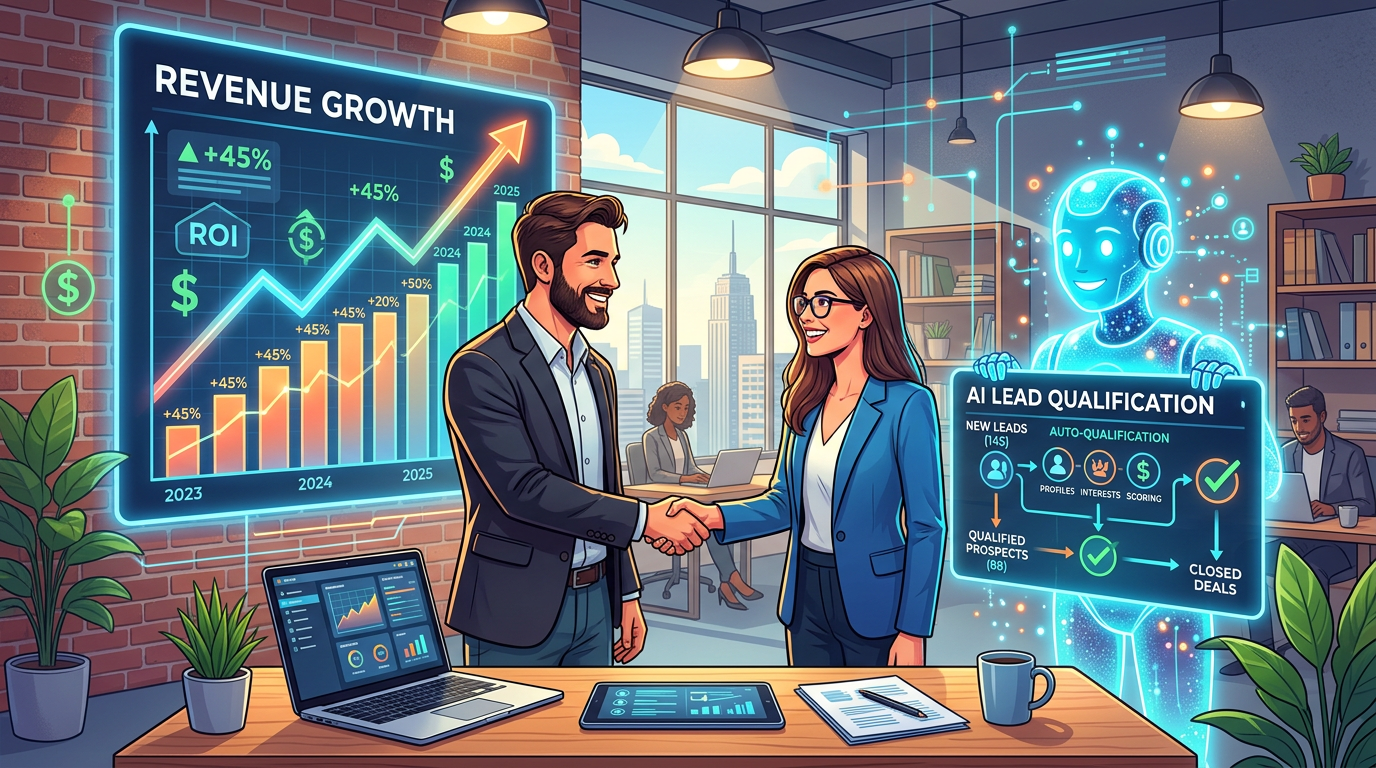
AI Sales for Small Business: How to Close More Deals With Less Manual Work
Small business owners wear many hats. You're managing leads, following up with prospects, drafting proposals, and trying to forecast pipeline—all while attempting to actually close deals. The result? Your sales process becomes reactive instead of strategic. AI sales for small business changes that equation by automating the repetitive work, so your team focuses on what matters: building relationships and closing deals.
This guide shows you how AI sales tools work, what they can automate for your business, and how to choose the right platform without overspending.
Why AI Sales Matters for Small Businesses
Your sales team's time is your most valuable resource. According to Salesforce's 2025 State of Sales report, sales reps spend only 28% of their time actually selling—the remaining 72% goes to admin work, data entry, and manual follow-up coordination. For a small business operating on tight margins, that's a significant productivity drain.
AI sales tools address this directly. Here's what's at stake:
Time Reclamation: Automation removes hours spent on lead qualification, email sequences, and proposal creation. A sales rep can redirect 10-15 hours per week toward actual selling activities.
Conversion Rate Improvements: AI lead scoring prioritizes high-value prospects, so your team pursues the most likely deals first. Businesses using AI-powered lead scoring report 30-50% higher conversion rates on qualified leads, according to Gartner's 2024 research on sales enablement technologies.
Pipeline Visibility: Forecasting pipeline by hand is guesswork. AI-driven analytics give you real-time visibility into deal health, win probability, and revenue trajectory—essential for small businesses making budget decisions.
Faster Response Times: Prospects expect faster engagement. Automated follow-ups ensure no lead goes dark, and AI can trigger timely touchpoints based on prospect behavior rather than manual reminders.
The financial impact is tangible. A small business with five sales reps investing in AI sales automation typically recovers its software investment within 4-6 months through time savings and improved close rates.
What AI Can Automate in Your Sales Process
AI isn't replacing your sales team—it's amplifying their output. Here are the four core automation opportunities:
Lead Scoring and Qualification
Manually reviewing every lead wastes time. AI lead scoring evaluates prospects against your ideal customer profile, assigning a confidence score based on company size, industry, engagement, and buying signals. A prospect who downloaded your comparison guide and visited your pricing page multiple times gets flagged as sales-ready; a small non-profit with zero engagement drops down the priority list.
Tools use machine learning to learn from your closed deals, continuously improving scoring accuracy. Instead of your sales team guessing who's ready for a call, they get a prioritized queue of the most likely buyers.
Real-world impact: Pipedrive users report 40% faster sales cycles after implementing AI lead scoring because reps focus on qualified prospects rather than time-wasting cold outreach.
Automated Follow-Ups
Consistent follow-up is critical—most deals close after 5-7 touchpoints. But manually scheduling 50+ emails per day isn't realistic. AI-powered sequences send templated emails, SMS, or LinkedIn messages at optimal times based on prospect behavior.
Advanced systems detect when a prospect opens an email or clicks a link, then trigger the next step in the sequence automatically. If someone goes quiet for a week, an AI-driven system can send a "checking in" message without your rep doing anything.
Proposal Generation and Contract Management
Drafting proposals is time-intensive. Modern AI sales tools create proposals in minutes by pulling information from your CRM (company name, requirements, pricing, terms) and populating pre-built templates. Some tools even suggest upsell opportunities based on the prospect's company size or industry.
Tracking proposals matters too. AI analytics show whether a prospect viewed the document, which sections they spent time on, and whether they forwarded it to stakeholders—invaluable signal for your next conversation.
Pipeline Analytics and Revenue Forecasting
Predicting revenue is difficult without good data. AI-powered analytics examine your historical deals (win rates, deal velocity, customer acquisition costs) and current pipeline to forecast quarterly revenue with surprising accuracy. This helps you understand which stages are bottlenecks, where deals tend to stall, and which reps have the highest close rates.
Early warning systems alert you when deals are at risk (a prospect hasn't engaged in 10 days, or a deal is stuck in a stage longer than average), giving you time to intervene before losing it.
AI Sales Tools Compared
Here's a breakdown of leading AI-enabled sales platforms for small businesses:
| Tool | Best For | Lead Scoring | Automated Follow-Up | Proposal Gen | Pipeline Analytics | Pricing |
|---|---|---|---|---|---|---|
| HubSpot Sales Hub | All-in-one CRM with AI | Yes (predictive) | Yes (sequences) | Basic | Yes | $50-3,200/mo |
| Salesforce (Einstein) | Enterprise-grade with AI | Yes (machine learning) | Yes (workflows) | Yes (Salesforce CPQ) | Advanced | $165-500/mo per user |
| Pipedrive | Sales-first teams | Yes (win probability) | Yes (automated sequences) | Yes | Yes | $14-99/mo per user |
| Apollo.io | Prospecting and outreach | Yes (lead scoring) | Yes (email/SMS sequences) | No | Basic | $49-499/mo |
| Close | High-touch sales teams | Yes (predictive) | Yes (email/call logging) | Basic | Yes | $29-129/mo per user |
| Gong | Conversation intelligence | No | No | No | Yes (call analytics) | Custom pricing |
Notes on selection:
- HubSpot is ideal if you want a unified platform (CRM + email + landing pages) without switching tools.
- Salesforce is overkill for most small businesses but essential if you have complex workflows or need deep customization.
- Pipedrive is built for sales teams obsessed with deal management and forecasting.
- Apollo.io excels at prospecting and outreach automation if lead generation is your bottleneck.
- Close suits teams doing phone sales with AI-powered call summaries and logging.
- Gong focuses on conversation intelligence (recording and analyzing sales calls) rather than CRM automation.
Most small businesses start with HubSpot or Pipedrive because they balance ease of use with robust AI features.
How to Choose the Right AI Sales Tool
Consider these criteria:
1. Your Biggest Bottleneck: Are you losing deals because leads aren't followed up? Then automation sequences matter most. Are your sales reps struggling to prioritize? Lead scoring is critical. Are you flying blind on pipeline? Analytics should be first. Choose based on your specific pain.
2. CRM Integration: Does the tool connect to systems you already use (Stripe, Hubspot, Slack, Microsoft Teams)? Mismatched systems create data silos and extra manual work.
3. Ease of Implementation: AI tools are only valuable if your team actually uses them. Overly complex platforms gather dust. Prioritize intuitive interfaces and good onboarding.
4. Per-Seat Cost vs. Flat-Rate: Some tools charge per user (Salesforce, Pipedrive) making them expensive as your team scales. Others like HubSpot charge per-seat but include more features. Calculate total cost of ownership.
5. AI Capabilities: Not all "AI" features are equal. Some offer basic rule-based automation (not really AI). Look for tools with machine learning that improve over time as they learn from your data.
6. Trial Availability: Most platforms offer 14-30 day trials. Use them. Have your sales team test workflows, evaluate how quickly they can set up sequences, and measure how accurately lead scoring works in your context.
Implementation Guide: 4 Steps to Launch AI Sales Automation
Step 1: Clean Your Data (Week 1)
AI learns from your data, so garbage in means garbage out. Audit your CRM: remove duplicate contacts, fill in missing company information, standardize field values (don't mix "California" and "CA"). This takes 1-2 days and saves weeks of model training.
Step 2: Define Your Ideal Customer Profile (Week 1-2)
AI lead scoring needs rules to follow. Document: company size, industry, revenue, geography, and job titles you sell to best. The more specific, the better the scoring algorithm works.
Step 3: Set Up Your Automation Workflows (Week 2-3)
Start simple. Configure one email sequence (e.g., "nurture for unqualified leads") and one lead scoring model. Test with a subset of your team before rolling out company-wide. Measure results after two weeks.
Step 4: Train Your Team and Iterate (Week 3 onward)
Your sales team needs to understand how to use the tool and when to override AI recommendations. Plan 2-3 hours of training. After 30 days, review performance: which sequences have the highest open rates? Which deals did lead scoring correctly identify as high-value? Iterate.
Most small businesses are operationally ready within 3-4 weeks.
Key Considerations: Avoiding Common Pitfalls
CRM Integration and Data Flow
AI tools only work with good data. If your CRM is disconnected from email, phone, or proposal software, the AI can't see the full customer journey. Invest in integrations so every touchpoint feeds back into your CRM. This is nonnegotiable.
Data Quality and Hygiene
If you feed an AI model incomplete or inaccurate data, its predictions will be poor. Establish data governance early: who updates what fields, how often, and to what standard. This sounds boring but pays dividends in AI accuracy.
Balancing Automation with Human Judgment
AI scores a prospect as low-priority, but you recognize them as a strategic account worth pursuing. Don't blindly follow the algorithm. AI is a tool to surface patterns and free time; your sales judgment still matters. The best teams use AI recommendations as a starting point, not a final decision.
Privacy and Compliance
AI systems can inadvertently introduce bias (e.g., scoring similar to past customers, which may reflect historical biases in who you've sold to). Review your lead scoring model periodically to ensure it's not discriminating against geographies, industries, or company sizes you want to target. Also ensure you comply with regulations like GDPR if you're storing EU customer data.
The Bottom Line
AI sales automation is no longer a luxury—it's table stakes for small businesses competing on efficiency. The businesses that will outgrow their peers are those redirecting 10-15 hours per sales rep per week from admin work to actual selling. That time compounds.
Start by identifying your biggest sales bottleneck (lead qualification, follow-ups, forecasting), choose a tool that addresses it, and commit to 30 days of focused implementation. Most small businesses see ROI within 4-6 months through faster deal cycles and higher close rates.
The tools listed above are all viable. The key is choosing one, not overthinking the decision. Your sales team will tell you within weeks whether it's working. If not, switching costs are low.
Learn more about measuring AI ROI and broader AI adoption strategies for small business.
Frequently Asked Questions
Q: Will AI replace my sales team?
A: No. AI eliminates the tedious admin work that keeps your sales team from selling. A rep freed from 20 hours of weekly data entry and follow-up coordination can focus on relationship-building and closing deals. Your best closers will become even more productive.
Q: How long does AI lead scoring take to "learn" my business?
A: Most tools need 100-200 historical deals to train an effective model. If you have less history, you start with rule-based scoring (company size, engagement signals) and transition to machine learning within 2-3 months. The model improves continuously as new deals close.
Q: Can I use AI sales tools if I don't have a CRM?
A: Technically yes, but you'll miss much of the value. AI needs data from multiple touchpoints (email opens, website visits, proposal views, call records) to work effectively. Start with a simple CRM like HubSpot or Pipedrive, then layer in AI. Don't attempt AI without foundational data infrastructure.
Q: What if our sales process is unique or highly consultative?
A: AI tools have some limitations with complex, non-linear sales processes. However, even highly consultative sales benefit from lead scoring (prioritizing promising prospects), automated email sequences (freeing time for strategy), and pipeline analytics (forecasting). Evaluate whether the tool supports your workflow before committing. Many platforms allow customization via workflows or integrations.
Q: How much should we budget for AI sales tools?
A: A small team of 3-5 reps can start with HubSpot or Pipedrive for $200-500/month. Mid-market (10-20 reps) budgets $2,000-5,000/month. Account for implementation time (20-40 hours), training, and ongoing optimization. Most small businesses recover this investment within 4-6 months through improved efficiency and higher close rates.