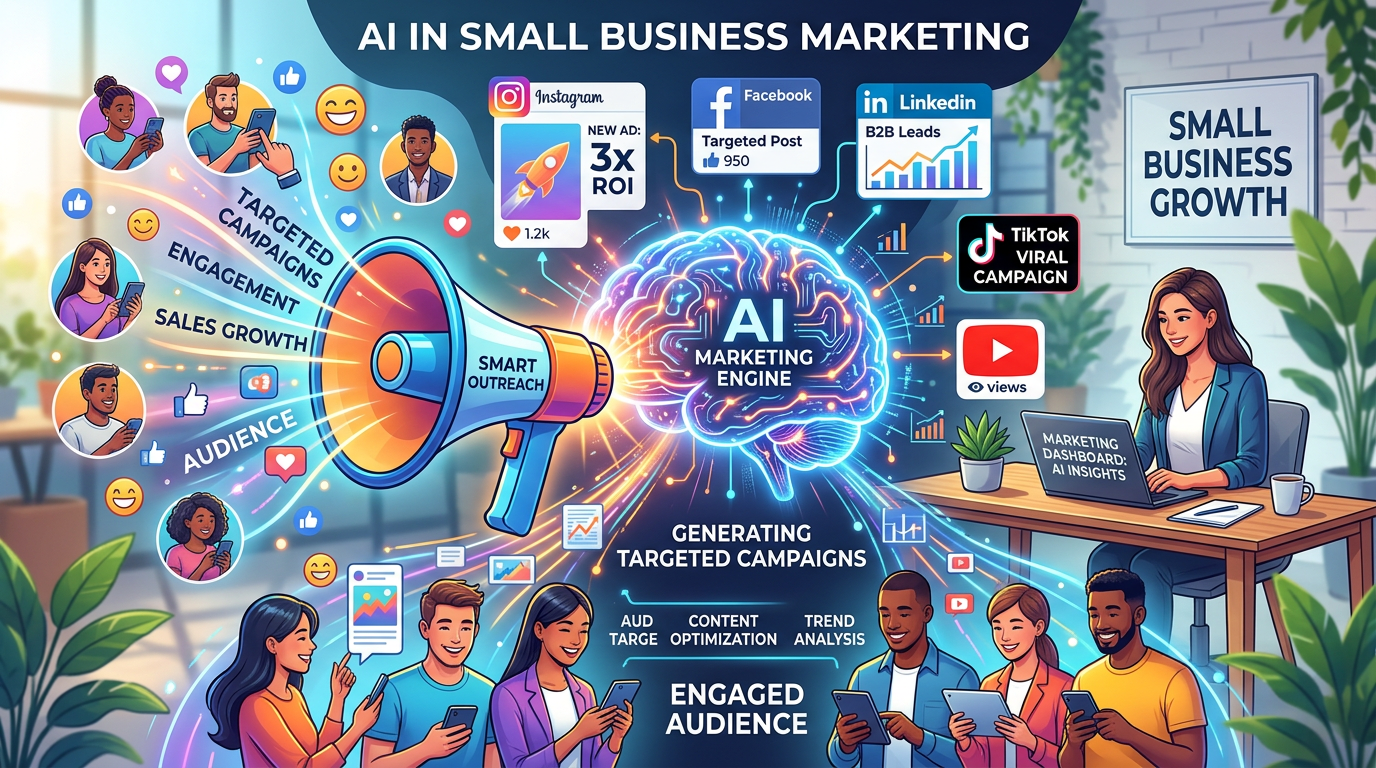
Small business owners are drowning in marketing tasks. Content calendars, email segmentation, social media posting, analytics reporting—these take hours away from strategy and growth. This is where AI marketing automation enters the picture. AI marketing tools enable small businesses to automate campaigns, personalize customer experiences, and optimize ad spend without hiring a full marketing team. According to a 2025 McKinsey report, companies using AI marketing tools see 35% faster campaign execution and 25% improvement in marketing ROI. This guide walks you through the best AI marketing tools for SMBs, how they work, and a practical four-week implementation roadmap to get results fast.
Why AI Marketing Matters for SMBs
Small businesses face a unique challenge: they need enterprise-level marketing results without enterprise budgets or headcount. Your competitors may have dedicated content creators, email specialists, and analytics teams. You don't. That's where AI levels the playing field.
Time Savings
The average small business spends 15-20 hours per week on marketing tasks that AI can automate. According to HubSpot's 2025 State of Marketing report, teams using marketing automation save an average of 4 hours per day on routine tasks. For a two-person marketing team, that translates to 40 hours per month—nearly a full-time employee's output—freed up for strategy and creative work.
ROI Improvement
Personalization drives results. Gartner research shows that companies using AI-driven personalization in email campaigns see 50% higher conversion rates and 10x higher click-through rates compared to non-personalized campaigns. AI marketing tools segment audiences, recommend optimal send times, and A/B test subject lines automatically, so your message reaches the right person at the right time.
Cost Efficiency
Hiring a marketing coordinator costs $35,000-$50,000 annually. A mid-tier AI marketing platform costs $300-$500/month ($3,600-$6,000/year). The ROI is immediate: you get 80% of the capability at 10% of the cost. For SMBs, this is the difference between having a marketing operation and not having one.
Scalability
As you grow, your marketing workload grows exponentially. Customer databases expand, campaign frequency increases, reporting becomes complex. AI tools scale with you without proportional cost increases. You can manage 5,000 or 50,000 contacts with the same effort.
What AI Can Automate in Marketing
AI's marketing applications fall into four core categories. Each solves specific problems and delivers measurable impact.
Content Creation and Optimization
AI content tools generate blog outlines, social media captions, email copy, and ad variations in seconds. Tools like Jasper and Copy.ai learn your brand voice and produce on-brand content that maintains consistency across channels. This isn't about replacing human creativity—it's about removing the blank-page problem and letting writers focus on strategy and refinement.
Surfer SEO takes this further by analyzing top-ranking pages and recommending content structure, keyword placement, and word count to maximize search visibility. For SMBs targeting competitive keywords, this is invaluable. Instead of guessing what Google wants, AI tells you exactly what your content needs to rank.
Email Campaign Automation
Email remains the highest-ROI marketing channel (42:1 return according to DMA data), but manual email management doesn't scale. AI marketing platforms automate segmentation, send-time optimization, subject line testing, and dynamic content insertion. Mailchimp AI, for example, analyzes historical open rates and predicts the optimal send time for each subscriber. HubSpot automatically scores leads based on engagement and triggers follow-up emails when prospects show buying signals.
Behavioral triggers are where automation shines. When a prospect abandons their shopping cart, AI immediately sends a personalized recovery email. When a customer completes a purchase, AI sequences them into an onboarding or upsell flow. This happens 24/7 without you lifting a finger.
Social Media Scheduling and Analytics
Buffer AI and Hootsuite AI handle content calendar management, optimal posting times, and performance analysis. Instead of logging into five platforms daily, you schedule weeks of content once and let AI determine when your audience is most active. The tools analyze engagement patterns and recommend posting frequency and format (video vs. carousel vs. single image).
Social listening is another game-changer. AI tools monitor mentions of your brand, competitors, and industry keywords, alerting you to conversations where you can add value. This reveals customer pain points and market trends in real-time, informing product development and messaging strategy.
SEO and Ad Targeting
AI SEO tools analyze your site against competitors, identify content gaps, and recommend which keywords you should target based on search volume, difficulty, and relevance. Surfer SEO and Clearscope do this automatically. Instead of manual competitive analysis (which takes days), AI delivers a prioritized roadmap in minutes.
For paid advertising, AI bidding strategies optimize your ad spend automatically. Google Ads and Meta Ads both use machine learning to allocate budget toward high-performing audience segments and keywords. AI also generates ad variations, tests copy combinations, and pauses underperforming ads—all without intervention. For an SMB running a limited ad budget, this is the difference between wasting $1,000 and generating $3,000 in revenue.
Top AI Marketing Tools Compared
| Tool | Best For | Pricing | Key Features |
|---|---|---|---|
| HubSpot | All-in-one automation and CRM | Free - $3,200/mo | Email automation, lead scoring, chatbots, basic AI content |
| Mailchimp AI | Email marketing and segments | Free - $500/mo | Send-time optimization, dynamic content, predictive analytics |
| Jasper | Content creation and copywriting | $125 - $600/mo | Brand voice library, long-form content, social media templates |
| Surfer SEO | Content optimization and SEO | $99 - $399/mo | SERP analysis, content briefs, on-page optimization, keyword research |
| Buffer AI | Social media management | $100 - $588/mo | AI writing assistant, optimal posting times, cross-platform scheduling |
| Clearscope | Content strategy and SEO | $170 - $900/mo | Content brief generation, competitor analysis, readability scoring |
How to Choose the Right Tool
Selecting an AI marketing platform depends on three factors: your primary need, your budget, and your technical comfort level.
Start with your biggest pain point. If email is your highest-ROI channel but you lack segmentation and personalization, prioritize Mailchimp AI or HubSpot. If content creation is bottlenecking your blog and social media, start with Jasper or Buffer. If SEO and organic search are critical to your business model, Surfer SEO or Clearscope should be first. Don't try to solve everything at once. Pick one problem, solve it, then layer in additional tools.
Define your budget. Most AI marketing tools offer tiered pricing ($100-$600/month for individual tools, $500-$3,200/month for platforms). Establish whether you need a single specialized tool or an integrated platform. Platforms like HubSpot cost more but reduce switching between tools. Single-purpose tools are cheaper but require more integration work. For most SMBs, starting with one $200/month tool is better than spreading $400 across two incomplete solutions.
Test before committing. Almost every platform offers a free trial (7-30 days). Use this to evaluate ease of use, integration with existing tools, and actual time savings. Set a specific test objective: "We'll schedule 4 weeks of social content and measure time saved" or "We'll send three AI-generated email campaigns and track open rate improvement." Don't adopt a tool on potential alone—require proof it works for your business.
Consider integration needs. If you already use Shopify, make sure your AI tool connects to it. If you have a custom CRM, verify integrations exist. Tools that integrate with your existing stack save enormous setup time.
Step-by-Step Implementation Guide (4 Weeks)
Week 1: Audit and Selection
Spend 3-4 hours auditing your current marketing tasks. List everything: blog writing, social media posting, email campaign setup, analytics reporting, keyword research. Time each task. You'll quickly see where AI saves the most hours. Select your first tool based on highest time savings. Sign up for the free trial and set it up with dummy data. Read the first three sections of the documentation. No live campaigns yet—just familiarization.
Week 2: Setup and Integration
Connect your tool to existing systems (email lists, social accounts, website analytics). Migrate past data (email subscribers, previous posts, performance history). Most platforms provide migration guides or support. Configure basic workflows: set up email segments, create a social media content calendar for the next month, or generate your first AI content brief. Assign one team member as the "owner" of the platform—they'll become the expert others rely on.
Week 3: Pilot and Measurement
Run your first AI-powered campaign at limited scale. Send one AI-written email to a segment of your list, schedule two weeks of AI-assisted social content, or publish one AI-outlined blog post (still human-written and edited). Track baseline metrics: email open rate, click-through rate, social engagement, organic traffic to AI-generated content. Set calendar reminders to collect data weekly. This establishes your "before" baseline so you can measure improvement.
Week 4: Expand and Optimize
Scale your pilot to full usage. If your AI email improved open rates by 5%, move all email campaigns to the platform. If social content performed well, extend the calendar to 8 weeks. If your content ranked, produce more. Review performance data, refine settings (adjust send times, pause underperforming content types, increase output of high-performing formats), and document what's working. Train your team on full platform capabilities.
Key Considerations: Budget, Learning Curve, and Data Privacy
Budget Reality
Most SMBs see positive ROI within 6-12 weeks of AI marketing adoption, but set realistic expectations. A $300/month tool won't generate $10,000 in revenue immediately. Start with conservative estimates: if email is your main channel and you do 20 campaigns/month, a tool that improves open rate by 5% might generate $500-$1,000 in additional revenue monthly. Surfer SEO might bring 3-5 additional qualified leads monthly if you're pursuing organic search. Track everything in a simple spreadsheet so you see when ROI kicks in.
Learning Curve
Most modern AI tools have 15-30 minute onboarding. The learning curve exists because you need to learn what AI can actually do, not because the interface is hard. Spend a few hours exploring features, watching demo videos, and reading the knowledge base. The biggest mistake SMBs make is expecting the tool to do everything automatically without setup. AI tools require you to set preferences, define workflows, and review outputs. Treat initial setup as an investment, not an obstacle.
Data Privacy and Security
AI tools process your marketing data. Verify the platform's compliance (SOC 2, GDPR, CCPA). Read privacy policies, specifically around data retention, third-party access, and model training. Most major platforms (HubSpot, Mailchimp, Buffer) store data securely and don't use your data to train models. Ensure your email subscriber agreements allow you to use marketing automation. If you handle sensitive customer data (healthcare, financial info), add additional security requirements to your tool evaluation.
Team Buy-In
Your team might worry that AI tools eliminate jobs. They don't—they eliminate busywork. A content writer using AI spends less time on outlines and first drafts, more time on strategy and refinement. An email marketer using Mailchimp AI spends less time on list segmentation, more time on strategy and messaging. Position AI tools as a way to make jobs more strategic and enjoyable, not as a replacement.
The Bottom Line
AI marketing isn't a luxury for SMBs anymore—it's a necessity. Your competitors are already using these tools. The three AI marketing adoptions that deliver the fastest ROI are (1) email automation with send-time optimization and segmentation, (2) social media scheduling with AI-assisted content creation, and (3) SEO content optimization. These three together save 8-12 hours per week while improving campaign performance 15-30%.
Start small: pick one tool, solve one problem, measure results. Once you prove the concept, expand. The SMBs winning in 2026 aren't the ones with the biggest budgets—they're the ones using AI most effectively to stretch limited resources and deliver better results faster. Your next step is a 30-minute research call: define your top three pain points, research tools that solve them, and run a free trial. Give yourself four weeks to see if the tool delivers value. If it does, it pays for itself. If it doesn't, you've lost only time, not money.
FAQ
Q: Will AI marketing take away my personal touch and relationship with customers?
A: AI automates routine tasks (segmentation, send times, social scheduling). The strategic and creative work—deciding what to say, defining your brand voice, crafting customer narratives—remains human. If anything, AI frees your team to focus on strategy and relationship-building instead of busywork. Your customers don't care if a send-time optimization algorithm picks 10 AM or you do—they care that your message is relevant and valuable.
Q: How long before I see ROI from AI marketing tools?
A: This depends on the tool and your starting point. Email automation typically shows results in 6-8 weeks (improved open/click rates). Social media scheduling shows engagement improvements in 3-4 weeks. SEO content optimization takes 8-12 weeks (search rankings lag). Set a three-month evaluation window and track specific metrics from day one. Most SMBs see 15-25% improvement in key metrics within 90 days.
Q: Do I need to replace my entire marketing stack or can I use AI tools alongside existing tools?
A: You can absolutely mix and match. Many SMBs use HubSpot for email/CRM but keep Surfer SEO for content optimization. Some use Mailchimp AI for email and Buffer for social. The only real constraint is integration: if your tools don't connect, data becomes siloed. Check integration requirements before choosing tools, but don't feel pressured to buy a monolithic platform if single-purpose tools better fit your specific needs and budget.
Q: What's the learning curve for AI marketing tools? Will my team find them overwhelming?
A: Most AI marketing platforms have much gentler learning curves than traditional marketing software from 10 years ago. If your team can use email and social media, they can use AI marketing tools. Expect 2-4 weeks of gradual adoption as your team discovers features and workflows. Set aside 1-2 hours per week for training and experimentation during your first month. After that, the tool becomes routine.
Q: How do I ensure my AI-generated content aligns with my brand voice?
A: This is critical and often overlooked. Most AI tools require you to "train" them on your brand voice by uploading past content, writing guidelines, or entering voice instructions. Jasper calls this the "Brand Voice" library. HubSpot allows you to input style guides. Before generating large amounts of content, have your AI tool create 3-5 samples and review them carefully. Edit, refine, and provide feedback. After 10-15 iterations, the AI learns your style and outputs improve significantly. Never publish AI content without human review—this is mandatory.