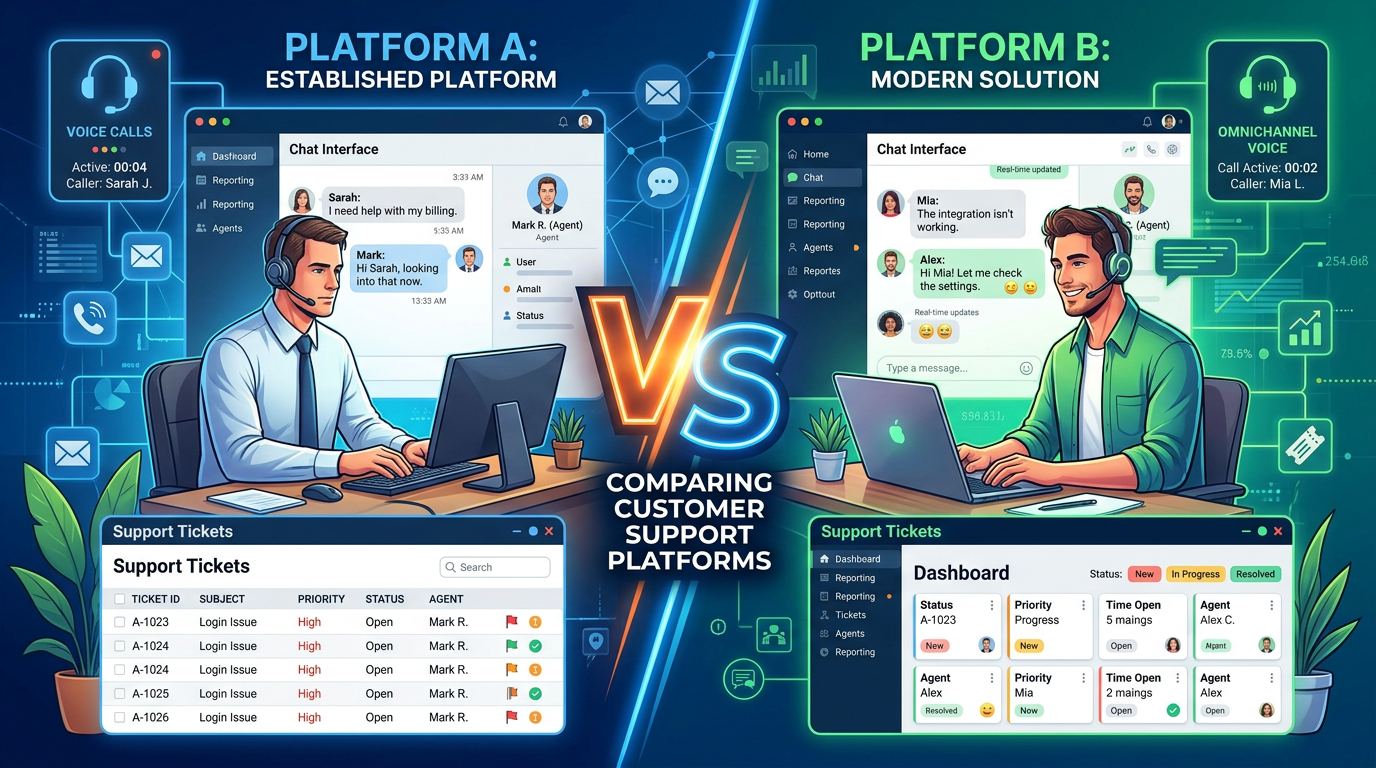
Quick Comparison Table
| Feature | Intercom | Zendesk |
|---|---|---|
| AI Chatbot | Intercom Fin (native, built-in) | Zendesk AI (add-on, requires configuration) |
| First-Response Time | < 2 minutes (AI-first) | 4-8 minutes (agent-assisted) |
| Automation Resolution Rate | Up to 67% for common queries | 40-55% with extensive training |
| Starting Price | $39/month (Starter) | $19/month (Suite Team) |
| AI Agent Cost | Included in Professional plan ($99/month) | Additional $50-100/month per agent |
| Setup Time | 2-3 days | 2-3 weeks |
| Ticketing System | Good for small teams | Enterprise-grade, highly customizable |
| Knowledge Base Integration | Automated content suggestions | Manual setup required |
| Multi-channel Support | In-app, web, email, SMS, mobile | Email, chat, phone, social, web |
| Best For | Product-led SaaS, startups | Enterprise, high-volume support teams |
Intercom Overview: AI-First Customer Support
Intercom has evolved into an AI-native customer support platform with Intercom Fin, its generative AI agent built directly into the core product. Unlike Zendesk, which treats AI as an add-on module, Intercom positions AI as the foundation of its support model.
Intercom Fin learns from your knowledge base and previous conversations to handle customer inquiries autonomously. The system can resolve up to 67% of support tickets without human intervention, significantly reducing response times and support team workload.
Key strengths of Intercom: Intercom's greatest advantage is speed of deployment. New customers typically activate AI support within 2-3 days. The platform uses your existing product knowledge and conversation history to train the AI agent automatically. This out-of-the-box intelligence means you don't need extensive configuration before seeing results.
The messaging-first approach makes Intercom ideal for SaaS and mobile-first businesses. Customers reach support through in-app messages, websites, and mobile apps, creating a seamless experience. Intercom also excels at proactive support—you can message customers before they open a ticket, addressing issues in real-time.
Pricing for Intercom starts at $39/month for the Starter plan (suitable for very small teams), but Intercom Fin is included in the Professional plan at $99/month for up to 3 users. This makes AI adoption extremely cost-effective for growing teams.
Zendesk Overview: Enterprise-Grade Ticketing with AI
Zendesk has been the enterprise standard for customer support ticketing for over a decade. Zendesk AI represents the platform's shift toward intelligent automation, but it requires more configuration than Intercom's approach.
Zendesk AI operates on top of a powerful ticketing system designed to handle thousands of concurrent conversations. The platform excels at sophisticated routing, SLA management, and multi-team collaboration—critical for large organizations with 50+ support agents.
Key strengths of Zendesk: Zendesk's greatest asset is its flexibility and depth. The ticketing system can be customized extensively to match complex business processes. Advanced routing rules, custom fields, and workflow automation provide powerful ways to organize and prioritize customer conversations.
However, activating Zendesk AI requires more work. You must first build a comprehensive knowledge base, then configure AI models to reference it. Typical setup takes 2-3 weeks of dedicated effort. The learning curve is steeper, but the investment pays dividends for large support teams managing complex products.
Zendesk AI pricing starts at $19/month for the Suite Team plan, but Zendesk AI capacity is an additional charge ($50-100/month per agent depending on volume). This means real costs scale quickly as your team grows.
Head-to-Head Comparison: Five Critical Criteria
AI Chatbot Quality & Capabilities
Intercom Fin is designed to resolve common support issues autonomously. The system integrates with your help center and conversation history, allowing it to provide contextual, accurate responses. Customers report that Fin resolves 60-67% of inquiries completely without escalation.
Zendesk AI requires you to manually train it by uploading content, defining intents, and configuring response patterns. This means AI quality is directly tied to your knowledge base maturity. New Zendesk customers often see lower resolution rates initially because the knowledge base isn't yet optimized.
Winner: Intercom for speed and out-of-box accuracy. Zendesk becomes competitive once fully configured but requires significant investment upfront.
Ticketing System & Workflow Management
Zendesk's ticketing system is purpose-built for high-complexity support environments. You can create unlimited ticket types, custom workflows, automation rules, and integration points. For companies managing 50+ concurrent conversations across multiple products, Zendesk's capabilities are unmatched.
Intercom's ticketing is competent but simpler. It handles routing, assignment, and workflow automation well, but lacks Zendesk's depth of customization. For small to mid-market teams (under 15 agents), this simplicity is an advantage—less configuration means faster onboarding.
Winner: Zendesk for enterprise complexity. Intercom for simplicity and speed.
Ease of Setup & Implementation
Intercom's setup is fast. Most customers go live with basic configuration in 2-3 days. You import your help content, customize the chat widget, and launch. Intercom Fin begins learning immediately from your product and conversations.
Zendesk's setup is methodical and thorough. You typically need to spend 1-2 weeks configuring ticket types, automation rules, and knowledge base structure. While more involved, this upfront work creates a solid foundation for scaling.
Winner: Intercom for time-to-value. For businesses that need to launch support quickly, Intercom's rapid deployment is a significant advantage.
Pricing & Total Cost of Ownership
Intercom's pricing is transparent and straightforward. You pay per user, and AI is included in professional plans. A 3-person support team with Intercom Fin costs $99/month ($33 per person). Adding a 4th user is $33 additional.
Zendesk's pricing is tiered by features, and AI is an add-on. A 3-person team on the Suite starts at $57/month ($19 per user), but adding Zendesk AI capacity adds $50-150/month depending on volume. Total cost: $107-207/month for comparable capabilities.
For small teams (under 10), Intercom is typically 20-30% less expensive. For large teams (50+), Zendesk's per-user costs become more competitive, but you'll pay significantly more for AI capability.
Winner: Intercom for small to mid-market. Zendesk becomes competitive at enterprise scale (100+ agents).
Self-Service & Knowledge Base Integration
Intercom automatically surfaces relevant knowledge base articles within chat conversations. When a customer asks a question, Intercom Fin checks your knowledge base first and often resolves the issue without escalation. This creates a seamless self-service experience embedded in your support channel.
Zendesk requires you to manually link knowledge articles to tickets and configure AI to reference them. The knowledge base integration is powerful once set up, but requires ongoing maintenance and curation to remain effective.
Winner: Intercom for automated self-service. Zendesk requires more manual effort to maintain knowledge base quality.
Which Should You Choose?
Choose Intercom if:
- You're a startup or SMB with under 15 support agents
- You want to launch AI customer support quickly (2-3 days, not 2-3 weeks)
- Your business is product-led and you value messaging-first support
- You need AI to be core to your support strategy, not an afterthought
- You want to minimize setup complexity and focus on customer conversations
- You value transparent, predictable pricing
Choose Zendesk if:
- You have 50+ support agents or plan to scale significantly
- You need enterprise-grade customization and complex workflows
- Your support team handles multiple products with different processes
- You require advanced SLA management and performance tracking
- You already use Zendesk and have established workflows
- Your team can invest 2-3 weeks in proper implementation
For most growing businesses in 2026, Intercom represents a significant productivity leap over traditional ticketing systems. Intercom Fin resolves two-thirds of customer issues without any human involvement, freeing your team to focus on complex problems that require genuine expertise. Zendesk remains the choice for mature organizations with complex support needs and dedicated implementation resources.
Frequently Asked Questions
Q: Can I use Intercom Fin to completely replace my support team?
A: Not entirely. While Intercom Fin resolves 60-67% of common issues, your team still handles complex problems, billing disputes, and escalations. The AI acts as a force multiplier, allowing your existing team to handle 2-3x more volume without hiring. A 3-person team with Intercom Fin typically handles the volume of a 6-7 person traditional support team.
Q: What's the difference between Intercom Fin and Zendesk AI?
A: Intercom Fin is built into the core product and learns automatically from your content and conversations. Zendesk AI is a configurable module that requires you to set up training data, intents, and response patterns manually. Intercom Fin reaches high accuracy faster; Zendesk AI offers more customization once configured.
Q: How much does Intercom Fin cost compared to hiring a support agent?
A: Intercom Fin is included in the Professional plan ($99/month for up to 3 users). One support agent typically costs $3,000-4,500/month in salary. Intercom Fin handles 60-67% of issue volume, so it effectively replaces 0.6-0.7 of a full-time agent for $99/month—a 20-30x ROI.
Q: Can Zendesk match Intercom's AI speed?
A: Yes, but it requires significant upfront work. Zendesk AI is equally capable once your knowledge base is mature and training is complete. Many enterprises report 50-60% resolution rates with Zendesk AI after 3-6 months of optimization. The difference is setup time: Intercom gets to 60% in days, Zendesk in weeks.
Q: Which platform integrates better with other tools?
A: Both integrate broadly. Zendesk has more pre-built integrations (500+) due to its enterprise heritage. Intercom focuses on quality of the most common integrations (Slack, Salesforce, Stripe) and includes a robust API for custom connections. For standard SaaS stacks, both are equally capable.