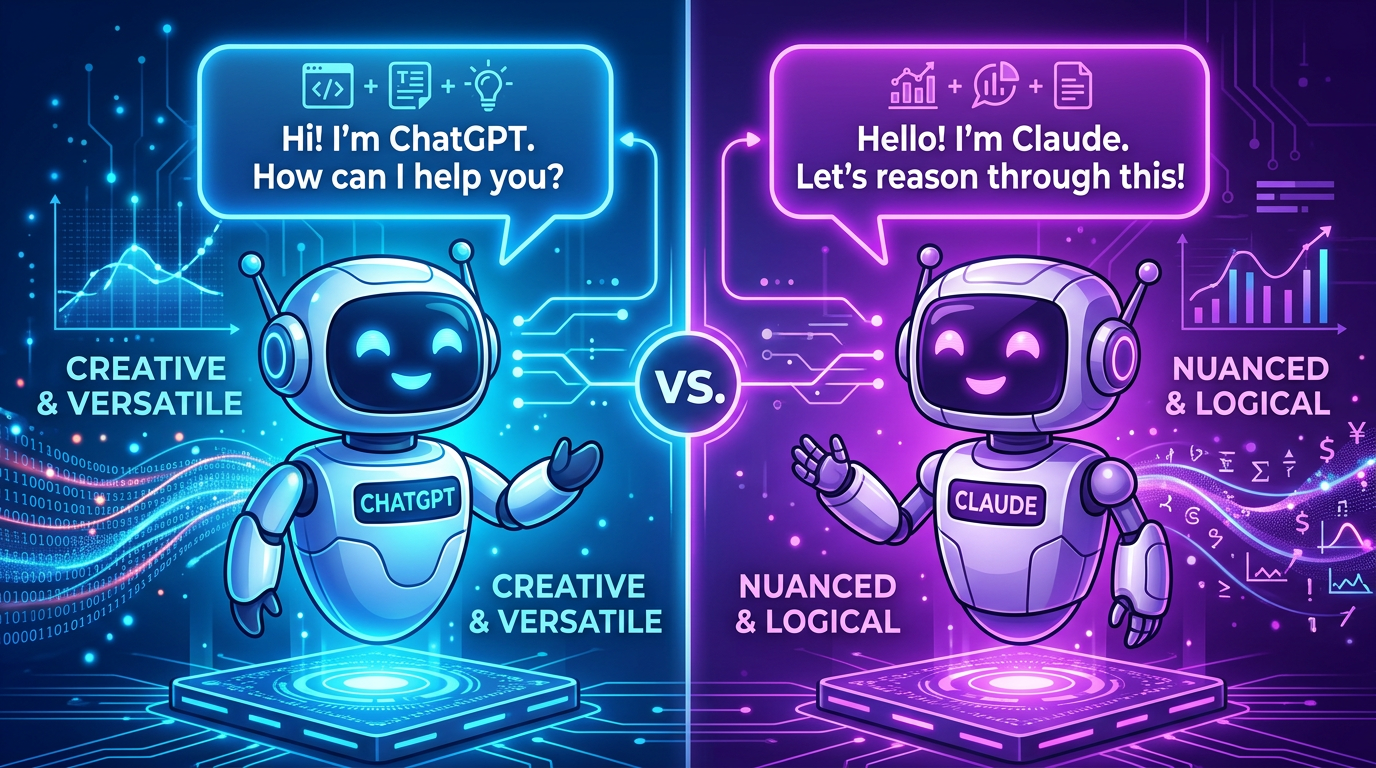
Quick Comparison Table
| Feature | ChatGPT | Claude |
|---|---|---|
| Pricing (March 2026) | Free / $20/month Plus / $200/month Pro | Free / $20/month Pro / $600/month Team |
| Context Window | 128K tokens | 200K tokens (Pro) |
| Writing Quality | Excellent for general copy | Excellent for long-form, nuanced content |
| Code Generation | Strong, broad language support | Excellent, detailed explanations |
| Data Analysis | Good with charts and visualization | Excellent with large datasets |
| Integrations | 300+ via API and Zapier | Growing, fewer integrations |
| Response Speed | Fast, consistent | Very fast on Pro tier |
| Document Handling | Up to 20 files | Handles longer documents naturally |
| Learning Curve | Very easy | Very easy |
| Best For | Marketing, automation, breadth of tasks | Analysis, coding, long documents |
ChatGPT Overview
ChatGPT has become the household name in AI assistants, and for good reason. OpenAI's platform combines ease of use with extensive ecosystem integration, making it the go-to tool for businesses exploring AI workflows.
Strengths
ChatGPT's primary advantage lies in its mature ecosystem. With hundreds of pre-built integrations through Zapier, Make, and native connections to Microsoft 365, Slack, and Google Workspace, it functions as a central hub for your business processes. The platform excels at handling diverse tasks sequentially—from drafting emails to brainstorming marketing campaigns to generating social media content.
The Plus tier ($20/month) provides a reasonable balance of capability and cost for small teams. The real-world implementation is straightforward; most businesses report faster onboarding with ChatGPT than with competitors. Mobile applications are polished and feature-rich, enabling teams to collaborate and share conversations easily.
ChatGPT's training data and broad knowledge base make it reliable for general business questions, trend research, and decision-making summaries. For marketing teams specifically, the platform's creative writing capabilities remain industry-leading.
Weaknesses
ChatGPT struggles with truly long-form work and deep contextual analysis. While it handles documents well, feeding 50+ pages of contracts or technical documentation becomes cumbersome. The 128K context window, while substantial, fills quickly when you're working with enterprise documents and maintaining conversation history.
Pricing escalates sharply. The Pro tier ($200/month for individuals) becomes costly when deployed across teams. Enterprise pricing lacks transparency, and many businesses report negotiating rates but seeing significant bills. The platform also exhibits occasional hallucination issues on specialized technical topics and complex data analysis.
Finally, despite its integration breadth, many integrations require custom development or workarounds for advanced use cases. The learning curve flattens quickly, but advanced prompt engineering demands deeper knowledge.
Best For
ChatGPT is ideal for marketing teams, customer service teams using AI for drafting responses, small businesses automating routine writing tasks, and organizations already invested in the Microsoft or Google ecosystems. It's the right choice if integration breadth and ease of use are your primary concerns.
Claude Overview
Claude, developed by Anthropic, has emerged as the thinking person's AI assistant. Rather than pursuing breadth, Anthropic optimized for reasoning depth, context handling, and transparent, accurate responses.
Strengths
Claude's most compelling feature is its 200K context window on the Pro tier—roughly 150 pages of text. This makes it genuinely practical for analyzing entire contracts, technical documentation, financial reports, and code repositories without chunking or multiple uploads. Businesses handling complex documents report that Claude reduces workflow friction significantly.
The platform excels at detailed coding work. Developers consistently praise Claude for generating clean, well-commented code with thorough explanations. Unlike ChatGPT, Claude tends to break down the reasoning behind code suggestions, making it valuable for knowledge transfer and junior developer training.
Claude's approach to accuracy is measurable. Anthropic publishes transparency reports on model behavior, and businesses report fewer hallucinations on specialized topics. The Pro tier pricing ($20/month for individuals) is competitive, and the team tier ($600/month, billed annually) offers genuine enterprise features with single sign-on and usage analytics.
Safety and bias are architectural priorities. Claude's constitution-based training approach results in fewer problematic outputs, which matters significantly in regulated industries or companies with strict brand guidelines.
Weaknesses
Claude's ecosystem integration trail lags significantly behind ChatGPT. While the API is robust, pre-built integrations are fewer, and custom development is often necessary. For businesses seeking plug-and-play automation across dozens of tools, this is a real limitation.
The mobile experience, while functional, is simpler than ChatGPT's. Feature parity between web and mobile versions isn't guaranteed. Anthropic also doesn't offer a ChatGPT Plus equivalent tier for individual professionals; you either use the free tier or commit to Pro at $20/month.
For purely creative marketing work—generating dozens of social media captions or brainstorming campaign angles—ChatGPT's broader training approach sometimes feels more creative. Claude tends toward precision over novelty, which is an advantage in analysis but a potential drawback in pure ideation.
Best For
Claude is purpose-built for developers, data analysts, researchers, content writers handling long-form work, and businesses operating in regulated industries. Choose Claude if context window size, coding quality, or reduced hallucination risk are critical factors.
Head-to-Head on Five Key Business Criteria
Writing Quality
ChatGPT maintains a slight edge for marketing copy—it's trained to generate attention-grabbing headlines and promotional content. Claude excels at long-form, nuanced writing: white papers, technical documentation, detailed analysis pieces, and business reports where accuracy and depth matter more than novelty.
For general business writing—emails, memos, meeting summaries—both are equivalent. The winner depends on your specific needs: breadth and creativity (ChatGPT) or depth and accuracy (Claude).
Coding and Development
Both platforms generate functional code across major languages. Claude differentiates through superior explanation quality and handling of legacy code analysis. When you upload a 500-line Python script, Claude navigates it more naturally than ChatGPT. For teams using AI to accelerate development and maintain code quality, Claude's advantage is material.
ChatGPT's integration with GitHub Copilot provides ecosystem value for organizations already using that toolset. However, Claude's raw code quality and reasoning is demonstrably stronger.
Data Analysis and Reporting
Claude handles large datasets and complex analysis more reliably due to its extended context window. Uploading CSV files with thousands of rows, financial models with multiple sheets, or research datasets works more smoothly. Claude also maintains analysis context better across follow-up questions.
ChatGPT requires more manual intervention—chunking large files or running analysis in stages. For time-sensitive data work, this friction accumulates.
Integrations and Ecosystem
This is ChatGPT's decisive advantage. With 300+ integrations through Zapier and Make, plus native support for Microsoft 365, Slack, Google Workspace, and Salesforce, ChatGPT functions as a hub. Setting up workflows that trigger ChatGPT from Slack, populate Google Sheets, and send alerts requires minimal custom development.
Claude's API is powerful, but building equivalent integrations demands developer resources. For non-technical teams automating workflows, ChatGPT wins decisively.
Pricing at Scale
For a single user, both are affordable. At organizational scale, the math diverges. ChatGPT's Pro tier ($200/month individual, negotiated enterprise rates) becomes expensive across teams. Claude's Pro tier ($20/month individual) and Team tier ($600/month annual, shared organization) are more predictable and often cheaper for mid-sized teams.
However, ChatGPT's integration ecosystem can eliminate costs elsewhere—reducing custom development spend and Zapier/Make subscription tiers. Total cost of ownership requires modeling your specific use case.
Which Should You Choose? A Decision Matrix
Choose ChatGPT if:
- Your team prioritizes ease of use and minimal onboarding
- Integration breadth across 20+ business tools is essential
- Marketing and creative content generation are primary use cases
- You're already invested in Microsoft or Google ecosystems
- Your budget allows for $20-200/month per user with flexibility on enterprise pricing
Choose Claude if:
- Your team includes developers who need superior code assistance
- You regularly work with long documents (contracts, reports, datasets)
- Reduced hallucination risk and measurable safety are priorities
- You need transparent usage analytics and team controls
- Your workflow centers on deep analysis, research, or content writing
- You operate in regulated industries (finance, healthcare, legal) where accuracy is paramount
Hybrid Approach:
Many growing Malaysian SMBs optimize by using both. ChatGPT handles routine marketing and automation; Claude handles deep analysis and code work. Total cost: $40-60/month for individual subscriptions, but ROI often improves through specialized tool matching.
FAQ
Q: Can I migrate my ChatGPT conversations to Claude?
A: Not directly. Both platforms store conversations in their respective systems. You can export ChatGPT conversations and manually provide context to Claude, but true data portability is limited. This is important if you're evaluating both tools in parallel.
Q: Which platform has better security and data privacy?
A: Both employ enterprise-grade encryption. Claude has a documented constitution-based approach to safety. ChatGPT uses OpenAI's trust and safety team oversight. For regulatory compliance (GDPR, Malaysia's PDPA), confirm with each vendor's current data processing agreements. As of March 2026, both offer options for data non-retention in certain tiers.
Q: How often do the models update, and does that affect my workflow?
A: OpenAI updates ChatGPT regularly—roughly quarterly major updates. Claude updates less frequently but with more substantial releases. ChatGPT updates can occasionally change behavior in production workflows; Claude's are generally more stable. If consistency is critical, test after major updates before deploying widely.
Q: What's the real performance difference for business tasks?
A: For straightforward writing and brainstorming, the difference is negligible. For complex analysis, coding review, and document handling, Claude measurably outperforms. Testing with your actual business data—send 10 real analysis requests to both tools—is the most reliable evaluation method.
Q: Can I use these for customer-facing applications?
A: Both offer APIs suitable for embedding in customer applications. ChatGPT's broader feature set is easier to implement; Claude's reasoning capabilities enable more advanced support workflows. Factor in costs at scale—API pricing differs from consumer tiers, and usage can accumulate quickly with high-volume applications.
Final Thoughts
The "best" AI assistant depends entirely on your business workflow, team composition, and specific use cases. ChatGPT remains the safer default choice for broad organizational adoption—its network effects and integration ecosystem are unmatched. Claude represents the higher-capability option for teams capable of managing narrower integration scope in exchange for superior reasoning and handling of complex work.
For Malaysian SMBs specifically, consider piloting both platforms with a small team segment before full deployment. Most businesses find value in combining both, using each tool where it excels. This requires minimal additional cost and substantially improves organizational AI literacy and output quality.