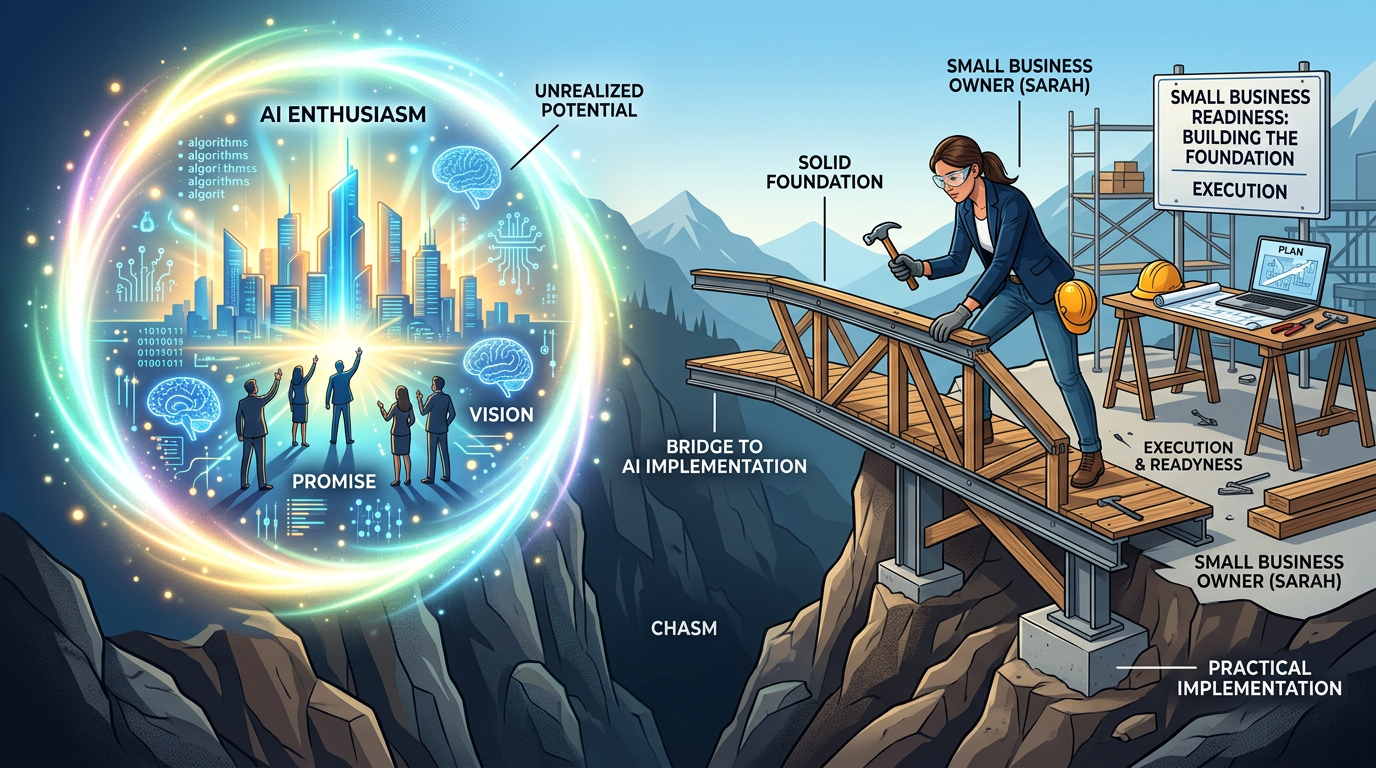
SMB AI Optimism Is Sky-High — But Most Aren't Ready to Execute
There's a growing disconnect in the small business world right now: enthusiasm for AI is at an all-time high, but the ability to turn that enthusiasm into measurable results is lagging far behind.
ECI Software Solutions just released their AI Readiness Report this week, surveying over 550 SMB leaders across the U.S., Canada, and Australia. The headline finding? More than 70% of SMB leaders hold a positive view of AI — but adoption maturity is wildly uneven. The gap between "excited about AI" and "getting real ROI from AI" is where most small businesses are stuck.
This isn't just an abstract data point. If you run a small business and you've been tinkering with ChatGPT or experimenting with a chatbot, you're in good company. But if you haven't moved past the experimentation phase, you're also in the majority — and that's the problem.
The Three Walls Holding SMBs Back
The ECI report, alongside data from IDC and the U.S. Chamber of Commerce, points to three consistent barriers preventing small businesses from making AI work:
1. Data Readiness
You can't feed AI garbage and expect gold. Among SMBs using or planning to adopt AI, 60% identified data analysis and reporting as their top focus — but many lack the clean, structured data needed to make AI tools effective. If your customer records are scattered across spreadsheets, sticky notes, and three different apps, AI can't magically unify them.
The fix: Before investing in any AI tool, spend a week auditing your data. Consolidate your customer information into one CRM. Clean up your product catalog. Standardize how your team logs interactions. This unglamorous work is the foundation everything else builds on.
2. Internal Expertise
Most small teams don't have a dedicated data scientist — and they don't need one. But they do need at least one person who understands how to evaluate AI tools, set up basic workflows, and measure whether something is actually working.
The fix: Invest in AI literacy for your team. LinkedIn's research shows this is emerging as a genuine competitive edge for small businesses. You don't need a PhD — you need someone who can confidently set up a Zapier automation, write a decent prompt, and interpret the results critically.
3. Strategy Over Shiny Objects
The most common failure mode is attempting to automate everything at once, or buying a platform that promises comprehensive automation without understanding what the business actually needs. Structured AI implementation with clear workflow mapping produces 3–4x the return of ad-hoc tool adoption.
The fix: Pick one workflow. Just one. The one that eats the most staff time for the least value. Automate that. Measure the result. Then move to the next one. The businesses seeing the strongest results are doing exactly this — not chasing the latest AI announcement.
The Numbers That Should Get Your Attention
The data from multiple sources this month paints a compelling picture for SMBs that get this right:
- 58% of US small businesses now use generative AI, double the rate from 2023 (U.S. Chamber of Commerce)
- Among those using AI to scale, 93% report revenue growth and 82% cut costs (Salesforce SMB Trends Report)
- The average small business owner saves 10–15 hours per week with the right AI stack
- Most small teams spend just $50–$300/month on AI tools, with an average ROI of 3–5x within six months
- McKinsey research shows AI automation reduces operational overhead by 20–35% within six months
These aren't enterprise numbers. These are results from businesses with 5, 10, 50 employees.
The Practical Starting Stack for 2026
If you're an SMB owner reading this and wondering where to start, here's the no-nonsense stack that's working for small businesses right now:
- Workflow automation: Start with Zapier for simple integrations or Make if you want more visual control. Both now support natural-language workflow creation.
- AI assistant: Use Claude or ChatGPT for drafting emails, analyzing data, summarizing documents, and brainstorming strategy.
- Customer service: A tool like Tidio or Intercom can handle 80% of customer queries at the cost of a single monthly subscription.
- Accounting: QuickBooks AI can automate categorization, flag anomalies, and generate reports without manual data entry.
The key is starting small, measuring outcomes, and expanding methodically. Businesses that pilot one or two high-impact automations typically see results within 30–60 days.
The Bottom Line
The era of AI experimentation is over. The question isn't whether your small business should use AI — it's whether you'll be among the businesses that figure out how to make it work, or the ones still tinkering while competitors pull ahead.
The good news: the barrier to entry has never been lower. API costs have fallen over 90% since 2023. The tools are more intuitive than ever. And the playbook is straightforward — clean your data, upskill your team, pick one workflow, and execute.
The gap between AI optimism and AI execution is where the opportunity lives. Close it.