Iran War 2026: What the Strait of Hormuz Crisis Means for You
One week ago, most Americans had never heard of the Strait of Hormuz. Today, it's the reason gas prices jumped overnight — and why economists are warning of a potential repeat of the 1970s oil embargo. The Iran war 2026 isn't just a distant geopolitical conflict. It's landing directly in your wallet.
What Is Operation Epic Fury — and How Did We Get Here?
On February 28, 2026, the United States and Israel launched coordinated military strikes against Iran in an operation officially named "Operation Epic Fury." Now in its sixth day, the conflict has already reshaped the Middle East in ways that analysts say could take years to fully understand.
The strikes targeted more than 500 military sites across 153 Iranian cities. Iran's Supreme Leader Ayatollah Ali Khamenei was killed in the opening hours of the campaign. Iran's navy has been effectively destroyed. In retaliation, Iran's Islamic Revolutionary Guard Corps launched attacks on at least 27 U.S. military bases across the region, and an Iranian drone strike on a port in Kuwait killed six American service members.
The U.S. Senate voted 47–53 to reject a war powers resolution that would have forced the administration to halt military action, meaning strikes are legally authorized to continue. A CNN poll conducted in the conflict's early days found that nearly 60% of Americans disapprove of the military action — a remarkable finding given how early in the conflict polling began.
More than 1,000 people have been killed in Iran since strikes began.
Why the Strait of Hormuz Is the World's Most Important Waterway
Here's the geography that makes this conflict so economically dangerous. The Strait of Hormuz is a narrow passage — just 21 miles wide at its narrowest point — between Iran and Oman. Every day, roughly 20% of the world's entire oil supply passes through it. That includes petroleum from Saudi Arabia, the UAE, Iraq, Kuwait, and Qatar, all heading to markets in Asia, Europe, and North America.
When Iran effectively closed the Strait following the U.S. and Israeli strikes, it didn't just disrupt oil. It also knocked out QatarEnergy's LNG production at Ras Laffan — taking roughly 20% of global liquefied natural gas export capacity offline overnight. European natural gas futures responded by surging 30–40% in a single session.
There are alternative routes — tankers can route around the Cape of Good Hope — but they add weeks and enormous cost to every shipment. There is no short-term fix.
Rystad Energy analyst Claudio Galimberti described the closure as "blocking the aorta." He wasn't exaggerating.
How the Iran War Is Already Hitting Your Wallet
1. Gas Prices Are Spiking Fast
The U.S. national average gas price reached $3.11 per gallon on March 3 — up $0.11 overnight, the largest single-day increase since March 2022. GasBuddy is forecasting prices reaching $3.25–$3.50 in the coming weeks under current conditions.
Brent crude, the global oil benchmark, briefly surged 13% to approximately $83 per barrel in the days following the conflict's start. Where prices go next depends almost entirely on how long the Strait remains closed and whether Iran escalates attacks on neighboring energy infrastructure.
2. Analyst Forecasts Range From Bad to Catastrophic
The spread of analyst predictions tells you everything about how uncertain this situation remains:
- Bank of America projects $100/barrel if Iran begins targeting energy infrastructure in neighboring countries
- JPMorgan forecasts $120/barrel if the conflict extends beyond three weeks
- Deutsche Bank has modeled a scenario where oil reaches $200/barrel if Iran moves to mine the Strait of Hormuz
Helima Croft of RBC Capital Markets called this "what looks like the biggest energy crisis since the oil embargo in the 1970s." The last time oil supply disruption reached this scale, the U.S. experienced stagflation — simultaneous economic stagnation and inflation — that lasted nearly a decade.
3. Global Markets Are Already Feeling It
South Korea's Kospi index fell 12.1% in a single session — the worst single-day decline in its history. Gold surged past $5,400 per ounce as investors fled to safe havens. Defense stocks jumped sharply while airline and travel stocks cratered.
The stock market reaction reflects something deeper than short-term volatility. When oil prices spike this fast, they ripple through virtually every sector: airlines, shipping, manufacturing, agriculture, and retail all face higher input costs. Those costs eventually reach consumers.
4. Grocery and Shipping Costs Will Follow
This is the part that gets less attention but hits hardest. Oil isn't just for cars. It's in fertilizer, plastics, and packaging. It powers the trucks, ships, and planes that move food across continents. When crude prices spike 13% in a week, supply chain costs follow — and those costs show up in grocery prices within weeks, not months.
The World Economic Forum flagged the Middle East conflict's impact on international shipping as a key trade risk for March 2026, noting that disruption to key maritime routes compounds existing supply chain pressures from tariffs and geopolitical tensions elsewhere.
What Happens Next: Three Scenarios
Scenario A — Short Conflict, Partial Recovery
If military operations wind down within two to three weeks and the Strait partially reopens to neutral shipping, oil prices likely settle in the $85–$95 range. Gas prices stabilize near $3.50 in most U.S. markets. Economic damage is significant but manageable.
Scenario B — Prolonged Conflict, Sustained Closure
If the Strait remains closed for six to eight weeks and Iran continues attacking regional energy infrastructure, the $100–$120/barrel projections become realistic. Consumer price inflation accelerates. Central banks face a near-impossible choice between fighting inflation and supporting growth.
Scenario C — Escalation Into a Broader Regional War
If Iran successfully draws in Hezbollah, Yemen-based forces, or other regional actors into a coordinated multi-front campaign, the conflict morphs into something far more complex. The $200/barrel Deutsche Bank scenario — once considered fringe — moves into the range of possibility.
What This Means Politically at Home
The domestic political dimension of the Iran war 2026 is impossible to separate from its economic impact. With 60% of Americans already opposed to the military action and no formal congressional authorization, the conflict is becoming a flashpoint ahead of the 2026 midterm elections.
The failed Senate war powers vote — 47 in favor, 53 against — means the administration retains authority to continue operations. But public opinion data suggests that if gas prices continue rising and economic pain spreads, political pressure will intensify rapidly.
There are also serious humanitarian concerns that have fueled opposition. Among the targets struck in Iran was a girls' school, where 165 children were killed. International condemnation has been swift, and several U.S. allies have publicly distanced themselves from the military campaign.
What You Can Actually Do Right Now
Rising energy costs are genuinely disruptive, but there are practical steps to reduce their impact on your household:
- Lock in gas prices where possible — Use apps like GasBuddy to find the cheapest local stations and consider filling up before prices rise further
- Reduce discretionary driving — Consolidate errands, use public transit where available, and avoid unnecessary highway driving which burns fuel faster
- Check your home energy contracts — If you're on a variable-rate electricity or gas plan, this may be a good time to explore fixed-rate options before rates adjust
- Monitor your investments — Energy sector stocks and energy ETFs tend to outperform during supply disruptions; safe-haven assets like gold and Treasury bonds are already rising
- Stock a modest pantry buffer — Not in a panic-buying sense, but grocery prices typically follow energy prices with a 4–8 week lag; buying shelf-stable staples now at current prices is a reasonable hedge
The Bottom Line
The Iran war 2026 and the Strait of Hormuz crisis represent the most significant global energy disruption in decades. The direct military conflict may feel distant — but its economic consequences are already showing up at the pump, in financial markets, and soon in the grocery aisle. The situation is evolving daily, and the range of outcomes is genuinely wide. The best thing you can do is stay informed, reduce your exposure to rising energy costs where you can, and understand that the worst-case scenarios, while not inevitable, are no longer theoretical.
Suggested Internal Links:
- How oil prices affect inflation — a simple explainer
- What is the Strategic Petroleum Reserve and how is it used?
- How to protect your finances during economic uncertainty
- Middle East conflict: a timeline of U.S. military involvement
Suggested External Links:
- Live oil price tracking — OilPrice.com
- GasBuddy national gas price tracker
- U.S. Energy Information Administration — Strait of Hormuz fact sheet
Schema Markup: Article + FAQPage
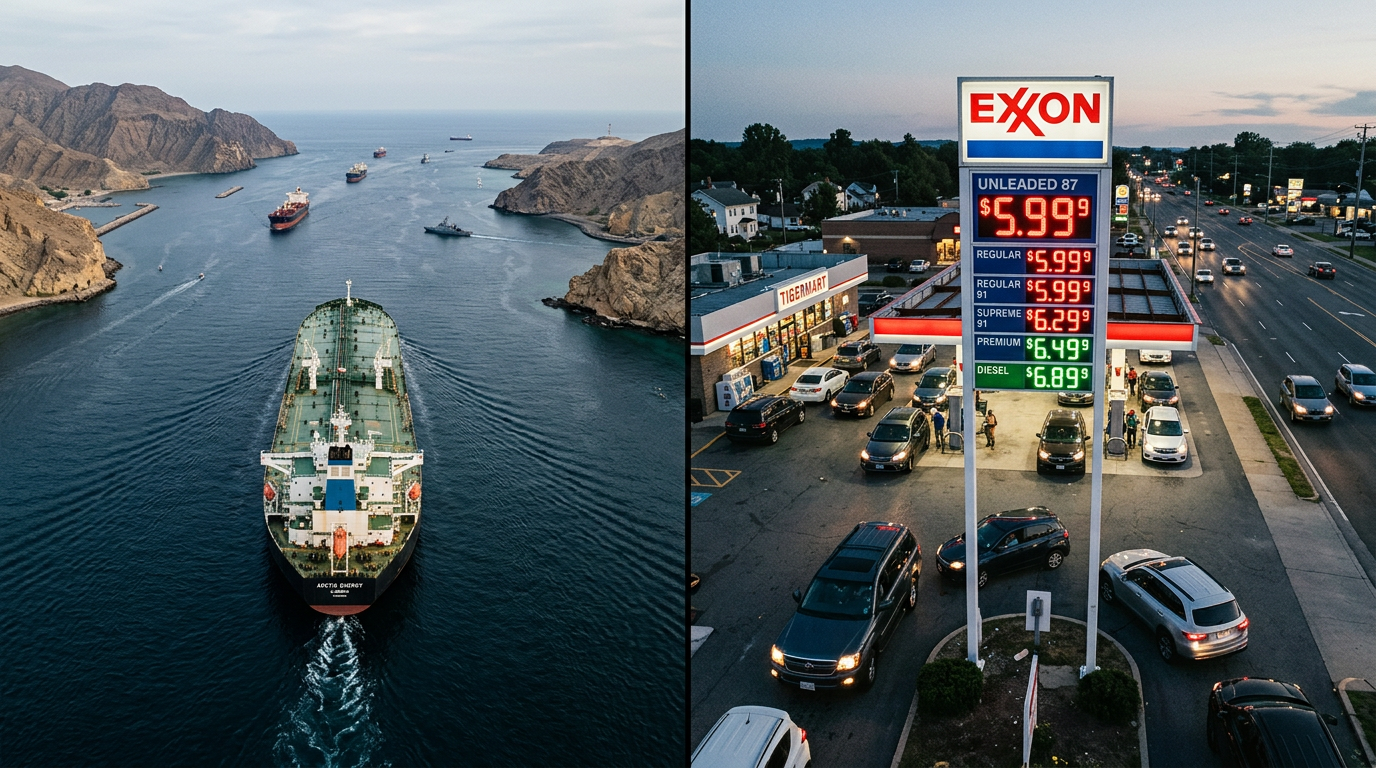
Featured Image Concept: A split-panel aerial image — left side shows a tanker navigating a narrow waterway (Strait of Hormuz), right side shows a U.S. gas station price sign displaying high prices. Dramatic, wide-angle, slightly desaturated tone to convey urgency without sensationalism.